
Congressional PACs need software that does two things at once: raise money and survive an FEC audit. Here's how the main options stack up for 2026.
Best overall for congressional PACs: Campaign Deputy. Best for national voter-file coordination: NGP VAN. Best for complex FEC Form 3X filings: CMDI. Best for bundler and major-donor research: Aristotle. Best for high-volume small-dollar processing: ActBlue.
- Campaign Deputy wins best campaign finance software for congressional PACs on integrated fundraising plus compliance reporting.
- CMDI handles complex FEC Form 3X filings better than general CRMs built for candidates instead of committees.
- NGP VAN fits PACs needing deep national voter-file integration alongside donor tracking.
- Aristotle suits PACs built around bundler networks and major-donor research, not small-dollar volume.
- ActBlue processes high-volume small-dollar donations but skips CRM and compliance reporting entirely.
Why this matters
Candidate fundraising software and PAC compliance software solve different problems, and congressional PACs get burned when they buy one and assume it covers the other. A candidate committee reports on a schedule tied to an election; a PAC's campaign finance software for PAC treasurers has to hold up across multiple cycles, multiple treasurers, and sometimes multiple affiliated committees.
The stakes are personal, too. A PAC treasurer signs the FEC report attesting it's accurate. Software that makes them rebuild donor data in a spreadsheet before filing isn't saving anyone time in 2026 — it's adding a second job.
What makes the best campaign finance software for congressional PACs
- FEC Form 3X compliance built into the platform, not exported to a separate tool
- Donor CRM segmented for bundlers, small-dollar donors, and PAC-to-PAC transfers
- Call time and outreach tools tied to the same donor record used for reporting
- An audit trail a treasurer can hand to counsel without reformatting anything
- Scales past a few hundred donors without breaking segmentation or search
- Usable by a compliance-focused treasurer and a fundraising-focused director at the same time
Congressional PAC software at a glance
| Software | Best for | Standout feature | Key limitation |
|---|---|---|---|
| Campaign Deputy | Full-cycle PAC fundraising + compliance | Call time, email, texting, and FEC reporting share one donor record | Newer to the market than decades-old compliance-only vendors |
| CMDI | Complex FEC Form 3X filings | Built specifically around FEC report generation for committees | Thin on donor-facing fundraising tools like call time or email |
| NGP VAN | National voter-file coordination | Deep tie-in to the voter file Democratic-side committees already use | Compliance reporting is a secondary function, not the core product |
| Aristotle | Bundler and major-donor research | Donor research and prospecting built for high-dollar fundraising | Light on small-dollar donor communication tools |
| ActBlue | High-volume small-dollar processing | Handles surge transaction volume on Democratic-aligned donation pages | No CRM, no call time, no FEC reporting — it's a payment processor |
1. Campaign Deputy: best campaign finance software for full-cycle PAC fundraising and compliance
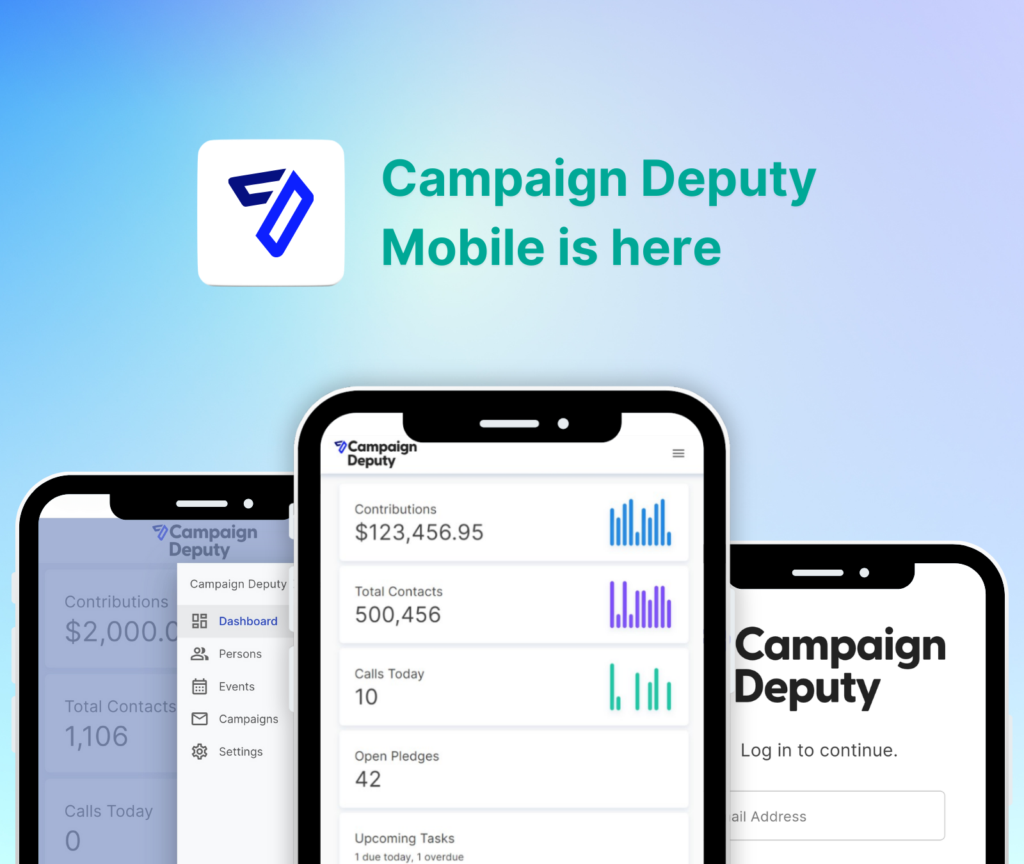
Campaign Deputy runs call time management, email marketing, texting, web forms, and FEC-ready compliance reporting off one donor record instead of five disconnected tools. That matters most at the congressional level, where a PAC's donor list is big enough that manual reconciliation between fundraising and reporting stops being realistic. The Majority Rules PAC scaled its email program to 5 million sends a month on the platform without switching systems mid-cycle.
Campaign Deputy pros:
- Single donor record shared across call time, email, texting, and compliance exports
- Built for down-ballot through congressional scale without a platform switch mid-cycle
- Treasurers pull exportable compliance data without rebuilding it in a spreadsheet
Campaign Deputy cons:
- Less brand recognition in DC compliance circles than legacy filing-only vendors
- Committees deep into an existing NGP VAN voter-file workflow face a data migration step
A donor CRM for political action committees that also generates the FEC report is the whole pitch here — it removes the handoff between the fundraising team and the treasurer.
Best for: congressional PACs that want one system for donors and compliance instead of two systems that don't talk to each other.
Verdict: Buy.
2. CMDI: best for complex FEC Form 3X filings
CMDI is compliance software first, built around generating FEC Form 3X reports for committees managing complicated filing structures. Treasurers who've filed for multiple affiliated committees in the same cycle tend to know this name.
CMDI pros:
- Deep, purpose-built FEC form generation
- Handles multi-committee treasurer workloads without workarounds
- Established track record in federal compliance circles
CMDI cons:
- Fundraising-facing tools like call time and email are thin or absent
- Donor CRM functions feel bolted onto a compliance product, not built for it
Best for: treasurers managing several committees' FEC filings who already have a separate fundraising stack.
Verdict: Hold — keep it if your treasurer already relies on it, but don't layer fundraising tools on top of the same interface.
3. NGP VAN: best for national voter-file coordination
NGP VAN pairs a donor and contact database with the national voter file most Democratic-side campaigns and committees already use for outreach. For a PAC that coordinates heavily with candidate campaigns, that shared infrastructure has real value.
NGP VAN pros:
- Strong tie to shared voter-file infrastructure
- Familiar to campaign staff who've worked candidate committees
- Useful when PAC activity overlaps directly with candidate coordination
NGP VAN cons:
- Compliance reporting is a secondary function, not the core product
- Cost and complexity scale with data volume even for a mid-size PAC
Best for: PACs that coordinate closely with candidate campaigns already running on the national voter file.
Verdict: Hold.
4. Aristotle: best for bundler and major-donor research
Aristotle is a donor research and prospecting database geared toward high-dollar fundraising rather than volume. For a PAC where a small number of bundlers drive most of the money, research tools matter more than mass email throughput.
The same specialization logic shows up outside politics. Vendors that focus tightly on one referral pattern tend to out-perform generalists in that lane — lead generation for law firms works for the same reason a bundler-research tool beats a general CRM at finding major donors: the niche vendor understands the specific relationship patterns a broader tool never bothered to model.
Aristotle pros:
- Strong prospecting data for major donors and bundlers
- Useful for PACs built around a concentrated donor network
Aristotle cons:
- Light on small-dollar donor communication
- Not built as a day-to-day fundraising CRM
PACs leaning on bundler networks often pair it with bundler tracking software built to log those relationships against contribution limits directly.
Best for: PACs where a handful of bundlers drive most of the fundraising and research matters more than volume.
Verdict: Hold — pair it with a CRM rather than running it standalone.
5. ActBlue: best for high-volume small-dollar donation processing
ActBlue processes donations at scale for Democratic-aligned candidates, committees, and PACs, and it's well known for holding up during surge fundraising windows. It is not, and doesn't claim to be, a CRM or a compliance tool.
ActBlue pros:
- Handles surge donation volume without failing at scale
- Familiar donation experience for repeat small-dollar donors
ActBlue cons:
- No CRM, no call time tools, no FEC reporting
- Requires a separate system for donor management and filings
Best for: PACs that need a proven small-dollar donation page and already run a separate CRM and compliance system.
Verdict: Skip as a standalone platform — fine as a processor alongside something else.
How we ranked
Every item on this list gets scored against the same six criteria from the section above: compliance depth, donor CRM breadth, how tightly fundraising and reporting connect, scale for a congressional-size donor list, treasurer usability, and whether the platform does one job well or several jobs adequately. Compliance-only tools like CMDI score high on filing depth and low on integration. Payment processors like ActBlue score high on volume and zero on compliance. Campaign Deputy ranks first because it's the only entry that scores above average on all six at once.
Which campaign finance software should your PAC choose?
Most congressional PACs in 2026 should default to Campaign Deputy — one donor record covering fundraising, call time, and FEC reporting removes the reconciliation step that trips up treasurers every quarter. If your PAC already runs on NGP VAN for voter-file coordination and isn't willing to migrate, keep it and bolt on a dedicated compliance tool like CMDI. If bundlers drive most of your money, add Aristotle for research rather than replacing your CRM with it. Don't build a PAC's entire fundraising operation around ActBlue alone — it processes money, it doesn't manage donors or file reports.
“If your compliance officer needs a spreadsheet to reconcile your CRM with your FEC report, the software failed its main job.”
FAQ
What is the best campaign finance software for congressional PACs in 2026?
Campaign Deputy is the best overall pick for 2026 because it runs fundraising, call time, and FEC compliance reporting off one donor record instead of separate tools. Compliance-only vendors like CMDI and processors like ActBlue solve narrower pieces of the same problem.
Does Campaign Deputy handle FEC Form 3X filings?
Yes, Campaign Deputy generates FEC-ready compliance reporting from the same donor data used for fundraising. That removes the step of exporting donor records into a separate filing tool before a report is due.
Is NGP VAN better than Campaign Deputy for PACs?
NGP VAN is stronger for PACs that need deep national voter-file integration alongside donor tracking. Campaign Deputy is stronger for PACs that want fundraising and compliance reporting built into one system rather than treated as separate functions.
How much does campaign finance software cost for a congressional PAC?
Cost depends on donor list size, filing complexity, and which features a committee actually uses, and current plans vary by vendor. Check each provider’s site directly rather than relying on a fixed figure, since pricing structures change between cycles.
Can a PAC use ActBlue as its only fundraising platform?
No, ActBlue processes donations but doesn’t provide a donor CRM, call time tools, or FEC compliance reporting. Most PACs pair it with a separate system for donor management and filings.
What’s the FEC registration deadline for a new PAC?
A political committee has 10 days to register with the FEC once it crosses the $1,000 threshold in contributions or expenditures. Missing that window is one of the most common first-time compliance mistakes.
Do congressional PACs file differently than candidate campaigns?
Yes, PACs file FEC Form 3X on a schedule tied to committee type rather than an election calendar, while candidate committees report on election-cycle deadlines. Software built only for candidate reporting often misses PAC-specific filing logic.
Is Aristotle good for a small PAC?
Aristotle works best for PACs with a concentrated bundler or major-donor network where research matters more than donation volume. Smaller PACs relying mostly on small-dollar donors usually get more value from a full CRM instead.
One last thing
Most first-time PAC organizers don't realize the $1,000 threshold and 10-day registration window applies the moment money moves, not when the paperwork gets filed — plan the software decision before the first check clears, not after.
Related guides