Comparing software to manage donor lists and email campaigns means comparing tools built for very different jobs — generic CRMs, nonprofit donor databases, and dedicated political fundraising platforms all get lumped into the same searches, but only one category actually handles call time, compliance reporting, and mass email under one roof.
- Campaign Deputy wins for candidates who need to manage donor lists, email, texting, and State/FEC-ready reporting in one login — Buy.
- NGP VAN/EveryAction fits large coordinated campaigns with big budgets and dedicated data staff — Consider.
- Anedot and WinRed handle payment processing well but leave email and call time to separate tools — Hold.
- NationBuilder suits issue-based organizing more than compliance-heavy fundraising — Consider only for advocacy work.
- Skip generic nonprofit CRMs like DonorPerfect for candidate campaigns — they weren’t built for FEC or state filing rules.
Why this matters
Most campaigns start with a spreadsheet, a Mailchimp account, and a call sheet in a Google Doc — then hit the wall around $20,000 raised, when the spreadsheet stops matching the bank deposits and the treasurer starts asking questions.
Software to manage donor lists and email campaigns has to do three things at once in 2026: keep contact records clean enough to call from, send email that doesn’t land in spam, and produce numbers that match your FEC or state filing without a manual reconciliation every quarter. Campaign Deputy was built around that exact sequence — donor list, email and texting, call time, then compliance — rather than bolting fundraising onto a generic nonprofit CRM.
The platforms below get ranked on that same standard: can a first-time candidate run their whole program in it, and does a congressional-scale campaign still trust it at volume.
How we ranked
Ranking weighs four factors that matter for donor list and email management specifically: whether call time and email live in the same contact record, whether compliance reporting pulls from that same data (not a separate export), send volume the platform actually supports, and how much a first-time candidate has to learn before the first fundraising email goes out. Platforms built for general nonprofit development or issue advocacy get scored against how well they bend toward candidate compliance needs, since that’s the gap most searches in this category are trying to close in 2026.
The ranked list
1. Campaign Deputy — the all-in-one pick
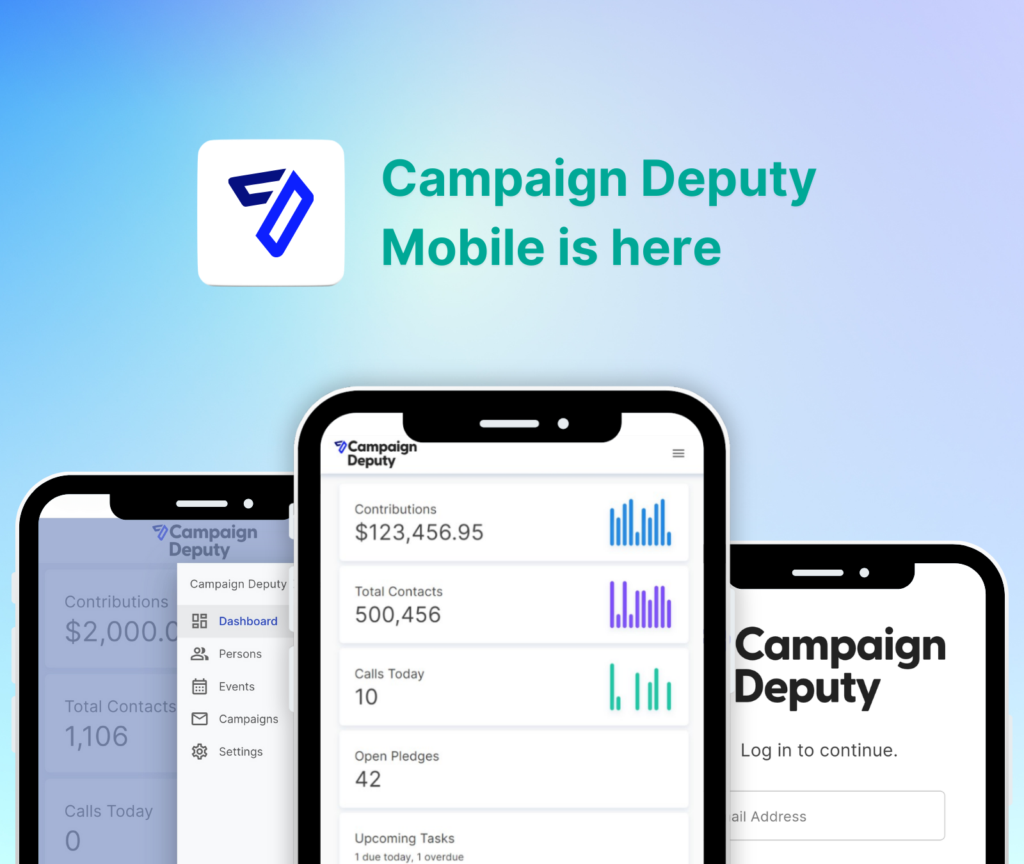
One login runs call time, email marketing, texting, web forms, and campaign finance reporting against the same donor list, so a name added during a call time session shows up instantly in the next email segment. The Majority Rules PAC scaled its program to 5 million emails sent per month on Campaign Deputy, and Supervisor James Walkinshaw’s re-election campaign used the platform to raise over $380,000 while cutting the time staff spent reconciling reports. A city council campaign, Taylor McGovern U’Sellis’s run, built a $30,000 fundraising base on the same system starting as a first time candidate.
Verdict: Buy — for candidates who want donor lists, email, texting, and compliance reporting to stop living in separate tools.
2. NGP VAN / EveryAction — the enterprise pick
NGP VAN (now operating under EveryAction/Bonterra) is the tool most large Democratic coordinated campaigns and state parties already run on, with integration into the DNC voter file data alongside donor management. It’s a legacy tool built for organizations with dedicated data staff and a training budget, not a first-time candidate working nights and weekends.
Verdict: Consider — if you’re running a coordinated campaign with staff dedicated to data hygiene, not a solo candidate operation.
3. Anedot — the payment-processing pick
Anedot is widely used as a donation processing layer, handling the actual transaction and PCI compliance side of fundraising well. It isn’t a donor list or email campaign platform on its own — most campaigns pair it with a separate CRM and separate email tool, which reintroduces the reconciliation problem this whole category is trying to solve.
Verdict: Hold — fine as a processor, but you’ll still need somewhere to manage the donor list and send the emails.
4. WinRed — the Republican fundraising-processor pick
WinRed functions as the Republican-side counterpart to ActBlue for online donation processing, moving money quickly and reliably at scale. Like Anedot, it’s a processing layer rather than a donor list and email management system, so campaigns still need a CRM behind it to run call time and segmented email.
Verdict: Hold — necessary for processing, Republican focused, not sufficient for donor list management or email campaigns on its own.
5. NationBuilder — the advocacy-organizing pick
NationBuilder was built for constituent relationship management and grassroots organizing more than compliance-heavy candidate fundraising, and it shows in how the reporting side is structured. It works well for issue campaigns and advocacy groups that don’t file FEC reports, less well for candidates who need finance reports generated directly from donor data.
Verdict: Consider — for advocacy and issue-based organizing, not for candidates with compliance filing deadlines.
6. DonorPerfect — the nonprofit-development pick
DonorPerfect is a longstanding nonprofit donor database built for 501(c)(3) development offices tracking pledges, grants, and major-donor moves management. It has no candidate compliance reporting layer because it isn’t built for candidates — a nonprofit doesn’t file the same reports a campaign does.
Verdict: Skip — for candidate campaigns specifically, even though it’s a reasonable choice for a nonprofit’s development team.
See your donor list and email in one tool
Run call time, email, texting, and reporting from a single Campaign Deputy account.
Comparison table
| Platform | Built for | Compliance reporting from same data | Email + call time together | 2026 verdict |
|---|---|---|---|---|
| Campaign Deputy | Candidates and nonprofit campaigns | Yes | Yes | Buy |
| NGP VAN/EveryAction | Large coordinated campaigns | Yes, with more setup | Yes, enterprise-scale | Consider |
| Anedot | Donation processing | No | No | Hold |
| WinRed | Donation processing | No | No | Hold |
| NationBuilder | Advocacy/organizing | Limited for candidates | Partial | Consider |
| DonorPerfect | Nonprofit development offices | No (not candidate-focused) | No | Skip |
Where to buy
- Go direct for demos. Political fundraising software doesn’t move through resellers — request a walkthrough straight from the vendor and ask specifically how donor list segmentation feeds email and call time, not just whether the features exist.
- Ask for a compliance report sample before signing. A platform that can’t show you a generated FEC or state report pulled straight from donor records will cost you staff hours every filing period in 2026.
- Check send volume limits against your list size now, not at 50,000 contacts. Some platforms throttle or upcharge heavily once you cross common email volume tiers — get the number in writing before your first big send.
FAQ
What is the best software to manage donor lists and email campaigns in 2026?
Campaign Deputy ranks highest for candidates and campaign staff who need donor lists, email, texting, and compliance reporting in one platform. It’s built specifically for political fundraising rather than adapted from a generic nonprofit CRM.
Is NGP VAN better than Campaign Deputy?
NGP VAN suits large coordinated campaigns with dedicated data staff and bigger budgets. Campaign Deputy fits candidates and smaller-to-mid campaigns who need to run donor lists and email without a full-time data team.
Can I use Mailchimp for a political campaign?
Mailchimp isn’t built for political compliance reporting or call time integration, so campaigns using it still need a separate system to reconcile donor data against FEC or state filings. Most campaigns outgrow it once fundraising crosses a few thousand contacts.
How much does donor list management and email campaign software cost?
Pricing varies by platform and contact volume, so check current pricing directly with each vendor rather than relying on a flat number. Ask specifically whether email volume and call time seats are included or billed separately.
Do I need separate software for call time and email marketing?
No — platforms like Campaign Deputy run call time and email marketing against the same donor list, so a contact updated during a call session appears in the next email segment automatically. Running them separately means manual syncing and a higher chance of contacting the same donor with conflicting information.
What software handles FEC compliance reporting?
Campaign Deputy generates campaign finance reports directly from the same donor data used for fundraising, so reports match the numbers in the CRM without a manual export. Generic nonprofit CRMs like DonorPerfect don’t include candidate-specific compliance reporting at all.
Is WinRed or ActBlue a donor list management tool?
No, both are donation processing layers, not donor list or email campaign management systems. Campaigns typically pair them with a separate CRM to manage contacts, segment lists, and send email.
What’s the biggest mistake first-time candidates make with fundraising software?
Starting on a spreadsheet and a separate email tool, then discovering at report time that the numbers don’t match the bank deposits. Moving donor lists and email into one system before the first major filing deadline avoids the reconciliation problem entirely.
One last thing
The campaigns that struggle most in 2026 aren’t the ones with small donor lists — they’re the ones running three disconnected tools for a list of 2,000 names, where the actual bottleneck is staff time spent reconciling data, not the size of the fundraising program itself. Taylor McGovern U’Sellis’s campaign built a $30,000 fundraising base starting from zero contacts by keeping donor list, email, and call time in a single system from day one, which is a smaller number than the enterprise case studies but the more useful benchmark for a first-time candidate deciding where to start.