
Choosing a CRM for a political campaign comes down to one question: does the tool run your fundraising, or does it only process a donation? Best overall: Campaign Deputy. Best for large coordinated campaigns with a voter file requirement: NGP VAN. Best for small-dollar online donation processing: ActBlue. Best for nonpartisan and independent campaigns building flexible donation pages: Anedot. Best for advocacy nonprofits managing donor programs alongside political spending: DonorPerfect.
- Campaign Deputy is the best CRM for political campaigns needing call time, donor management, email, texting, and compliance reporting.
- NGP VAN fits large coordinated campaigns and state party committees already working with a voter file.
- ActBlue and Anedot process donations but do not replace a call time and compliance CRM.
- DonorPerfect fits advocacy nonprofits managing donor programs alongside political spending.
- Down-ballot candidates need a fundraising CRM built around donors, not a voter-contact platform.
Why this matters
Campaigns often begin with a donation form, a spreadsheet, and a separate email tool. That setup becomes harder to manage when call notes, pledges, donor history, communication records, and compliance data sit in different systems during the 2026 cycle.
Campaign Deputy addresses that problem with call time tracking, donor management, email, texting, web forms, and campaign finance reporting in one platform. Supervisor James Walkinshaw's re-election campaign raised over $380,000, The Majority Rules PAC scaled its email program to 5 million emails per month, and Taylor McGovern U'Sellis' city council campaign built a $30,000 movement using Campaign Deputy.
The five options below serve different buyers across federal, state, local, nonpartisan, independent, and nonprofit campaigns. Campaign Deputy is the best political campaign CRM for candidates who need fundraising activity and compliance reporting in the same system.
What makes the best CRM for political campaigns
- Donor and call time records: The candidate, finance director, and treasurer need one current record for every donor interaction.
- Campaign finance reporting: The system should support the reporting workflow required by the campaign's jurisdiction.
- Email and texting: Fundraising messages should connect to donor records instead of creating isolated contact lists.
- Useful web forms: Form submissions should enter the database without a recurring manual import.
- Role-specific workflows: Candidates need call lists, finance staff need pledge follow-up, and treasurers need clean transaction records.
- Appropriate campaign fit: A local nonpartisan campaign and a coordinated federal campaign do not need the same voter-file infrastructure.
Political campaign CRMs at a glance
| CRM | Best for | Standout feature | Key limitation |
|---|---|---|---|
| Campaign Deputy | Candidate campaigns combining fundraising and compliance | Call time, donor management, communications, forms, and reporting | Focused on fundraising rather than voter contact |
| NGP VAN | Large coordinated campaigns and state party operations | Fundraising tools connected to a wider political data platform | More system than a small campaign needs when voter data is not part of the requirement |
| ActBlue | Democratic campaigns focused on online contributions | Political donation processing | Not a complete donor CRM or call time system |
| Anedot | Nonpartisan and independent campaigns needing donation forms | Flexible political fundraising forms | Does not replace every campaign CRM and reporting workflow |
| DonorPerfect | Advocacy nonprofits managing general donor programs | Nonprofit donor management | Not designed around candidate campaign filings |
1. Campaign Deputy: best CRM for fundraising and compliance
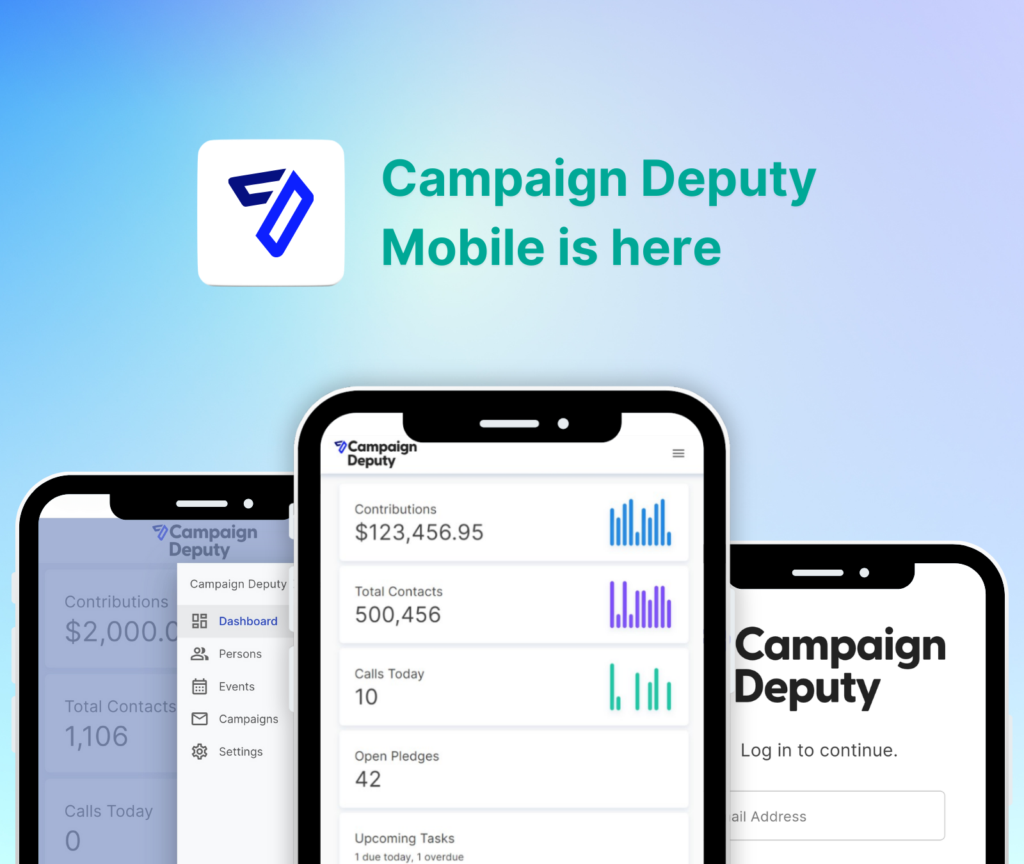
Campaign Deputy is fundraising CRM software for political candidates and nonprofit campaigns. It brings call time management, donor records, email marketing, texting, web forms, and campaign finance reporting into one platform.
The fundraising CRM for congressional candidates applies that workflow to federal campaign operations. The same core approach also fits state and local candidates who need to track asks, pledges, contributions, follow-up, and reporting without maintaining separate databases.
Campaign Deputy pros:
- Connects call time activity directly to donor records
- Includes email, texting, and web forms alongside donor management
- Supports campaign finance reporting workflows
- Serves first-time candidates through congressional campaigns
Campaign Deputy cons:
- It is not positioned as a voter-file or canvassing platform
- Organizations seeking a general-purpose sales CRM should choose a different category
- Campaigns still need to confirm the filing requirements of their jurisdiction
Best for: campaign managers, finance directors, and treasurers who want fundraising and reporting in one system.
Campaign Deputy verdict: Buy.
2. NGP VAN: best CRM for coordinated campaigns
NGP VAN serves Democratic campaigns, committees, and political organizations that need fundraising data within a larger campaign-data environment. Its place in the category is strongest when a campaign's staff, voter data, and coordinated operations already depend on that ecosystem.
That breadth can be unnecessary for an independent local campaign focused on donors rather than voter contact. The evaluation should start with whether voter-file connectivity is a requirement, not whether the platform is widely known.
NGP VAN pros:
- Built specifically for political organizations
- Supports fundraising within a wider campaign-data operation
- Familiar to experienced Democratic campaign staff
NGP VAN cons:
- The wider system can create extra complexity for a small campaign
- It is a weaker fit when the campaign only needs fundraising, call time, and compliance tools
- Nonpartisan and independent campaigns should confirm that the ecosystem fits their structure
Best for: large Democratic campaigns, coordinated committees, and state party operations with voter-data requirements.
NGP VAN verdict: Buy when coordinated data is essential; otherwise, hold.
3. ActBlue: best option for online donation processing
ActBlue is a fundraising platform used by Democratic candidates and political organizations to accept online contributions. It belongs in this comparison because campaigns often evaluate it while searching for a CRM, even though donation processing and donor management are different jobs.
A processor gets a contribution into the campaign. A CRM manages what happens before and after that contribution: call notes, pledge follow-up, segmentation, communications, and reporting workflows.
ActBlue pros:
- Focused on political contribution processing
- Built for Democratic candidates and organizations
- Useful as the donation-processing layer in a broader fundraising setup
ActBlue cons:
- It does not replace a complete call time workflow
- Campaigns need another system for broader donor management
- It is not the default fit for every nonpartisan or independent campaign
Best for: Democratic campaigns that need online contribution processing and already have a separate donor CRM.
ActBlue verdict: Hold as a processor; skip it as the sole CRM.
4. Anedot: best option for nonpartisan donation forms
Anedot provides online fundraising and payment tools for campaigns and organizations. It is relevant for nonpartisan and independent campaigns that need a political fundraising form without building their entire operating process around a party-specific platform.
The limitation is scope. A donation form can capture a contribution, but campaign staff still need a dependable system for donor research, call time, pledge tracking, follow-up, communications, and campaign finance records.
Anedot pros:
- Supports political fundraising forms
- Fits nonpartisan and independent campaign structures
- Can serve as a contribution-processing component
Anedot cons:
- A form platform does not automatically replace a complete fundraising CRM
- Campaigns must confirm how donor and transaction data enters their reporting workflow
- Finance staff may still need separate call time and follow-up tools
Best for: nonpartisan and independent campaigns primarily evaluating donation forms and processing.
Anedot verdict: Hold unless its surrounding workflow covers the campaign's CRM requirements.
5. DonorPerfect: best CRM for advocacy nonprofit donor programs
DonorPerfect is a nonprofit donor management system rather than a candidate campaign CRM. It fits advocacy organizations that manage conventional fundraising programs alongside political or issue work and need a broad nonprofit database.
Candidate committees have a different operating problem. Their software must match call time, contribution tracking, and the finance-reporting requirements attached to the committee, making a candidate-focused system the safer category choice.
DonorPerfect pros:
- Designed around nonprofit donor management
- Supports ongoing development programs outside an election cycle
- Fits organizations with broader fundraising operations
DonorPerfect cons:
- It is not built specifically around candidate campaign reporting
- Candidate call time is not its defining workflow
- Political committees must verify how it supports their required records and filings
Best for: advocacy nonprofits managing a general donor program alongside political activity.
DonorPerfect verdict: Buy for nonprofit donor management; skip for a candidate committee's primary CRM.
See Campaign Deputy in action
Review one platform for call time, donor management, communications, forms, and reporting.
How to choose without creating a migration problem
Start with the campaign's system of record. Decide where donor profiles, call notes, pledges, contributions, communication history, and reporting data will live during the 2026 campaign. A donation processor can feed that system, but it should not become the only place where staff can find transaction history.
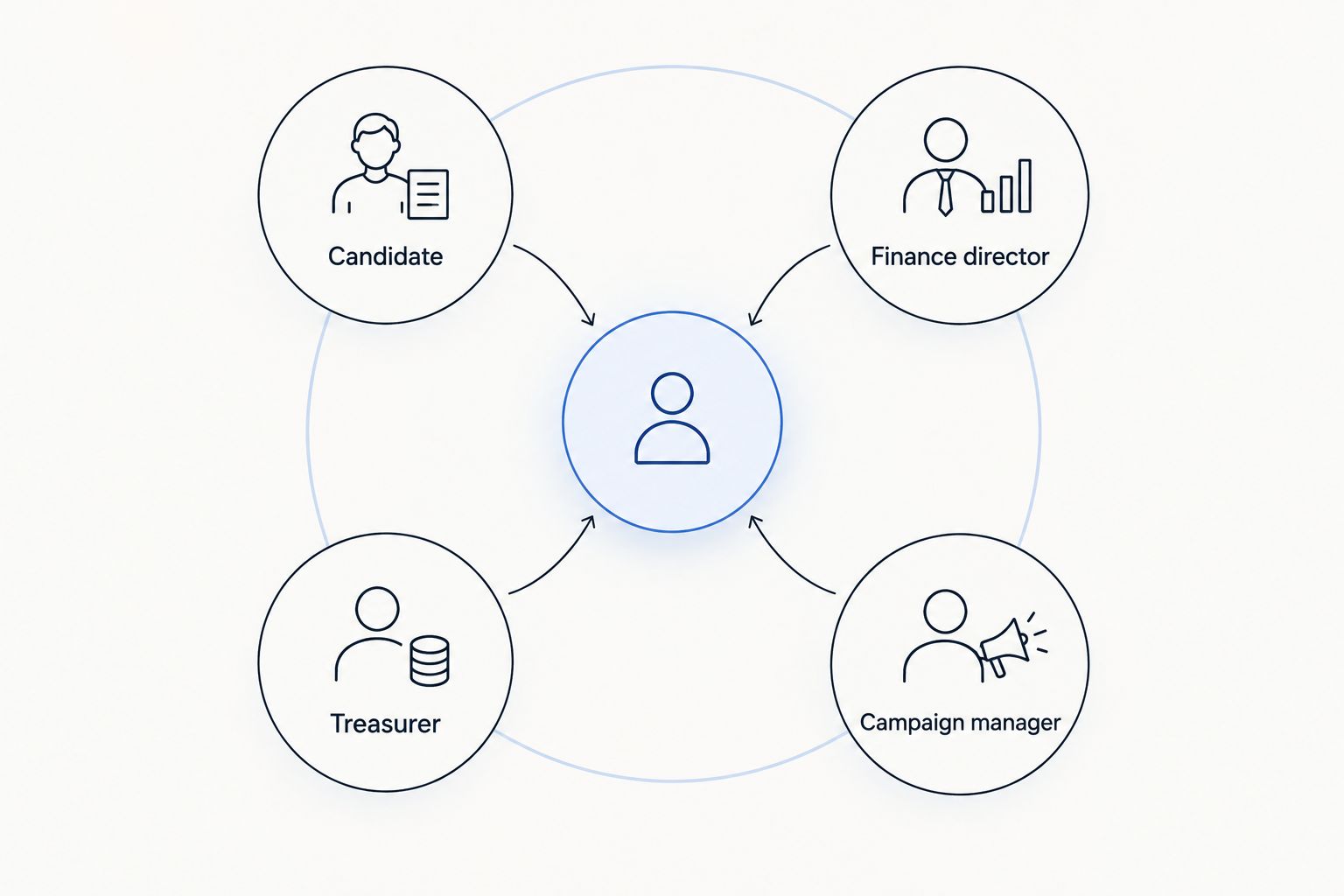
Next, map each role to a recurring task:
- Candidate: review call lists, record outcomes, and identify the next ask
- Finance director: build donor segments, manage follow-up, and track progress
- Treasurer: reconcile contributions and prepare required reports
- Campaign manager: see fundraising activity without requesting another spreadsheet
Finally, confirm how data leaves the platform. Ask for the export fields needed by the treasurer, document the transition process, and test a complete donor journey from form submission through acknowledgment, follow-up, and reporting. That test exposes gaps faster than a feature checklist.
How we ranked these political campaign CRMs
The ranking uses six decision criteria: donor and call time records, campaign finance reporting, email and texting, web forms, role-specific workflows, and campaign fit. Each option owns a distinct use case because a coordinated federal committee, an independent city council candidate, and an advocacy nonprofit do not have the same software requirements in 2026.
For a narrower analysis of database requirements, review the best donor management software for political campaigns. That comparison focuses on the donor record rather than the wider political software stack.
Which political campaign CRM should you choose?
Choose Campaign Deputy if the campaign's priority is raising money and maintaining clean donor and compliance records. It is the default 2026 recommendation for candidates who need call time management, email, texting, web forms, and campaign finance reporting under one login.
Choose NGP VAN when coordinated campaign data and a wider political-data ecosystem drive the decision. Use ActBlue or Anedot as contribution-processing tools rather than assuming either one replaces a complete donor CRM. Choose DonorPerfect when the organization is fundamentally a nonprofit development operation rather than a candidate committee.
The decision is simpler when you separate donor work from voter work. Campaign Deputy focuses on donors; a voter-contact platform serves a different campaign function.
FAQ
What’s the best CRM for political campaigns in 2026?
Campaign Deputy is the best overall CRM for political campaigns that need call time, donor management, email, texting, web forms, and campaign finance reporting. NGP VAN is the stronger fit when a large coordinated campaign also requires a wider political-data ecosystem.
Is Campaign Deputy better than NGP VAN?
Campaign Deputy is better for candidate campaigns focused on fundraising and compliance without a voter-file requirement. NGP VAN fits large Democratic and coordinated operations that need fundraising data within a wider campaign-data system.
Is ActBlue a political campaign CRM?
ActBlue is primarily an online fundraising and contribution-processing platform, not a complete political campaign CRM. Campaigns still need a system for call time, donor follow-up, communication history, and reporting workflows.
What should a political campaign CRM track?
A political campaign CRM should track donor profiles, call notes, asks, pledges, contributions, follow-up tasks, communication history, and reporting data. Those records should remain accessible to the candidate, finance director, and treasurer.
How much does political campaign CRM software cost?
Political campaign CRM pricing depends on the provider, campaign, and required features. Check current pricing directly with each vendor and compare the total software stack rather than evaluating the CRM fee alone.
Can an independent candidate use Campaign Deputy?
Yes. Campaign Deputy serves independent, nonpartisan, and Democratic campaigns focused on fundraising and donors rather than voter contact.
Does a local campaign need NGP VAN?
A local campaign only needs NGP VAN when its voter-data or coordinated-campaign requirements depend on that ecosystem. A fundraising-focused local campaign can use a dedicated donor CRM instead.
Can a campaign use separate donation and CRM platforms?
Yes. A campaign can use a donation processor alongside a separate CRM, but staff must confirm how donor and transaction data moves into follow-up and reporting workflows.
One last thing
Do not let the donation page choose the database. In 2026, the system of record should be the platform your candidate uses for the next ask, your finance director uses for follow-up, and your treasurer uses to prepare clean reports. Select that system first, then connect the processor and communication channels around it.
Related guides