State treasurer races run on smaller budgets and smaller teams than a governor's race, but the fundraising math still has to add up before filing deadlines and reporting periods hit. Call time software for state treasurer candidates has to track pledges, log donor history, and produce clean compliance exports without the overhead built for a US Senate operation.
- Call time software for state treasurer candidates needs pledge tracking, compliance-ready exports, and a call list that a 2-3 person team can run without training.
- Campaign Deputy handles call time, texting, and donor records in one system built for down-ballot state races in 2026.
- Spreadsheet-plus-dialer setups stall past 200 calls a week because pledges and follow-ups fall through manual tracking.
- Generic sales CRMs skip campaign finance report formatting, which forces a second tool at reporting time.
- Buy call time software that exports directly to your state’s filing format before your first 2026 reporting deadline.
Why this matters
A state treasurer candidate is not fielding a 40-person field team. Most run this race with a candidate, a treasurer, and one or two volunteers who also answer the phone for constituent questions once the race gets real.
That means the software carrying call time has to do double duty: log pledges from a call sheet, track the donor once they give, and hand clean numbers to whoever files the campaign finance report. Miss that link and the campaign either overpays for three separate tools or spends election week reconstructing a donor list by hand.
The volume is different from a congressional race, but the discipline required is not. A missed pledge follow-up on a $500 ask matters just as much at this level, because state treasurer campaigns typically run on a fraction of what a statewide governor's race raises.
Who this is for
This guide is for first-time and repeat state treasurer candidates, their campaign treasurer, and the one or two staffers doing call time between now and the filing window. It assumes a small team, a donor list under a few thousand names, and a need to move fast without hiring a data person. If that's the campaign, call time software for candidates and campaign staff is the starting point, not a nice-to-have add-on bought after the first fundraising email goes out.
What to look for in call time software for state treasurer candidates
Pledge tracking that survives a busy call session
A candidate working a call sheet needs to log a pledge in seconds, not switch screens to a separate spreadsheet. Software that makes pledge entry a two-click action keeps call time moving instead of turning a 90-minute session into 60 minutes of dialing and 30 minutes of data entry.
Compliance-ready donor records
Every dollar raised needs to land in a record that's ready for the state's campaign finance report, not a CSV that needs cleanup before it goes to the treasurer. Donor management built with FEC-style compliance reporting in mind saves the treasurer hours before every filing deadline in 2026.
A call list that updates itself
Static call lists go stale fast once a donor gives, declines, or asks to be called back next month. Software that automatically moves a contact out of the active call queue after a pledge or a decline keeps the next session focused on people who haven't been reached yet.
Texting and email that share the same donor record
A donor who gets a call, a text reminder, and a follow-up email should show up as one person with one history, not three disconnected touches. Tools that split call time, texting, and email into separate systems make it easy to double-ask the same donor by accident.
Setup speed for a small team
A state treasurer campaign doesn't have three weeks to onboard software. The right platform gets a candidate making calls inside a day, with a call list imported and pledge tracking live before the second fundraising push goes out.
Top picks for state treasurer candidates
The core call time engine — the daily driver.
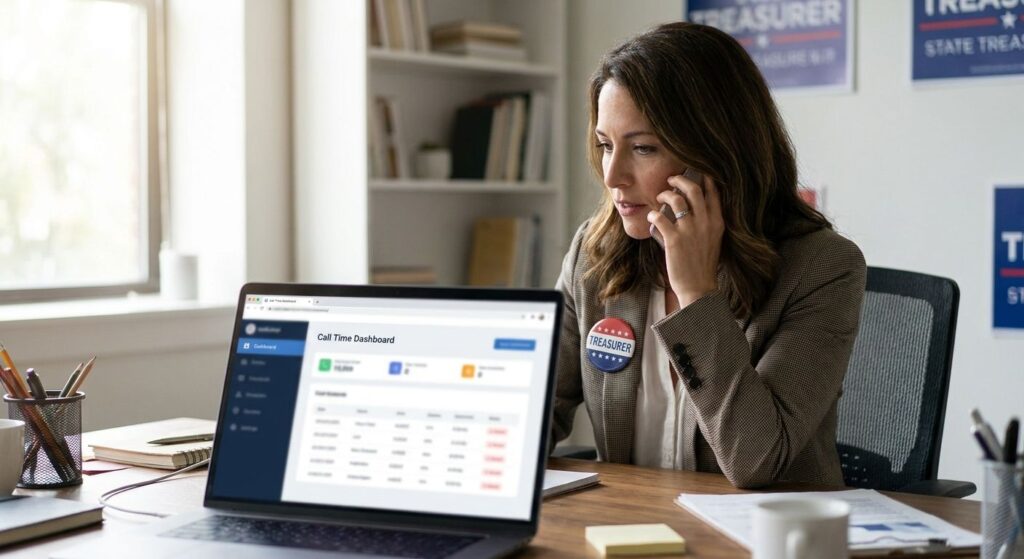
Every state treasurer campaign needs one place to run call sessions and log pledges in real time. A dedicated call time desk that tracks talk time, pledge amount, and follow-up date beats a shared spreadsheet the moment two people are calling the same list. Buy this as the first piece of the fundraising stack, before anything else gets purchased.
Compliance and donor records — the audit-proof pick.
Once pledges convert to actual contributions, the record needs to be clean enough to hand to a treasurer without a rebuild. Donor management paired with FEC-style FEC compliance reporting turns call time data straight into report-ready numbers. Buy — this is the piece that saves hours in the week before a 2026 filing deadline.
State and local election fit — the right-sized pick.
A platform built for congressional-scale operations often comes with features a state treasurer campaign will never touch and a price built for that scale. Software scoped for state and local elections matches the size of the race instead of forcing a small team to pay for capacity they don't need. Buy if the campaign is running with a staff of one to three people.
Text-based pledge reminders — the follow-up boost.
A pledge logged but never confirmed is money left on the table. Text reminders sent a day or two after a call close the loop on pledges that would otherwise sit unconfirmed through the reporting period. Consider this add-on once call time volume passes roughly 25-30 sessions a week.
Set up call time before your next filing
Track pledges, donor records, and compliance exports in one dashboard for 2026.
What to avoid
- Spreadsheet plus a phone dialer. It works for the first 100 calls, then pledge tracking falls apart once two people are calling off the same list and updating two different copies of the sheet.
- General sales CRMs. They're built to track deals, not campaign finance compliance, so the campaign ends up exporting data into a second tool right before every filing deadline anyway.
- Voter file tools marketed as fundraising software. A voter database helps with outreach and turnout, not donor tracking — state treasurer campaigns need donor-first software, not a voter list with a donation button bolted on.
Verdict comparison
| Setup | Pledge tracking | Compliance export | Team size fit | Verdict |
|---|---|---|---|---|
| Spreadsheet + dialer | Manual, breaks past ~100 calls | None built-in | 1 person | Skip |
| Generic sales CRM | Yes, not campaign-specific | No FEC-style export | 2-5 people | Skip |
| Call time software for candidates | Built-in, real-time | Built-in | 1-3 people | Buy |
FAQ
What is call time software for state treasurer candidates?
It’s software that tracks call lists, pledges, and follow-ups for a fundraising call session, then feeds that data into donor records for reporting. For a state treasurer race, the priority is speed of setup and a clean handoff to compliance reporting, not high-volume dialer features built for national campaigns.
How much call time does a state treasurer candidate need each week?
Most down-ballot statewide candidates run 3-5 sessions of one to two hours a week during active fundraising months. The number that matters more than hours is pledges logged per session, which is where software beats a spreadsheet.
Is call time software worth it for a small treasurer campaign staff?
Yes, once a campaign is making more than roughly 20-30 calls a week with more than one person dialing. Below that volume a simple call sheet can work, but pledge tracking still tends to slip without a system logging follow-up dates.
Does call time software replace a campaign finance report filing?
No. It feeds clean donor and pledge data into the reporting process, but the treasurer still files the report with the state. Software that exports in a compliance-ready format cuts the manual cleanup step before that filing.
Can call time software also handle texting and email for a treasurer race?
Yes, when the platform combines call time, texting, and email under one donor record. That matters more for state treasurer races than for larger campaigns because a small staff can’t afford to manage three disconnected tools.
What’s the difference between call time software and a voter database tool?
Call time software tracks donors and pledges for fundraising. A voter database tracks the electorate for outreach and turnout. State treasurer campaigns need the donor-focused tool first since fundraising, not voter contact, is usually the earlier bottleneck.
How fast can a new treasurer campaign get call time software running?
A campaign with an existing donor list can import contacts and start a call session the same day. The setup bottleneck is usually list cleanup, not the software itself.
One last thing
The pledge that doesn't get a follow-up within 48 hours is the one that never converts — that gap is where most state treasurer campaigns lose money in 2026, not in the call itself. A follow-up reminder tied to the donor record, sent the next day, recovers more of that pledge total than adding more names to the call list ever will.
Related guides