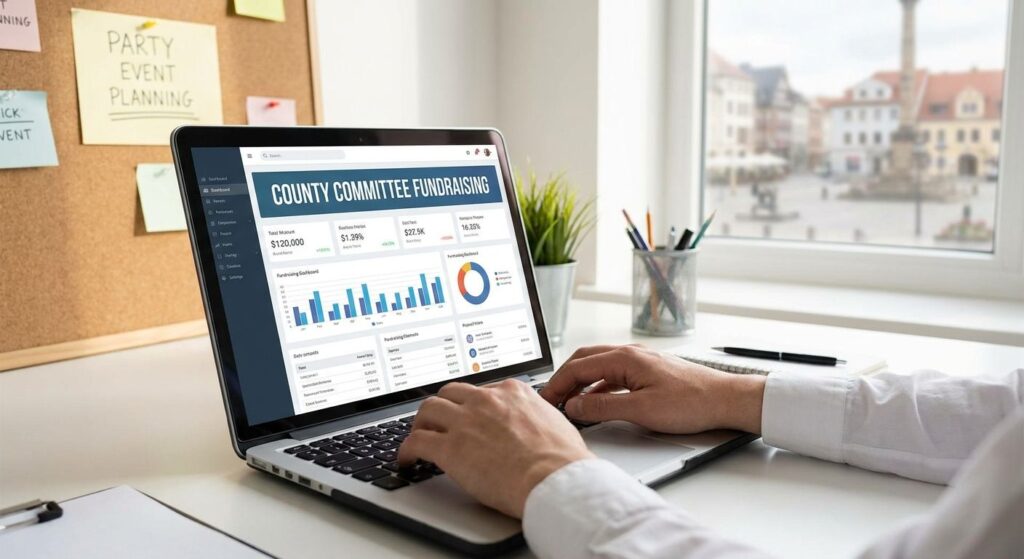
County party committee fundraising software is a CRM built to manage donor lists across multiple candidates, coordinate call time for a slate instead of one campaign, and keep the committee's periodic campaign finance reports on schedule. A county committee runs differently than a single candidate: it holds donor data for a chair, a treasurer, and often a dozen down-ballot candidates at once, and it files disclosure reports year-round, not just during an election cycle.
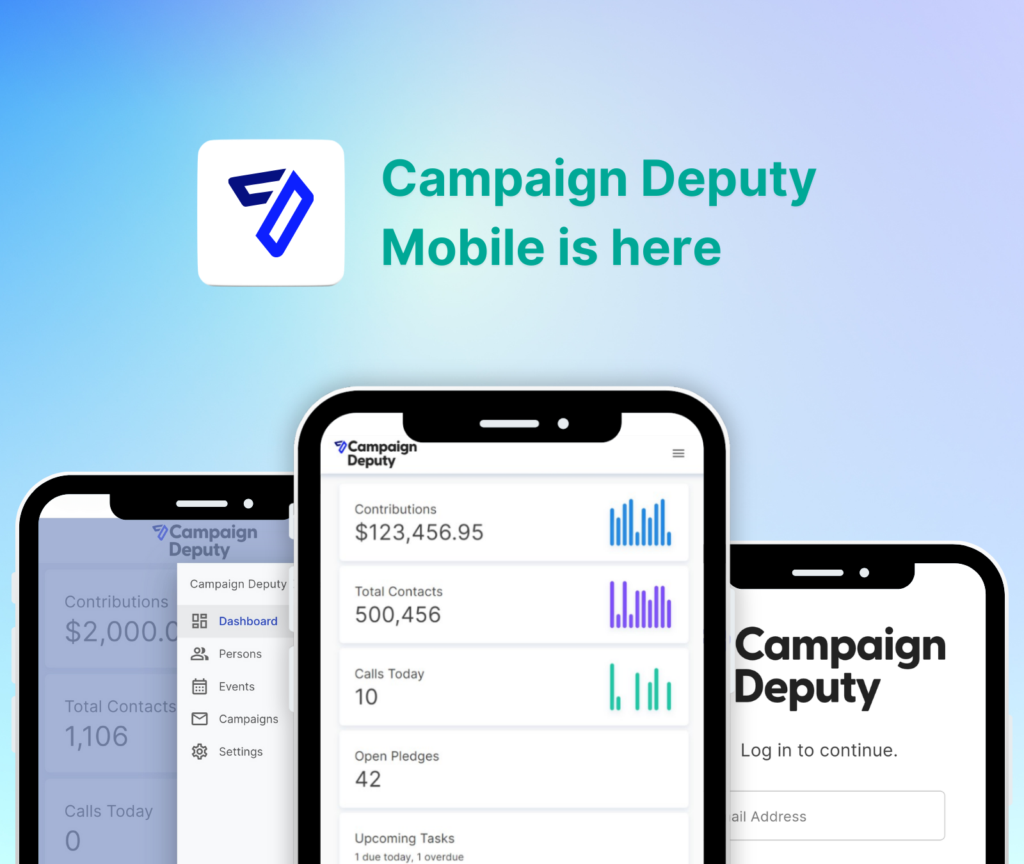
- Campaign Deputy runs call time, texting, and email for county party committees managing multiple candidates at once.
- Spreadsheets break down once a county committee tracks more than a few hundred donors across several election cycles.
- Compliance reporting matters more here than for a single candidate because county committees file on a recurring, not one-time, schedule.
- Campaign Deputy clients have raised over $380,000 in a single cycle and sent 5 million emails in a month.
Why fundraising software matters for county party committees
A county party committee isn't one campaign — it's a shared donor pool serving a chair, a treasurer, and every candidate the committee backs that cycle. That means the same donor might get asked by three different candidates in one month if nobody is tracking contact history in one place.
Most county committees still run on a shared Google Sheet passed between volunteer treasurers each election. That works until the sheet hits a few hundred rows, at which point duplicate asks, missed thank-yous, and late-filed reports start costing real money and real trust with donors.
County committees also carry a compliance burden that individual candidates don't: many jurisdictions require periodic filings even in off-years, and a missed deadline reflects on every candidate the committee endorses. The software decision here isn't about growth hacking — it's about not losing track of who gave what, and not missing a filing deadline that puts the whole slate at risk.
Centralize your donor database
Before anything else, get every donor record — past and present — into one system the whole committee can see. This is the manual work that has to happen regardless of what tool you land on.
- Pull donor lists from every past candidate treasurer and merge them into one file
- Standardize name, address, and employer/occupation fields so reports don't reject on formatting
- Flag donors who've given to more than one candidate the committee has backed
- Tag donors by giving history (first-time, recurring, lapsed)
- Remove duplicate entries before importing anywhere
Once the list is clean, a dedicated donor CRM built for state party committees applies the same structure down at the county level — shared visibility across candidates without three different spreadsheets floating around.
Set up call time blocks for multiple candidates
Call time is where county committees lose the most efficiency, because candidates often call the same donor list without coordinating who's already dialed whom.
- Build a shared call sheet ranked by donor giving history
- Block out call time slots per candidate so nobody double-dials the same donor same week
- Log every call outcome (pledge, no answer, declined) immediately, not at end of day
- Set a weekly dollar goal per candidate and track against it
- Rotate stale leads back into the queue after 30 days of no contact
Build compliant web forms for county-level giving
A donation form for a county committee needs to route funds correctly when multiple candidates share a page, and it needs to capture the same compliance fields every downstream report will require.
- Require occupation and employer fields on every form, not just above a threshold, so nothing gets flagged later
- Set contribution limit warnings per donor per candidate
- Confirm the form embeds cleanly on the committee's existing website
- Test the mobile checkout flow before a single email goes out driving traffic to it
Launch email and text programs across the full contact list
Once the list is clean and forms are live, email and text are how a county committee actually moves money at scale. The Majority Rules PAC scaled to 5 million emails sent per month running through Campaign Deputy — proof this works at volume, not just for a single candidate's list.
- Segment the list by candidate interest so asks feel relevant, not generic
- Send a dedicated ask for each candidate rather than one committee-wide blast
- A/B test subject lines on the first send of each cycle
- Layer in text-to-donate for time-sensitive asks (filing deadlines, debate nights)
- Track unsubscribe rates by segment and adjust send frequency accordingly
Automate campaign finance reporting
This is the step where county committees get burned most often. A missed report doesn't just cost the committee — it can trigger fines that follow the treasurer personally in some states.
- Build a filing calendar with every deadline for every jurisdiction the committee reports in
- Reconcile contributions against bank deposits monthly, not just before a filing
- Keep itemized records for every contribution above your state's disclosure threshold
- Assign one person as the report-of-record to avoid duplicate or conflicting filings
A platform built around campaign finance software for PAC treasurers exports the same itemized data county treasurers need, cutting the report-building step from days to hours.
Track donor history across election cycles
County committees exist longer than any single candidate's run, which means donor history should outlive the campaign that first collected it.
- Archive donor records after each cycle instead of starting fresh
- Note which candidate originally brought in each donor
- Track lifetime giving totals per donor, not just per-cycle totals
- Flag donors who lapsed after a candidate they supported lost or retired
Coordinate volunteer and canvassing data alongside donor data
Many county committee donors also volunteer or canvass, and treating those as separate systems means missing an easy ask from someone already showing up.
- Cross-reference volunteer sign-up sheets against the donor list weekly
- Flag volunteers who haven't given yet as a warm ask list
- Track door-knock outcomes alongside donor records so field data informs the next appeal
Run one system for the whole committee
See how Campaign Deputy handles multi-candidate call time, email, and compliance.
Comparing your options for 2026
| Option | Best for | Key limitation |
|---|---|---|
| Shared spreadsheet | Committees under 100 donors, one election cycle | Breaks down fast with multiple candidates and no audit trail |
| Generic nonprofit CRM | Committees that only need donor tracking, no compliance reporting | Not built for campaign finance disclosure fields or call time |
| Campaign Deputy | County committees running call time, email, texting, and compliance reporting for multiple candidates in one system | Requires initial data cleanup and import from legacy spreadsheets |
A broader look at donor management software built for political campaigns covers how these tools stack up for single-candidate use versus the multi-candidate load a county committee carries.
Verdict: county party committees juggling more than one candidate's donor list in 2026 need one shared system with call time, compliance reporting, and email in the same place — a spreadsheet passed between volunteer treasurers is not that system.
Common mistakes county party committees make
- Letting every candidate keep a separate donor list. This duplicates asks, annoys donors, and makes year-end reporting a manual reconciliation project.
- Treating compliance as a once-a-cycle task. Many states require periodic filings in off-years too, and county committees miss these more than individual candidates do.
- Skipping donor history from prior cycles. A donor who gave to a 2022 candidate is a warm lead in 2026 — most committees start from zero every time instead.
- Running call time without a shared schedule. Two candidates calling the same donor in the same week reads as disorganized and costs both of them the ask.
- Not assigning a single report-of-record. When two volunteers both think they filed, or neither does, the fine lands on the committee's reputation with every candidate it backs.
FAQ
What’s the best fundraising software for county party committees in 2026?
Campaign Deputy is built for committees managing call time, email, texting, and compliance reporting across multiple candidates at once, which is the structure most county committees run on. Spreadsheets and generic nonprofit CRMs don’t cover the compliance reporting layer county committees need.
Is fundraising software worth it for a small county committee?
Once a committee tracks more than a couple hundred donors or backs more than one candidate at a time, a shared spreadsheet stops working reliably. The switch pays off the first time it prevents a duplicate ask or a missed filing deadline.
How much does campaign finance reporting software cost?
Pricing varies by platform and committee size — check current pricing directly on the provider’s site rather than relying on a quoted number that may be outdated.
Can one system handle donor data for multiple candidates in the same committee?
Yes — a CRM built for county and state party committees keeps each candidate’s ask history visible while sharing the underlying donor database, which prevents the double-dial problem common on shared call time lists.
Do county party committees have to file the same reports as individual candidates?
Requirements vary by state, but many county committees file on a recurring periodic schedule rather than just around election dates, which is a heavier compliance load than a single candidate’s cycle-based filing.
What’s the difference between donor CRM software for PACs and for county committees?
PAC treasurer software focuses on itemized contribution disclosure for one filing entity. County committee software adds the layer of managing donor relationships across several candidates sharing the same pool of supporters.
How do county committees avoid annoying donors with duplicate asks?
Centralize the donor list so every candidate sees who’s already been asked and when. Segmented email and call time scheduling inside one shared system is the fix most committees are missing.
Should a county committee track donor data across multiple election cycles?
Yes — a donor who gave in a prior cycle is a warmer lead than a cold name, but only if the committee kept the record instead of starting a new list every election.
One last thing
The committees that struggle most in 2026 aren't the ones with small donor lists — they're the ones with three different donor lists that don't talk to each other. Fix the data-sharing problem before worrying about email volume or call time scripts; volume on a fragmented list just multiplies the duplicate-ask problem.
Related guides
- Best donor management software for political campaigns
- How to build a donor database for a nonprofit