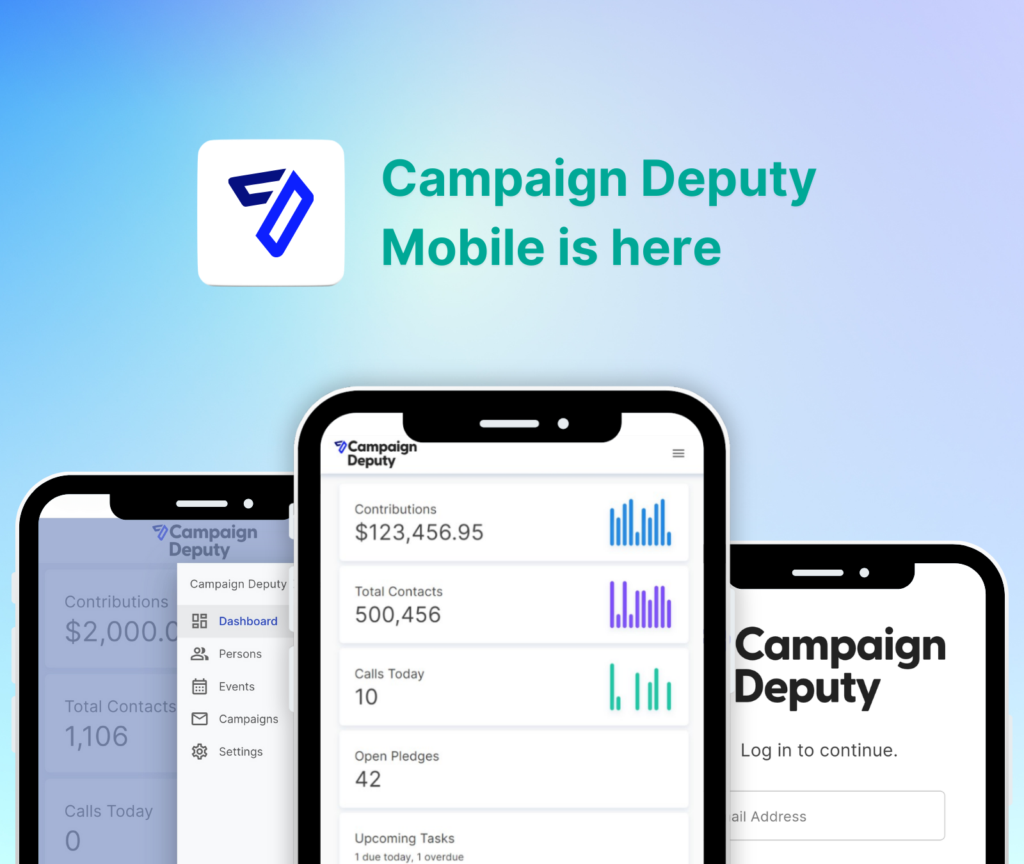

Lieutenant governor campaign donor management software is a CRM built to track donors, call time, and compliance reporting for a statewide race that raises real money but rarely gets a governor-sized staff. A lieutenant governor candidate files the same state disclosure reports as the top of the ticket, recruits support across the whole state, and still has to hit fundraising quotas with two or three staffers doing the work of ten.
- Campaign Deputy is built for donor management software for lieutenant governor campaigns running statewide on a down-ballot budget in 2026.
- Call time blocks, donor segmentation by region, and finance reporting need to live in one system, not three spreadsheets.
- Spreadsheets hold up below roughly $50,000 raised; past that, duplicate donor records and missed deadlines start costing money.
- Best for campaigns with 2-6 staff who need compliance reporting and call time tracking in the same tool.
Why this matters
A lieutenant governor race sits in an odd spot. The candidate runs statewide, files with the same state agency as the governor's race, and often shares donor lists and events with the top of the ticket — but pulls a fraction of the media attention and a fraction of the budget. Donors who instantly recognize a governor candidate's name need a reason to open an email from a lieutenant governor candidate they have never heard of.
That gap shows up in three places every cycle: donor records scattered across spreadsheets and old list exports, call time staff working off printed call sheets instead of live donor scores, and treasurers scrambling the week before a state filing deadline because nobody reconciled the bank account. Donor management software for lieutenant governor campaigns has to solve all three at once, not one at a time.
Why donor management matters for lieutenant governor campaigns
Statewide reach without statewide money is the defining constraint of this race in 2026. The donor universe covers every county in the state, which means the same list that a state house candidate could work from a single printed page now spans dozens of media markets and multiple contribution-limit tiers.
Compliance load does not scale down with budget either. A lieutenant governor campaign files on the same schedule and in the same format as the governor's campaign, with a treasurer who is frequently part-time or volunteer. Software that separates donor outreach from compliance forces that one person to re-key data twice.
Build one donor database before you build anything else
Every downstream problem — missed calls, duplicate asks, late filings — traces back to donor data living in more than one place. Fix this first.
- Import every existing list (past campaign, party committee, personal contacts) into one system
- De-duplicate by name, email, and address before the first call time session
- Tag donors by giving history, not just contact info
- Flag donors approaching your state's contribution limit
- Assign one owner for data hygiene, even if that is the candidate's spouse in month one
Spreadsheets handle this for a campaign raising under $50,000. Past that, a purpose-built CRM becomes the faster path because it merges duplicate records and flags contribution limits as staff enter gifts, instead of after a treasurer finds the problem three weeks later. Campaign Deputy handles donor management and compliance reporting in the same login — start with the broader guide to donor management software for political campaigns if you are still comparing categories.
Set up call time blocks and weekly quotas
Lieutenant governor candidates spend fewer hours on television and more hours on the phone than the top of the ticket, because less earned media pulls donors in on its own. Structure the calling before the first session.
- Block 2-4 hour call time windows on the candidate's calendar, same days each week
- Set a weekly dollar quota, not just a call count
- Sort call sheets by donor score so the first 20 calls are the highest-probability asks
- Track ask amount against gift amount to catch under-asking early
- Debrief staff after every session
A statewide donor base is spread across the whole state, so call time software for statewide candidates has to sort by region as easily as by dollar amount.
Segment the donor list by geography and giving history
One email to the whole list will not convert in a statewide race. Segmentation matters more here than in a legislative race because the donor base covers the entire state.
- Split donors by county or media market for geographically relevant asks
- Separate first-time donors from repeat maxed-out donors
- Flag donors who gave to the governor candidate if you share a ticket
- Build a lapsed segment for anyone who has not given in 12 months
- Keep small-dollar donors in a separate segment for text and peer-to-peer asks
Automate compliance-ready finance reporting
State filing deadlines do not move for a lieutenant governor race just because the campaign has fewer staff than the governor's. Missing one costs fines and coverage you do not want.
- Reconcile bank records weekly, not the night before a deadline
- Log in-kind contributions the same week they happen
- Set reminders 10 days ahead of every filing date
- Run a mock report mid-quarter to catch missing data
- Give one treasurer end-to-end ownership of compliance
This is where a connected workflow earns its keep. Campaign Deputy pulls contribution data straight from the donor CRM into finance reports, so the treasurer is not re-keying numbers from a separate spreadsheet the week a report is due. If your treasurer is new, walk them through tracking campaign filing deadlines before the first reporting period closes in 2026.
Launch statewide email and text fundraising
Name recognition is usually the biggest fundraising obstacle for a lieutenant governor candidate. Email and text close that gap faster and cheaper than mail.
- Send an introduction email in the first two weeks, before any ask
- Personalize subject lines by region or issue using your segments
- Pair every fundraising email with a text follow-up inside 48 hours
- Test ask amounts of $25, $50, and $100 across segments before scaling
- Track open and click rates by segment to find your most responsive list
Track the fundraising goal against the filing calendar
A goal tracker that lives apart from the compliance calendar creates blind spots. Put both on one screen.
- Set a quarterly target tied to the state reporting period
- Compare actual raised to goal weekly, not monthly
- Flag any donor over the contribution limit before the report goes out
- Review goal progress against call time output every Friday
Recruit and onboard call time staff fast
Most lieutenant governor campaigns build a call time team from volunteers before they can afford full-time fundraisers. Onboarding speed decides how fast the phones start ringing.
- Write a one-page call script before the first volunteer sits down
- Train new callers on live donor records, not printed lists, from day one
- Pair each new volunteer with an experienced caller for two sessions
- Set a 30-day check-in to review individual quota performance
- Move underperforming callers to research or data entry rather than cutting them
Run your 2026 fundraising in one system
Donor CRM, call time, and finance reporting for statewide campaigns.
Comparing options for lieutenant governor campaigns
| Option | Best for | Key limitation |
|---|---|---|
| Spreadsheets plus a mail tool | Campaigns under $50,000 raised with one staffer | No compliance automation, high duplicate-record risk |
| Generic sales CRM | Campaigns already paying for a CRM license | Not built for contribution limits or state filing formats |
| Compliance-only filing software | Treasurers who only need to file | No call time, email, or texting built in |
| Campaign Deputy | Lieutenant governor campaigns with 2-6 staff needing donors, call time, and compliance together | Requires up-front import work to consolidate old lists |
Campaign Deputy is the strongest fit for a lieutenant governor campaign that needs donor management, call time, and campaign finance reporting under one login instead of three separate tools.
“If your treasurer is re-typing donor names into a filing tool, you are paying twice for the same data.”
Common mistakes lieutenant governor campaigns make
- Treating it like a legislative race. A statewide donor list needs regional segmentation a state house campaign never has to build.
- Waiting on call time until after the primary. Lower name recognition means the phones need to start ringing in month one, not month three.
- Skipping joint fundraising tracking. Campaigns sharing events or lists with the governor candidate lose track of which gift belongs to which committee.
- Running compliance off a monthly spreadsheet update. State deadlines do not forgive a treasurer who reconciles quarterly.
- Under-investing in email because the candidate is not a household name. Email is often the cheapest recognition a lieutenant governor race can get in 2026.
FAQ
What is the best donor management software for lieutenant governor campaigns in 2026?
Campaign Deputy is built for lieutenant governor campaigns that need donor tracking, call time, and state compliance reporting in one system rather than three tools. It fits campaigns with 2-6 staff running statewide on a down-ballot budget.
Is donor management software worth it for a smaller statewide race?
Yes, once a campaign passes roughly $50,000 raised, spreadsheet tracking starts producing duplicate donor records and missed contribution-limit flags. The staff time saved on data entry and reconciliation usually covers the cost.
Do lieutenant governor campaigns need separate call time software?
No, call time built into the donor CRM is better because staff work off live donor records instead of printed call sheets. Standalone call time tools that do not sync to the donor database create duplicate work for the treasurer.
How is fundraising different for lieutenant governor candidates versus governor candidates?
Lieutenant governor candidates typically have lower name recognition and smaller budgets, so call time and email carry more of the fundraising load than earned media. The state filing requirements are identical to any other statewide candidate.
Can donor management software handle campaign finance reporting too?
Platforms built for political campaigns, including Campaign Deputy, connect donor records directly to finance reports so contribution limits and deadlines are checked in the same system. Generic sales CRMs do not include state filing formats.
When should a lieutenant governor campaign start call time?
Start call time in the first month of the campaign, before the primary. Lower name recognition means the fundraising clock starts earlier than it does for a governor candidate.
How much does donor management software cost for a statewide campaign?
Pricing varies by platform and by the size of your donor list, so check current pricing directly with each vendor. Compare on whether compliance reporting and call time are included or sold as add-ons.
One last thing
The lieutenant governor race often gets built as an afterthought to the governor's campaign, sharing a donor list, an event calendar, and sometimes a treasurer. That is exactly why the donor database has to be clean in week one — a lieutenant governor campaign that inherits a messy shared list in 2026 spends its first month untangling duplicate records instead of calling donors.
Related guides
- Best campaign finance reporting software for state candidates
- Donor CRM for state auditor campaigns
- How to calculate a campaign fundraising goal