Nonprofit staff and campaign treasurers ask the same question every cycle: which donation form builder actually converts donors and keeps the compliance record clean. This ranking compares the tools political campaigns, PACs, non-partisan committees, and 501(c)(3) nonprofits are running in 2026, from dedicated fundraising CRMs to standalone checkout pages.
- Campaign Deputy wins the best donation form builder for nonprofits and campaigns needing compliance tied to the form – buy it.
- ActBlue stays the default processor for Democratic donors but isn’t a full CRM on its own.
- Donorbox and Give Lively work fine for small 501(c)(3) nonprofits with no FEC or state filing requirement.
- Classy and Qgiv fit large nonprofits running events and peer-to-peer campaigns, not local candidates.
- The right pick in 2026 depends on whether the donation record also has to feed a compliance filing.
Why this matters
A donation form is the one page where a donor actually reaches for a card. If it's slow, asks for too much, or breaks on mobile, the click never turns into a contribution. For campaigns and PACs, the same form has to feed the record you'll need for FEC or state filings later – a nonprofit checkout tool that ignores itemized reporting creates a mess a treasurer fixes by hand in 2026.
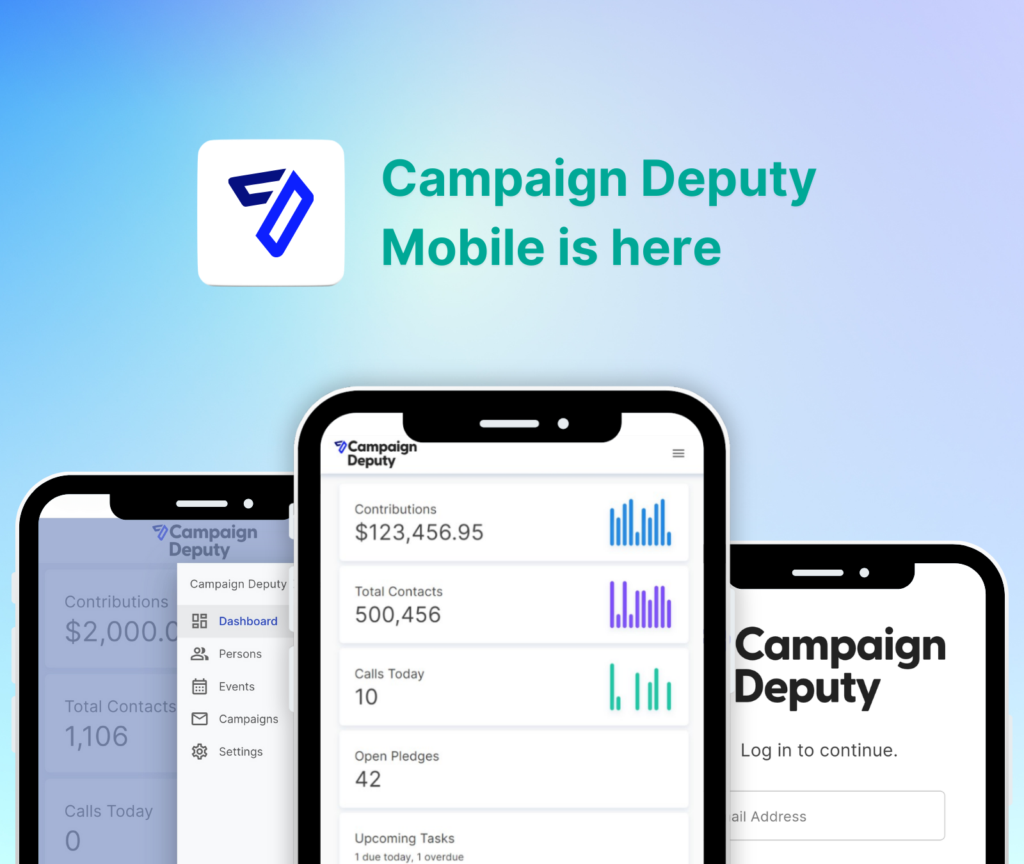
Campaign Deputy builds its web forms alongside call time tracking, email marketing, texting, and compliance reporting, so the donation record and the report a treasurer files come from the same dataset. That matters more the closer you get to a filing deadline, and it's the gap most nonprofit-first form builders leave open.
How we ranked
This list weighs four things: how fast a donor completes the form on mobile, whether the platform tracks recurring gifts and itemized totals automatically, whether the data flows cleanly into compliance or accounting records, and whether the fee structure fits a campaign or small nonprofit budget rather than an enterprise one. Case data from organizations already running these platforms counts more than marketing copy – a PAC scaling to 5 million email sends a month, a city council campaign that built a $30,000 donor base from zero, a re-election campaign that raised over $380,000. Every tool below is measured against 2026 fundraising conditions: donors expect a one-click mobile checkout, treasurers expect the numbers to reconcile without a spreadsheet, and compliance officers expect the itemized list ready before the filing window closes.
The ranked list
1. Campaign Deputy – the all-in-one pick for campaigns and PACs
Campaign Deputy's web forms sit inside the same dashboard as call time tracking, email, and texting, so every donation lands in the donor record used for donor management and FEC compliance reporting. The Majority Rules PAC used the platform to scale its email program to 5 million sends a month, and Sup. James Walkinshaw's re-election campaign raised over $380,000 running forms and outreach from one login. Taylor McGovern U'Sellis's city council campaign built a $30,000 donor base the same way, starting from nothing.
If you're a candidate, PAC, or non-partisan committee that needs the donation form to double as the compliance record, this is the fundraising CRM to run in 2026. A nonprofit with zero filing obligations gets less value from the compliance layer specifically, but the form and email tools still hold up on their own.
Verdict: Buy for candidates, PACs, and campaign committees that need forms and compliance in one place.
2. ActBlue – the default rail for Democratic donors
ActBlue is the shared processor most repeat Democratic donors already trust, with saved card details carried over from other campaigns and no setup fee on the committee side. It's built specifically for the party's donor ecosystem, which makes it hard to skip for federal and statewide races.
What it doesn't do is track outreach, manage a donor list, or generate a compliance-ready report – it processes the transaction and stops there. Pair it with donor lists and email campaigns tooling if you need the record to feed anything past the receipt.
Verdict: Consider as the processing rail for Democratic committees, not as a standalone donor management system.
3. Donorbox – quick to launch for small nonprofits
Donorbox embeds a working donation form in under an hour, with recurring giving built in and a simple checkout that doesn't require a developer. It's a reasonable first tool for a volunteer-run 501(c)(3) with no dedicated fundraising staff.
It has no compliance layer and no itemized contributor export built for political thresholds, so a campaign committee that adopts it usually ends up rebuilding those records manually later in 2026.
Verdict: Consider for a small nonprofit with no filing requirement; Skip for a candidate or PAC.
4. Classy – the enterprise nonprofit pick
Classy adds peer-to-peer fundraising pages, event ticketing, and campaign pages built for organizations running large seasonal pushes with dedicated marketing staff. It handles scale well when the nonprofit already has the team to run it.
The pricing and setup overhead don't make sense for a single-candidate committee or a small local PAC, and the feature set is built around use cases most local campaigns don't have.
Verdict: Hold unless you're a national or regional nonprofit running peer-to-peer campaigns at scale.
5. Give Lively – the free-to-start option
Give Lively doesn't charge nonprofits a platform fee – the donor covers processing at checkout instead – which makes it an easy first step for a small charity testing online giving for the first time. Setup is simple and the checkout is clean.
Reporting depth is thin, and there's no contribution-limit tracking or itemized compliance export, so it doesn't fit a political committee's needs in 2026 regardless of price.
Verdict: Consider for a small charity's first online giving page; Skip for any political committee.
6. Qgiv – built for event-heavy fundraising
Qgiv's strength is auctions, galas, and text-to-give at live events, with peer-to-peer pages layered on top. Organizations whose fundraising calendar runs on events get real value from the event-specific tools here.
If your donor pipeline runs mostly on email and phone outreach between events rather than ticketed nights, the event-first design doesn't add much.
Verdict: Consider for event-driven nonprofits; Skip if outreach, not events, drives most of your gifts.
7. NationBuilder – the legacy hybrid
NationBuilder combines a website and CMS builder with basic donor forms, and it's been a popular pick with independent and non-partisan campaigns for years. The website tooling is genuinely useful if you need a full site rebuild.
The checkout flow feels dated next to newer builders, and list-based pricing climbs fast as a campaign's donor file grows heading into 2026.
Verdict: Hold – solid for the website, weak for the donation form specifically.
Want forms tied to your compliance reports?
Run call time, email, texting, and web forms from one dashboard.
Comparison table
| Tool | Built for | Compliance reporting | Recurring gifts | Verdict |
|---|---|---|---|---|
| Campaign Deputy | Candidates, PACs, non-partisan campaigns | Built in | Yes | Buy |
| ActBlue | Democratic candidates and committees | None (processor only) | Yes | Consider |
| Donorbox | Small 501(c)(3) nonprofits | None | Yes | Consider |
| Classy | Large nonprofits, peer-to-peer | None | Yes | Hold |
| Give Lively | First-time small charities | None | Limited | Consider |
| Qgiv | Event-driven nonprofits | None | Yes | Consider |
| NationBuilder | Independent, non-partisan campaigns | Limited | Yes | Hold |
The pattern across the table is simple: compliance reporting only shows up where the platform was built with campaigns in mind, not adapted from a nonprofit checkout tool. Everything else in the 501(c)(3) column handles recurring gifts fine – it just stops at the receipt.
Where to source it
- Match the tool to your entity type first. A candidate committee or PAC needs compliance-ready records; a 501(c)(3) nonprofit needs tax-receipt handling instead, not itemized contribution limits.
- Ask whether compliance or reporting is bundled or a separate cost. A form builder that looks cheap upfront can cost more once you bolt on a separate export tool to satisfy a filing deadline.
- Test the mobile checkout before you commit. Load a $5 test donation on your phone; if it takes more than three taps past the amount field, donors abandon it.
“If the mobile checkout takes more than three taps past the amount field, donors abandon it.”
FAQ
What’s the best donation form builder for nonprofits in 2026?
Campaign Deputy is the best donation form builder for nonprofits and campaigns that also need compliance reporting in 2026, because the form data and the filing record share the same donor file. A nonprofit with no FEC or state filing requirement can cover the basics with Donorbox or Give Lively instead.
Is ActBlue a donation form builder or a payment processor?
ActBlue is a payment processor, not a full donation form builder or CRM. It handles the transaction and gives Democratic donors a saved-card checkout, but campaigns still need a separate tool for email, texting, and compliance tracking.
How much does a donation form builder cost for a small campaign or nonprofit?
Pricing varies by platform and donor volume rather than a flat rate, and most tools charge either a monthly platform fee or a percentage of each transaction. Check current pricing directly with each provider, since fee structures shift between election cycles.
Can a political campaign use a nonprofit donation form builder like Donorbox or Classy?
Technically yes, but neither tool tracks contribution limits or generates the itemized reports federal and state filings require. A campaign that adopts a nonprofit-first tool usually ends up rebuilding the compliance record by hand later.
Do donation form builders handle FEC or state compliance reporting?
Most standalone donation form builders do not handle compliance reporting – they process the transaction and stop there. Campaign Deputy carries the donation record into the same system used for FEC and state filing, which is the gap most nonprofit-first tools leave open.
What’s the difference between Donorbox and Classy?
Donorbox is built for a fast, simple setup a small volunteer-run nonprofit can launch in under an hour. Classy adds peer-to-peer fundraising pages and event ticketing for larger nonprofits with dedicated marketing staff, and it costs more to match.
How long does it take to set up a donation form?
A basic donation form on most builders takes under an hour to publish, including payment processor setup. Adding recurring giving, compliance fields, or CRM integration for a political campaign can stretch setup to a few days depending on the platform.
Is Give Lively really free to use?
Give Lively doesn’t charge nonprofits a platform fee, but the donor covers the payment processing cost at checkout instead. It’s a solid option for a small charity’s first online giving page, though it lacks the compliance tracking a political campaign needs.
One last thing
The form matters less than what happens after the donor clicks submit. A donor who gives once and never hears from the campaign again rarely gives twice, and most of the nonprofit-first tools on this list have no answer for that follow-up beyond an auto-generated receipt email. Pairing the form with a texting platform for political campaigns closes that gap fast – a same-day thank-you text after a first gift is one of the cheapest retention moves available heading into the rest of 2026.
Related guides