Building a small-dollar donor program for a political campaign means combining a donation web form, email, texting and recurring billing into one connected system instead of running each channel on its own. Below is the build order that gets a campaign from zero small-dollar donors to a repeatable monthly base, plus the compliance details that trip up first-time treasurers.
- A small-dollar donor program for a political campaign links web forms, email, texting and recurring billing into one repeat-giving system.
- The FEC requires itemization above $200 per election, so most small-dollar programs are built to stay under that line.
- Recurring monthly donors generate more total revenue per cycle than one-time givers, even when the average gift is small.
- Segmenting the donor list by gift size and channel response is what separates a program that scales from a list that goes stale.
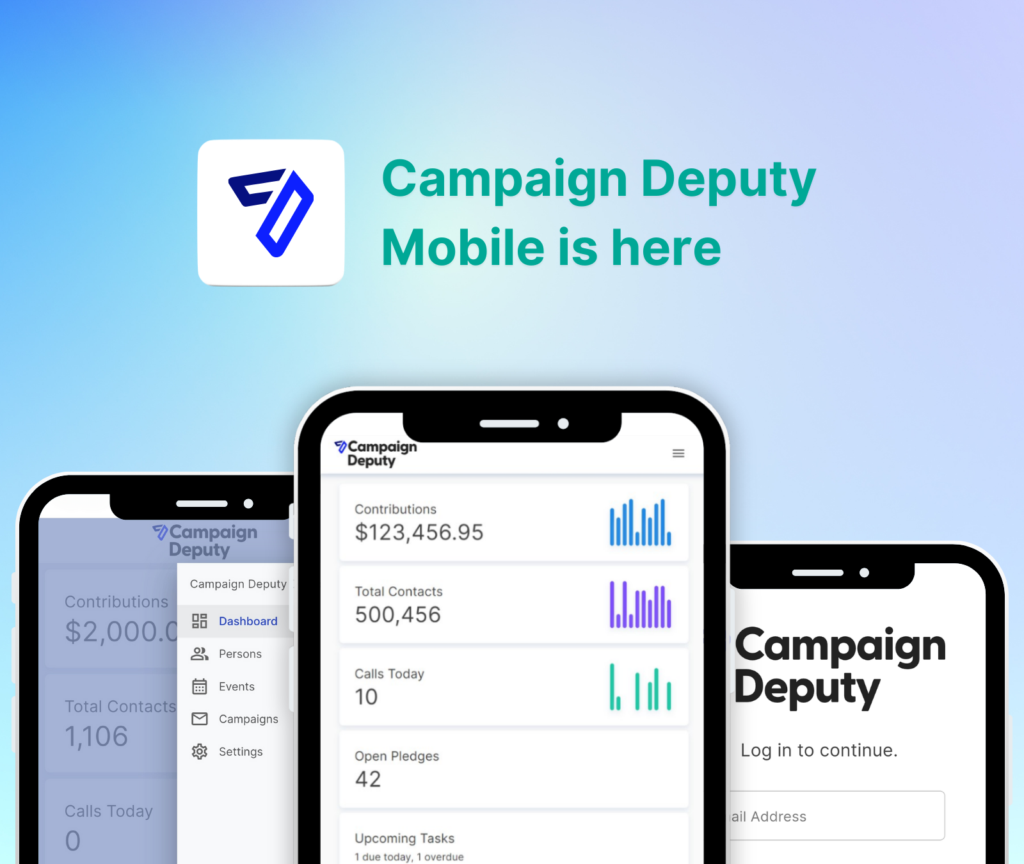
- Campaign Deputy pairs donor CRM tracking with compliance reporting so small-dollar volume doesn’t turn into manual itemization work.
Why this matters
A campaign that depends on a handful of high-dollar checks has a cash flow problem the moment one bundler goes quiet. Small-dollar programs spread risk across hundreds or thousands of donors, and they compound: a donor who gives $15 in March is a warmer prospect for a $25 ask in September than a cold name on a purchased list.
The tradeoff is volume. More donors means more emails to send, more texts to log, and more gifts to reconcile against FEC itemization rules before every 2026 filing deadline. A program built without a system for building the email list from day one usually stalls out around the same 200-500 donor mark every cycle.
How to Build a Small-Dollar Donor Program for a Political Campaign
-
Stand up a donation web form before the campaign has a message. A form that captures name, email, employer/occupation and card details in under 30 seconds is the foundation everything else feeds. Every list-building tactic below only works if there's somewhere to send the traffic.
-
Build the list from day one, not after the kickoff event. Volunteer sign-up sheets, petition circulators, and a candidate's personal contacts are the fastest early sources. A campaign that waits until month three to build an email list for a political campaign is giving up weeks of compounding growth.
-
Segment the list by gift size and channel behavior. Donors who open emails but never click need different treatment than donors who gave once and went quiet. A campaign that doesn't segment a donor list for a political campaign ends up sending the same $10 ask to a lapsed $500 donor and burns the relationship.
-
Convert one-time gifts into recurring gifts at the point of donation. A checkbox for "make this monthly" on the confirmation page, plus a follow-up ask 30 days after a first one-time gift, is what turns a $20 donor into a $240-a-year donor. Recurring donation software for political campaigns handles the failed-card retries and expiration reminders that manual tracking misses.
-
Automate the follow-up cadence. Email and text sequences triggered by donor behavior (first gift, lapsed 60 days, birthday, filing deadline) outperform one-off blasts because they arrive when the donor is already thinking about the campaign.
-
Track itemization as gifts come in, not at filing time. Every contribution over $200 in aggregate from one donor has to be itemized on the campaign finance report. Reconciling that after the fact against hundreds of small gifts is where treasurers lose entire weekends.
-
Set a written fundraising goal and check it weekly. A program without a target drifts. Break the cycle total into a monthly number and compare actual receipts against it every Monday.
Small-dollar vs. major donor fundraising
| Approach | Typical gift size | Primary channel | Compliance load | Best for |
|---|---|---|---|---|
| Small-dollar program | Under $200 (FEC itemization line) | Web forms, email, text | Low per-gift, high volume | Building a durable base early in the cycle. Build this first. |
| Major donor / bundler | Up to $3,500 per election (2025-2026 individual limit) | Call time, in-person asks | High per-gift, itemized individually | Scaling revenue once a base list exists. Layer in after the base is running. |
A small-dollar program that skips segmentation and recurring conversion is the single biggest reason first-time candidates plateau under 500 total donors.
Why small-dollar donor participation varies
- Candidate visibility — a candidate with local press coverage converts cold web traffic at a higher rate than one running a quiet race.
- List age and source — volunteer-collected contacts outperform purchased or scraped lists by a wide margin.
- Email deliverability — Apple's Mail Privacy Protection and similar inbox changes have made open-rate tracking less reliable, which is why cadence and click behavior matter more than opens alone.
- Ask cadence — too few asks leaves money on the table; too many asks drives unsubscribes and spikes complaint rates.
- Mobile giving experience — a donation form that's slow to load on a phone loses a large share of social-media-driven traffic before the donor finishes typing a card number.
- Proximity to deadlines — gifts spike in the days before FEC filing deadlines and in the final weeks before Election Day.
Run your small-dollar program in one place
Web forms, email, texting and compliance tracking in one campaign CRM.
What counts as a small-dollar donation?
A small-dollar donation is generally any contribution under $200, the threshold at which the FEC requires a campaign to itemize the donor's name, address, employer and occupation on its finance report. Campaigns and platforms differ slightly in where they draw the line internally, but $200 is the number that matters for compliance.
How much should a small-dollar donor program raise before Election Day?
There's no fixed dollar figure that applies to every race, since totals depend on the office, district size and competitiveness of the seat. What's consistent across cycles is that recurring monthly gifts, not one-time asks, produce the most predictable revenue heading into the final stretch.
Is texting or email better for small-dollar fundraising?
Neither channel replaces the other — texting drives faster response times for time-sensitive asks (a filing deadline, a debate night) while email carries longer-form asks and donor updates. Campaigns running both channels through one donor CRM avoid sending conflicting asks to the same donor on the same day.
FAQ
What is a small-dollar donor program for a political campaign?
A small-dollar donor program for a political campaign is a system of web forms, email, texting and recurring billing built to convert one-time low-dollar gifts into repeat donors. It’s the counterpart to call-time and bundler fundraising, which target donors closer to the $3,500 per-election limit.
How much does it cost to run a small-dollar fundraising program?
Cost depends on the CRM, email and texting platforms a campaign chooses, plus payment processing fees on each transaction. There’s no fixed industry figure since fee structures and platform pricing vary by vendor.
Do small-dollar donations need to be reported to the FEC?
Every contribution is reported in aggregate on a campaign’s finance report, but only contributions over $200 from a single donor require itemized detail like name and employer. Gifts under that line still count toward total receipts.
What’s the difference between small-dollar and grassroots fundraising?
The terms overlap heavily — grassroots fundraising describes the donor base (individuals, not PACs or bundlers), while small-dollar describes the gift size (typically under $200). A program can be both at once.
How often should a campaign email its small-dollar donor list?
Cadence should scale with the news cycle and proximity to deadlines rather than a fixed schedule, since sending too often drives unsubscribes and too rarely lets donors forget the campaign. Behavior-triggered sequences outperform flat weekly blasts.
Can recurring donations replace one-time fundraising events?
Recurring gifts build a predictable monthly base but rarely replace the revenue spikes events and end-of-quarter deadlines generate. Most campaigns run both in parallel rather than choosing one.
What software do campaigns use for small-dollar fundraising?
Campaigns typically combine a donor CRM, an email/texting platform, and a compliant web form builder, sometimes through separate vendors and sometimes through one connected platform like Campaign Deputy.
One last thing
The campaigns that scale small-dollar giving fastest don't chase bigger average gifts — they shorten the gap between a donor's first $10 gift and their first monthly recurring gift. Ask for the recurring upgrade inside 30 days of the first donation, not at the next major fundraising deadline, and the itemization headache stays smaller too since fewer donors cross the $200 aggregate line in any single burst.
Related guides