Call time only works when it is scheduled like a job, not squeezed in between events. This guide walks through building call time blocks that a campaign can actually stick to, week after week, through Election Day 2026.
- Build call time in 3-4 hour blocks with a target list of 60-100 names per session, not an open-ended pile of contacts.
- Track connects, asks, and dollars raised per block so you know which time slots actually work.
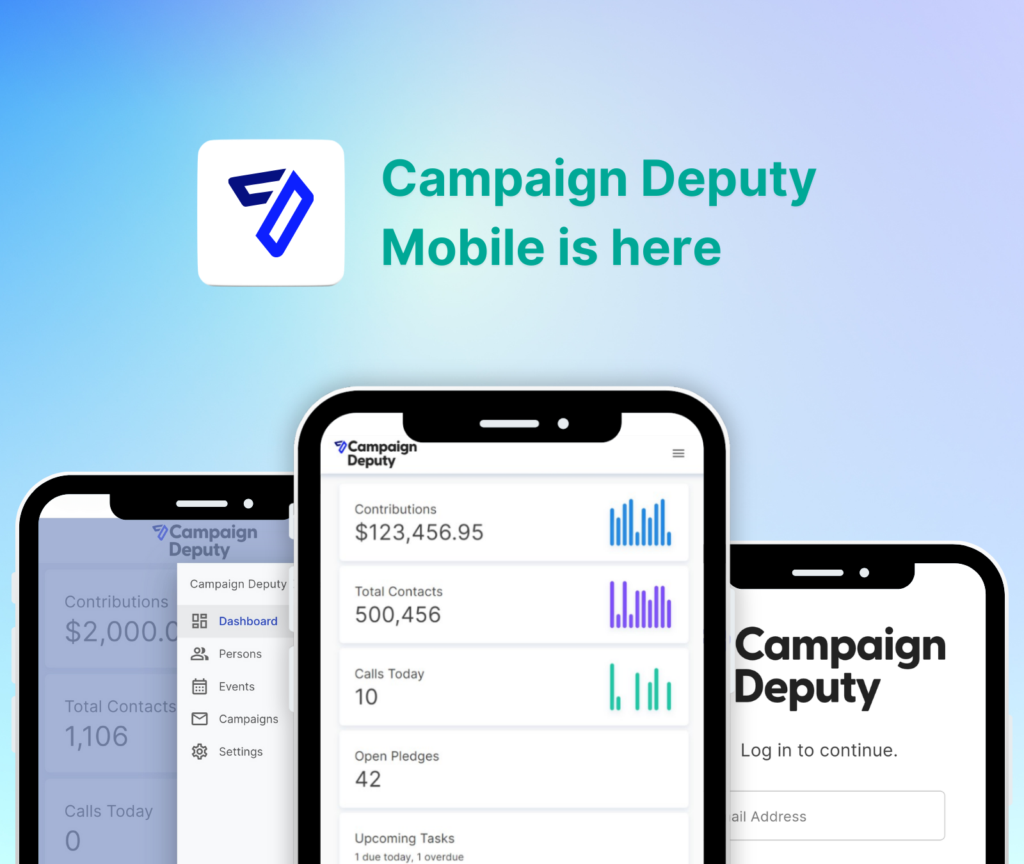
- Campaign Deputy’s call time software logs every dial and dollar automatically, cutting the spreadsheet work first-time candidates dread.
- Congressional and state legislative campaigns need separate call time tracking for prospect tiers – lumping them together kills the ask rate.
Why this matters
Candidates who treat call time as a vague daily obligation raise less than candidates who treat it as a scheduled shift with a start time, an end time, and a list. The difference isn't talent on the phone – it's structure.
A campaign that builds real call time blocks knows exactly how many dials happened this week, how many connects turned into asks, and how much money came out of Tuesday's 9am-noon block versus Thursday's 4-7pm block. Without that structure, campaigns guess. Campaign Deputy's call time tools exist because most first-time candidates lose track of this within the first two weeks of dialing.
What you'll need
- A call sheet or CRM with prospect tiers already sorted by ask amount
- A dedicated phone line or number the candidate is comfortable using for two to four hours at a stretch
- A quiet room with a door – not a shared campaign office where staff can hear every ask
- A written script with your ask amount, your reason for running, and a response to "I need to think about it"
- A way to log dials, connects, and pledges in real time, not from memory at the end of the block
- Calendar blocking software or a shared calendar the candidate and finance director both control
Campaign Deputy's call time software for first-time political candidates handles the list sorting and live logging pieces so the candidate isn't managing a spreadsheet mid-call.
The steps
1. Segment your donor list into tiers before you schedule anything
Call time only works when the list matches the block. Sort contacts into at least three tiers – major donors ($500+), mid-level ($100-499), and grassroots (under $100) – before you put a single block on the calendar.
Mixing tiers in one block means the candidate spends 20 minutes on a $2,500 ask and then rushes a $50 ask in the same energy. Sort first. Schedule second.
Common mistake: starting with the full contact list instead of the warmest 100 names. Cold dials burn morale fast in week one.
2. Set 3-4 hour blocks, not all-day marathons
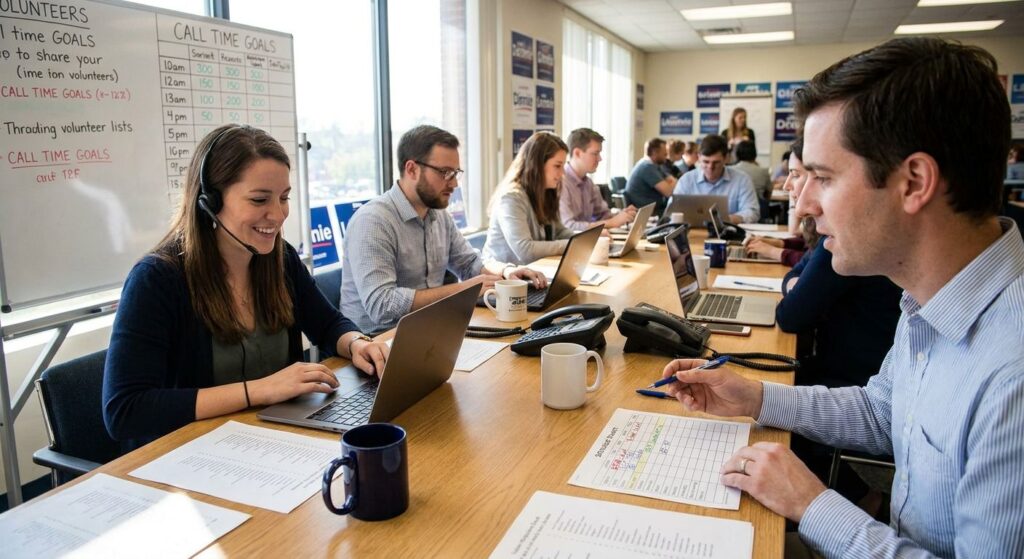
Most campaigns that sustain call time through an entire cycle run blocks of three to four hours, three to five days a week, rather than one long daily grind. Anything past four hours without a break tanks tone and ask confidence.
Put the block on the calendar with a hard start and stop time – 9:00am to 12:30pm, for example – and treat it the same as a debate prep session or a door-knocking shift.
Expected outcome: a candidate who knows exactly when call time starts stops treating it as optional filler between other tasks.
3. Build the target list inside the block, not the night before
Pull 60-100 names for each block from your sorted tiers, weighted toward donors who haven't been asked in the current cycle. Print or load the list before the block starts – never mid-call.
A finance director or call time manager should own this step so the candidate walks in with a ready list every single time.
4. Assign a call time manager to sit in the room
The candidate dials. Someone else tracks. A call time manager logs each dial, marks connect versus voicemail, and records the ask amount and pledge on the spot.
This is the single biggest driver of whether call time data is usable later. Candidates who dial and log their own numbers lose accuracy fast once the pace picks up.
5. Script the ask, the pause, and the follow-up in advance
Write the ask amount into the script by name – "Can I count on you for $250 today?" – rather than a vague "can you help out." Specific numbers convert better than open-ended requests.
After the ask, script a pause. Silence after the number is asked does more work than any follow-up sentence. Train the candidate to stop talking.
Common mistake: candidates who fill the silence after an ask with justification talk the donor out of saying yes.
6. Log every dial in real time, including no-answers
A connect rate of roughly 1 in 4 to 1 in 6 dials is typical for cold-to-warm donor lists, so no-answers and voicemails aren't wasted time – they're data. Log them the same way you log a connect.
Campaign Deputy's best call time software for candidates and campaign staff auto-timestamps each dial so the campaign has a real record instead of a manual tally sheet built after the fact.
7. Review block performance every week, not every month
At the end of each week, compare blocks: which day, which time slot, which tier produced the most pledges per hour. Redirect the candidate's best hours toward the highest-yield tier.
A campaign running for state representative or city council in 2026 has fewer total hours available than a congressional campaign, so this weekly review matters more, not less, when the schedule is tight.
Set up call time in one afternoon
Sorted lists, live dial logging, and pledge tracking built for first-time candidates.
Troubleshooting
The candidate skips or shortens blocks. Put call time on the shared campaign calendar the same way a debate or fundraiser goes on the calendar – a block that isn't visible to staff gets deprioritized within a week.
Connect rates are dropping. Check list freshness first. Donors who were called twice in the last cycle without a follow-up thank-you tend to stop picking up. Rotate the list every two to three weeks.
Asks are happening but pledges aren't converting to actual donations. This is a follow-up gap, not a call time gap. Every pledge needs a same-day or next-day link sent to complete the gift – a web form works better here than a mailed reminder.
The candidate loses confidence mid-block. Shorten the block to two hours and rebuild momentum with warmer, smaller-ask names before returning to the full 3-4 hour schedule.
Staff can't tell which tier drove which dollars. This means tiers weren't tagged before the block started. Go back to step one and re-sort the list before the next session.
Tools and resources
- Call time software for first-time political candidates – sorted lists and live logging for new candidates
- Best call time software for candidates and campaign staff – comparison of features for staff-run call time programs
- Call time tracking for congressional campaigns – built for larger donor universes and multiple call time managers
- A written script template with tiered ask amounts
- A shared calendar the candidate, finance director, and call time manager can all edit
What to do next
Once call time blocks are running on a schedule, the next gap is usually the donation follow-up – pledges that never turn into completed gifts. Pair your call time schedule with a campaign guide for city council candidates if you're still building out the broader fundraising timeline around call time, events, and email asks for the rest of 2026.
FAQ
How long should a call time block be for a political campaign?
Most campaigns run call time blocks of 3 to 4 hours, 3 to 5 days a week. Longer blocks without a break tend to lower connect quality and ask confidence in the final hour.
How many names should be on a call time list per block?
60 to 100 sorted names per block is typical for a single 3-4 hour session. The list should be pulled from tiered donor segments, not the full contact database.
What’s a normal connect rate for campaign call time?
Roughly 1 in 4 to 1 in 6 dials connect on a mixed warm-to-cold donor list. No-answers and voicemails should still be logged since they show which times of day work.
Should the candidate track their own call time numbers?
No. A call time manager should log dials, connects, and pledges while the candidate focuses on the ask. Candidates who self-track lose accuracy once the pace picks up.
Is call time software worth it for a first-time candidate?
Yes, for campaigns doing more than a handful of blocks a week. Manual spreadsheets fall apart once multiple staff or volunteers are logging dials across several sessions.
How do congressional campaigns run call time differently than local races?
Congressional campaigns typically manage a larger donor universe and more call time managers, so tracking needs to separate prospect tiers and staff assignments clearly to avoid double-asks.
What should happen right after a donor pledges on a call?
Send a donation link or web form the same day. Pledges that sit for more than 24 hours without a follow-up link convert at a noticeably lower rate.
How often should a donor call list get refreshed?
Rotate the list every 2 to 3 weeks. Calling the same names repeatedly without a thank-you or update in between drives connect rates down.
One last thing
The candidates who stick with call time through 2026 are the ones who stop treating a "no" as a wasted dial. A no with a reason – wrong time, wrong amount, not yet decided – is data the next call time manager can use to fix the list. Ask, raise, repeat, and log everything, including the calls that don't convert.
Related guides
- Call time software for first-time political candidates
- Best call time software for candidates and campaign staff
- Call time tracking for congressional campaigns
- How to run for city council: a campaign guide
- Campaign Deputy homepage