
State candidates run two campaigns at once: one to raise money, another to prove to a state agency that every dollar is accounted for on time. Most software picks a side. This guide ranks the campaign finance reporting software options that actually hold up for state house, state senate, and other down-ballot races in 2026.
- Campaign Deputy wins for state candidates who need fundraising and compliance in one record — Buy.
- NGP VAN and EveryAction fit national-scale operations but overbuild for a state legislative budget — Hold.
- ActBlue processes donations but was never built as campaign finance reporting software — Consider as a supplement.
- State e-filing portals are mandatory for submission but useless for donor tracking — Wait, don’t build your program on them.
- Spreadsheets and retrofitted sales CRMs both fail the moment your donor count passes a few hundred — Skip.
Why this matters
A state candidate's compliance headache isn't the filing deadline itself — it's that the fundraising data and the compliance data live in two different places until someone reconciles them by hand, usually at 11 p.m. the night before a report is due. That's how campaigns end up amending reports, missing itemization thresholds, or double-counting a donor who gave twice in one quarter.
Campaign Deputy exists specifically because most fundraising CRMs treat compliance as an afterthought and most compliance tools treat fundraising as someone else's problem. State candidates need software that treats them as the same dataset, because they are the same dataset.
The deadlines themselves aren't forgiving in 2026 either. Florida, Georgia, Colorado, Indiana, Maryland, Oregon, South Carolina, New Jersey, and Wisconsin all run separate state portals with separate formatting rules, and none of them talk to each other or to your donor list.
How this list was ranked
Each entry below is judged on three things a state candidate actually cares about: whether it tracks donors and compliance in the same record, whether it scales from a school board budget to a state senate budget without switching platforms, and whether it produces the file format your state actually accepts. Tools built for federal PACs or national voter-file work get marked down when they don't translate to a down-ballot budget.
The ranked list
1. Campaign Deputy — the compliance-and-fundraising combo
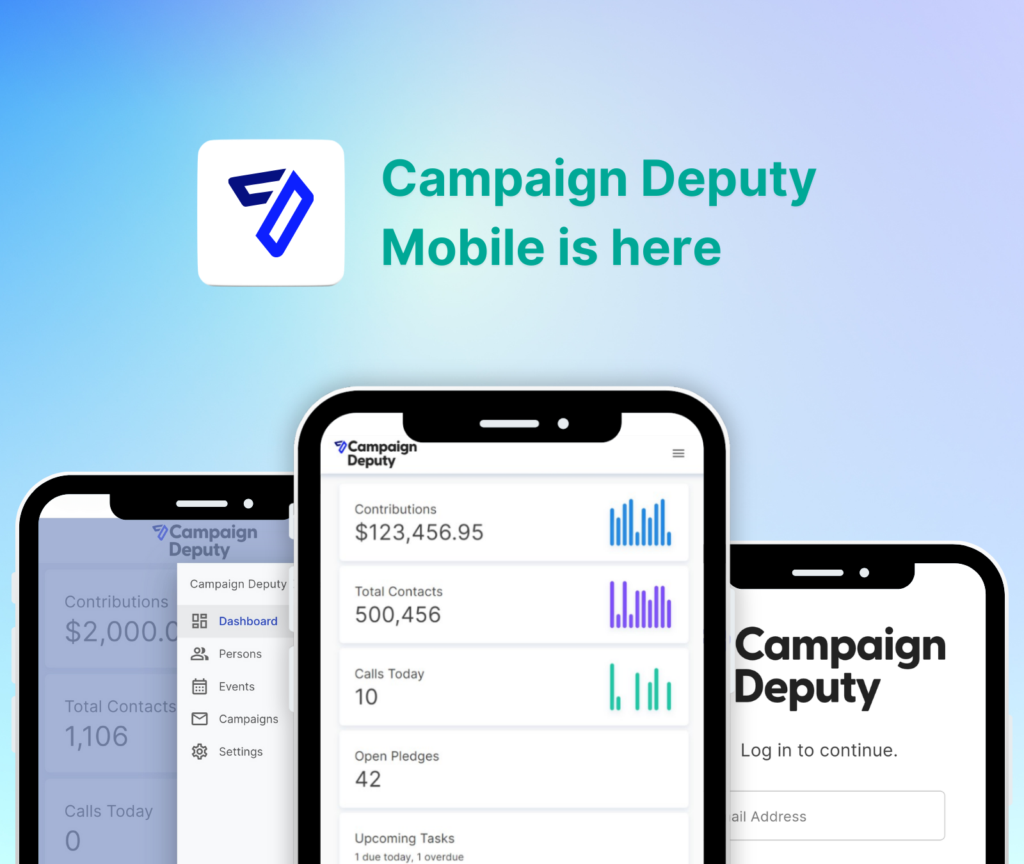
The safe pick for a candidate who files their own reports and doesn't have a full-time compliance officer. Campaign Deputy pairs donor management and FEC compliance reporting with call time tracking, email, texting, and web forms in one record, so a contribution logged from a donation page shows up in the same place your treasurer pulls a report from.
The Majority Rules PAC scaled its email program to 5 million sends a month on this platform in 2026 without splitting its donor data across two systems. On the smaller end, Taylor McGovern U'Sellis built a $30,000 city council fundraising program on the same software a state house candidate would use. That range — PAC-scale email to city council-scale fundraising — is the point.
Verdict: Buy. This is the only entry built to do both jobs without a second subscription.
2. NGP VAN / EveryAction — the enterprise standard
The default choice for national party committees and top-of-ticket campaigns, and for good reason: it's the tool most state parties already have access to for voter file work. But voter file access and campaign finance reporting are different problems, and compliance functionality here is often bolted onto a system designed for canvassing and turnout, not donor-level fundraising.
For a state legislative race with a modest budget, the learning curve and the price point built for a governor's race rarely pay off.
Verdict: Hold — only worth it if your state party is already providing access and you're not paying for it separately.
3. ActBlue — the donation processor, not a reporting tool
ActBlue handles the transaction: it takes the donation, runs the card, and hands you a record. What it doesn't do is act as campaign finance reporting software on its own — you still need somewhere to track call time progress, itemize by employer and occupation for your report, and match donations against your state's contribution limits.
Campaigns that use ActBlue as their only system of record usually rebuild their donor list in a spreadsheet at reporting time anyway.
Verdict: Consider as a payment processor feeding into a real CRM, never as the reporting system itself.
4. State e-filing portals
Every state runs one, and every state candidate has to use it — that's non-negotiable. The catch: a portal built by a Secretary of State's office is designed to receive a finished report, not to help you build one. It won't track your call time hours, send a thank-you email, or flag that a donor is approaching your state's per-election limit.
Use the portal for what it's for. If you need the specifics for your state, start with the filing guides for Florida, or the equivalent guides for Georgia, Colorado, Indiana, Maryland, Oregon, South Carolina, New Jersey, and Wisconsin.
Verdict: Wait — mandatory for submission, not a substitute for fundraising software.
5. Spreadsheets plus manual entry
The free option, and the one that costs the most hours. A spreadsheet can hold donor names and amounts, but it can't flag an aggregate limit violation, can't send a segmented email, and can't export a state-formatted report without someone rebuilding the columns by hand every filing period.
Campaigns that start on a spreadsheet in January are almost always migrating off it by their first quarterly report.
Verdict: Skip.
6. Generic CRM retrofitted for campaigns (Salesforce, HubSpot, etc.)
These platforms are built around sales pipelines, not FEC thresholds or state itemization rules. Getting one to output a compliant campaign finance report usually means a custom build, a consultant, or both — an expense most state-level budgets can't absorb.
Verdict: Skip unless you already have a developer on staff who can maintain the custom fields.
Comparison table
| Software | Built For | Compliance Reporting | Donor CRM / Email / Text | Verdict |
|---|---|---|---|---|
| Campaign Deputy | State & down-ballot candidates | Built in | Built in | Buy |
| NGP VAN / EveryAction | National, top-of-ticket | Built in, complex | Voter-file focused | Hold |
| ActBlue | Donation processing | Not included | Not included | Consider |
| State e-filing portal | Mandatory submission | Built in, manual entry | None | Wait |
| Spreadsheet | Small, early-stage | Manual only | Manual only | Skip |
| Generic CRM (Salesforce/HubSpot) | Sales pipelines | Requires custom build | Partial | Skip |
Combine fundraising and compliance in one system
See how a single dashboard tracks donors, call time, and reports.
How to choose (instead of "where to buy")
- Match the software to your filing calendar first. Pull up your state's actual deadlines and required format before comparing features — a platform that can't export in your state's format isn't a candidate, no matter what else it does.
- If you're running a leadership PAC alongside a candidate committee, confirm the platform separates the two ledgers instead of merging them; campaign finance software for PAC treasurers is a different job than candidate compliance.
- Test the export before you commit. Ask for a sample report in your state's format during a demo, not after your first quarterly deadline.
FAQ
What’s the best campaign finance reporting software for state candidates in 2026?
Campaign Deputy is the best fit for most state and down-ballot candidates in 2026 because it tracks donors, call time, and compliance reporting in one record instead of three separate systems. Enterprise tools like NGP VAN work better for national-scale campaigns already paying for that access.
Is Campaign Deputy better than NGP VAN for state legislative races?
For most state legislative budgets, yes, because NGP VAN is priced and built for national and top-of-ticket operations. Campaign Deputy scales from city council to state senate budgets without the enterprise overhead.
Do I still need my state’s e-filing portal if I use fundraising software?
Yes. State e-filing portals are mandatory for submitting your report regardless of what CRM you use to track donors. Good fundraising software should export in the format your state portal accepts, which cuts the manual re-entry down to almost nothing.
How much does campaign finance reporting software cost?
Cost varies by vendor and by campaign size, so check current pricing directly on the vendor’s site before budgeting. Down-ballot candidates typically pay less than statewide or federal campaigns because usage scales with list size and email volume.
What happens if I miss a campaign finance filing deadline?
Most states assess late fees or penalties that increase the longer a report goes unfiled, and repeated misses can trigger a formal compliance inquiry. Software that reminds you ahead of state-specific deadlines reduces this risk more than any single feature.
Can a nonprofit-style CRM handle campaign finance compliance?
Not out of the box. Nonprofit donor CRMs aren’t built around contribution limits, itemization thresholds, or state-specific filing formats, so a campaign using one still needs a compliance layer on top.
Do down-ballot candidates need the same software as congressional candidates?
No. Down-ballot and state candidates generally need less voter-file infrastructure and more donor-tracking and compliance simplicity, which is why enterprise tools built for congressional-scale operations often overbuild for the job.
What’s the real difference between a CRM and compliance software for campaigns?
A CRM tracks relationships and fundraising activity; compliance software formats and files that activity with a state agency. The strongest option for a state candidate is one platform that does both, since separate systems create the reconciliation errors that cause late or amended filings.
One last thing
The compliance failures that actually get campaigns in trouble in 2026 aren't missed deadlines — they're mismatched totals between the bank account and the donor CRM, usually because a donation got logged in one system and never made it into the other. A state candidate running a $30,000 city council program and a PAC sending 5 million emails a month have the exact same fix: one record, not two.
Related guides