Volunteer shift scheduling software for GOTV campaigns is a system for assigning canvassers, phone bankers, and poll greeters to specific time blocks and turf during the final push before Election Day, so every precinct gets covered without double-booking or gaps. GOTV scheduling is different from a normal volunteer calendar because the window is short, the volunteer pool spikes fast, and every shift ties directly to a turf-cut list or dialer file, not to a year-round program.
- Volunteer shift scheduling software for campaigns only pays off once you’re running more than one GOTV weekend.
- Free spreadsheets and SignUpGenius handle GOTV programs under 20 volunteers; bigger operations need built-in confirmations.
- Confirmation texts, not sign-up sheets, are what actually stop no-shows during the 72-hour program.
- Campaign Deputy pairs volunteer shift sign-ups with the same donor and texting data your campaign already runs, useful if you’re already on the platform for call time.
Why this matters for GOTV campaigns
GOTV programs run on a compressed clock: the final four to six weekends before Election Day, capped by the 72-hour program that runs from the Friday before to poll close. Every empty canvass block or phone bank shift in that window is turf that doesn't get walked and voters who don't get a reminder call.
Most campaigns run field and finance through the same small staff, which means the person building the GOTV shift calendar is often the same person pulling call time blocks or sending donor texts earlier in the day. A volunteer coordination software approach that sits apart from everything else the campaign runs means double data entry at the exact moment staff have the least time for it.
Volunteers who sign up for a single canvass block also no-show at a higher rate when there's no confirmation step between sign-up and shift start. A public sign-up sheet with no reminder built in looks full on paper and half-empty on the ground.
Set up your GOTV volunteer shift calendar
Map your shift calendar to the turf plan
Build shifts around precincts and turf cuts, not around a generic daily calendar. A campaign that schedules "Saturday canvass" without tying it to specific walk lists ends up with volunteers doubling up on easy turf and skipping the harder precincts.
- Break canvass and phone bank windows into 2-3 hour blocks tied to a specific turf cut or dial list
- Name a shift captain per block, not per day, so someone owns coverage
- Build buffer shifts into the 72-hour program for last-minute redeployment
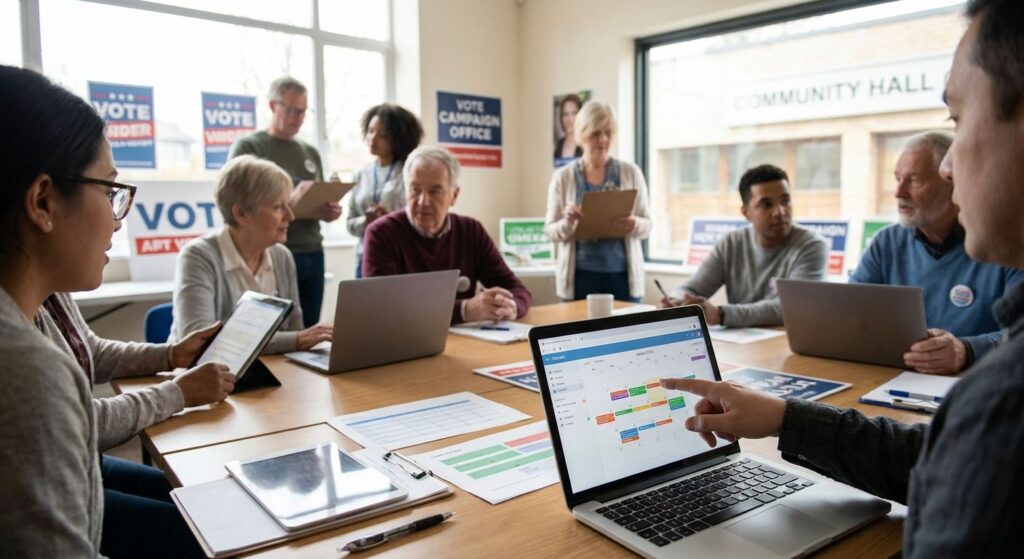
- Color-code a shared calendar by precinct so gaps are visible at a glance
- Lock the shift structure at least two weeks before the first GOTV weekend
Build a public sign-up sheet
Start with a free tool. A Google Form, a SignUpGenius page, or a shared spreadsheet link handles the first version of shift sign-ups without any budget commitment.
- List every shift type separately: canvassing, phone banking, poll greeting, rides to polls, data entry
- Cap sign-ups per shift so one time slot doesn't fill while others sit empty
- Require a phone number at sign-up, not just an email address
- Keep the form to under five fields so mobile sign-up doesn't drop off
- Publish the link everywhere the campaign already asks for volunteers: text blasts, social, canvass kickoffs
Confirm shifts and send reminders
A sign-up isn't a commitment until it's confirmed. This is the step most campaigns skip, and it's the single biggest driver of no-shows on GOTV weekends.
- Send a confirmation text or email the moment someone signs up
- Send a reminder the morning of the shift and again two hours before
- Track confirmed versus unconfirmed in a simple status column
- Flag no-shows immediately so a captain can backfill the block
- Ask volunteers to reply YES to confirm rather than just reading a reminder
A manual version of this works with a shared spreadsheet and a group text thread, but it takes someone watching it in real time all weekend. The texting platform for get-out-the-vote campaigns page covers what a dedicated texting tool handles instead of a staffer refreshing a spreadsheet.
Track turf coverage in real time
Once shifts are confirmed, the calendar becomes a coverage map. The goal is spotting an understaffed precinct 48 hours out, not after Election Day.
- Cross off precincts as shifts fill so gaps are visible immediately
- Flag any precinct under 50% shift coverage two days before its window
- Log no-shows by precinct for a post-election debrief
- Reassign confirmed volunteers from overstaffed blocks to gaps
A canvassing app for door-to-door campaign teams syncs turf assignments to the shift roster so field staff see coverage gaps without cross-checking two spreadsheets.
Coordinate phone bank shifts on their own cadence
Phone banks turn over faster than canvass shifts and pull from a different volunteer pool, often people who can't walk turf but can dial for two hours from home.
- Run phone bank shifts in shorter blocks than canvass shifts
- Track dial and contact rates by shift so you know which time blocks reach voters
- Rotate volunteers off high-decline-rate shifts to protect morale
- Keep phone bank sign-ups on the same public form as canvassing so nobody double-books
Phone banking software for political campaigns pairs dialer lists to specific shift blocks, which matters once a campaign runs both canvass and phone shifts in the same weekend.
Debrief and re-recruit after every shift
A GOTV program that treats each shift as a one-off loses volunteers between weekends. The campaigns that hold volunteers through the full 2026 cycle close the loop the same day.
- Send a same-day thank-you text with an invite to the next shift
- Text no-shows once, ask what happened, no guilt
- Roll high performers into shift captain roles for the following weekend
- Track repeat volunteers separately so recruiting effort goes toward new sign-ups, not people who already show up
Reconcile hours against the field budget
GOTV hours need to reconcile against the field budget, especially on campaigns mixing paid canvassers with volunteers.
- Log volunteer hours against turf covered so cost-per-door or cost-per-dial is visible
- Separate paid staff hours from volunteer hours for compliance and finance reporting
- Compare hours logged against shifts confirmed to catch scheduling drift early
Comparing shift scheduling options for GOTV campaigns
| Option | Best for | Key limitation |
|---|---|---|
| Spreadsheet + shared calendar | Campaigns under 20 volunteers running one GOTV weekend | No automatic reminders or confirmations; someone has to update it live |
| SignUpGenius or similar free tool | Campaigns that just need a public sign-up link | Sign-ups live outside your donor or voter file, so there's no shared record of who actually showed |
| Dedicated canvassing or phone bank app | Campaigns running daily canvasses across multiple precincts | Strong on turf and dials, weak on tying volunteer data back to finance or donor tools |
| Campaign Deputy volunteer coordination | Campaigns already running call time, texting, or donor data through the platform | Built to sit alongside donor and voter contact tools, not a standalone dialer replacement |
Verdict: use a free spreadsheet for a single GOTV weekend under 20 volunteers, and move to a connected system once you're running multiple weekends with paid and volunteer staff mixed on the same shifts.
“If a shift doesn’t have a confirmation text attached to it, treat it as an empty shift.”
Common mistakes GOTV campaigns make
- Scheduling by day instead of by turf. "Saturday canvass" without a precinct attached leaves easy turf double-covered and hard turf untouched.
- No confirmation step. A full sign-up sheet with no reminder text still shows up as a half-empty parking lot on shift day.
- Running canvass and phone bank sign-ups on separate forms. The same volunteer ends up double-booked for a Saturday canvass and a Saturday phone bank.
- Not separating paid canvassers from volunteers in the hours log. This creates a mess for compliance and finance reporting after the fact.
- Waiting until the 72-hour program to build the calendar. Campaigns that test the sign-up and confirmation flow during earlier canvass weekends catch no-show problems before the window that actually matters.
Coordinate volunteers and donors in one place
See how Campaign Deputy connects volunteer coordination to your fundraising data.
FAQ
What’s the best volunteer shift scheduling software for campaigns?
For a single GOTV weekend under 20 volunteers, a free spreadsheet or SignUpGenius link is enough. Campaigns running multiple GOTV weekends with mixed paid and volunteer staff need a system with built-in confirmations and turf tracking, which is where dedicated field or CRM-connected tools take over.
Is a free spreadsheet enough for GOTV shift scheduling?
Yes, for a small program with one canvass weekend and under 20 volunteers. Once a campaign runs phone banks and canvassing in parallel across multiple weekends, a spreadsheet alone can’t send confirmations or flag no-shows in real time.
How do I stop volunteer no-shows on GOTV shifts?
Send a confirmation text the moment someone signs up, then a reminder the morning of the shift and again two hours before. Campaigns that skip the confirmation step see sign-up sheets look full while actual shift attendance runs well under capacity.
What’s the difference between phone banking software and shift scheduling software?
Phone banking software manages the dialer list and call outcomes for a shift. Shift scheduling software manages who’s working which block and whether they showed up. GOTV programs need both connected so dial rates can be tracked back to specific shifts.
How much does volunteer shift scheduling software cost?
Free tools like Google Forms or SignUpGenius cost nothing. Paid options range from standalone field apps to platforms bundled with a campaign’s CRM; check current pricing directly with each vendor since it varies by campaign size.
Can I run GOTV shift scheduling and donor calls from the same platform?
Some fundraising CRM platforms, including Campaign Deputy, offer volunteer coordination alongside call time and texting tools, so shift data and donor data live in the same system instead of two disconnected spreadsheets.
Do I need a separate app for canvassing versus phone banking?
Not necessarily, but the two need different shift lengths and volunteer pools. Keep sign-ups on one shared form so a volunteer can’t double-book a canvass block and a phone bank shift at the same time.
When should a campaign build its GOTV shift calendar?
At least two weeks before the first GOTV weekend, and test the sign-up and confirmation flow on an earlier canvass before relying on it for the 72-hour program.
One last thing
Build the shift calendar backward from Election Day, not forward from the day volunteers start signing up. Campaigns that plan forward tend to overstaff the first GOTV weekend and scramble to fill the 72-hour program; planning backward from poll close forces the hardest-to-fill shifts onto the calendar first, when there's still time to recruit for them.
Related guides
- Texting platform for get-out-the-vote campaigns
- Best political campaign software for state and local elections