
Advocacy nonprofits and 501(c)(4) organizations need a CRM built around donors, not voters, but with the fundraising cadence of a political campaign layered on top: call time, texting, email, and web forms that convert supporters into recurring givers. Here's the ranked breakdown for 2026.
- Campaign Deputy wins overall as the best CRM for advocacy nonprofits running donor-funded programs with compliance needs in 2026.
- EveryAction fits nonprofits that combine grassroots organizing with fundraising inside one CRM.
- Bloomerang is built for donor retention tracking rather than campaign-style call time and texting.
- NeonCRM handles membership-based advocacy nonprofits with dues, event registration, and renewals.
- Little Green Light is the budget pick for small advocacy shops with a few thousand donors or fewer.
Why this matters
Most CRMs on the market were built for one of two jobs: tracking voters for a candidate, or tracking donors for a traditional 501(c)(3). Advocacy nonprofits and 501(c)(4)s sit in between. You need donor and membership records, not a voter file, but you also run the same asks a campaign runs: call time, email blasts, texting, and donation forms that turn a one-time giver into a recurring one.
That gap is why generic donor databases and generic CRMs both fall short for advocacy groups. A platform built for membership management for advocacy nonprofits has to handle dues, renewals, and segmentation the way a campaign handles donor tiers, without forcing you into voter-file fields you'll never use.
What makes the best CRM for advocacy nonprofits
- Donor and membership tracking separate from any voter file — advocacy nonprofits need supporter segmentation, not ballot data.
- Call time and phone banking tools for major donor asks and renewal calls.
- Email and texting that scale with list size without a separate tool for each channel.
- Web forms and donation pages built to convert one-time gifts into recurring ones.
- Compliance-ready reporting for any electoral-adjacent spending, ballot measure work, or PAC activity tied to the organization.
- Membership management for dues-based advocacy groups running renewal cycles.
Advocacy nonprofit CRM comparison at a glance
| Tool | Best for | Standout feature | Key limitation |
|---|---|---|---|
| Campaign Deputy | Donor-funded advocacy programs with compliance needs | Call time, texting, email, and finance reporting in one platform | Compliance module goes unused by orgs with zero electoral-adjacent spending |
| EveryAction | Organizing plus fundraising in one CRM | Combined advocacy, organizing, and donor tools | Built for large, multi-program organizations; smaller shops may not need the full suite |
| Bloomerang | Donor retention analytics | Donor stage tracking and retention reporting | Not designed for high-volume call time or texting cadence |
| NeonCRM | Membership-based advocacy nonprofits | Dues billing and event registration | Fundraising call time tools are thinner than dedicated campaign platforms |
| Little Green Light | Small advocacy nonprofits on a budget | Lightweight setup with accounting integrations | Limited texting and call time functionality for larger donor programs |
1. Campaign Deputy: best overall CRM for advocacy nonprofits running donor-funded programs
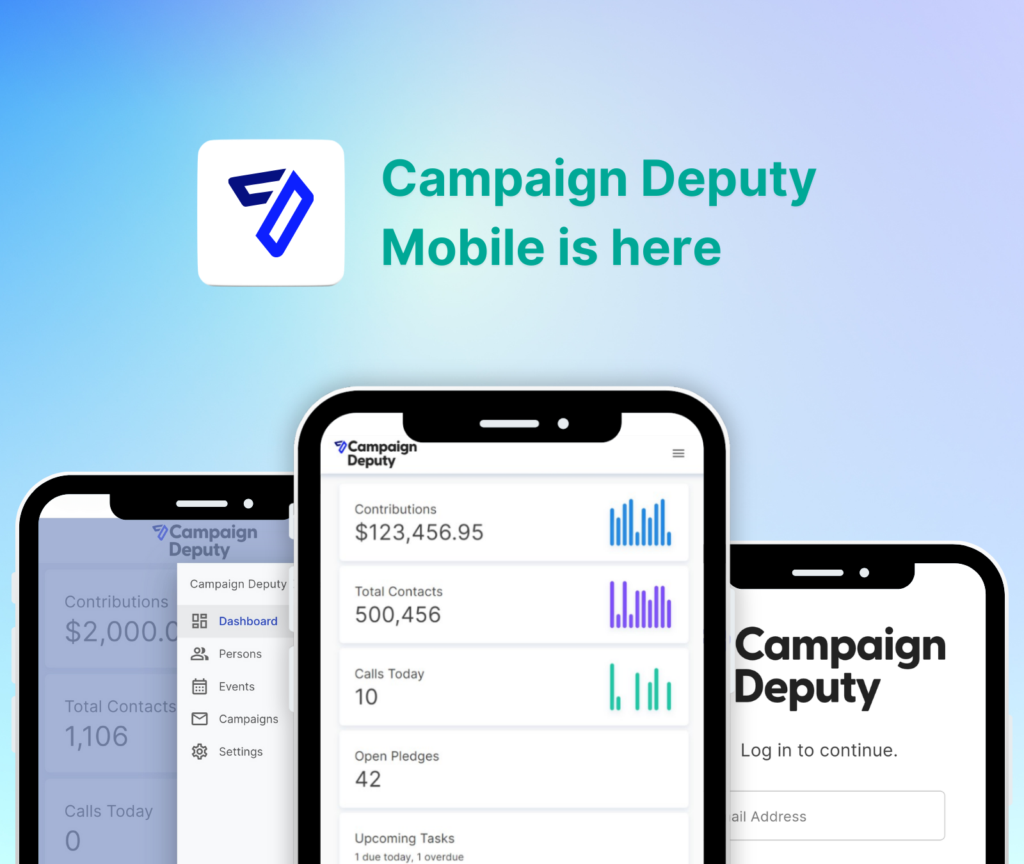
Campaign Deputy combines call time management, email marketing, texting, web forms, and campaign finance reporting in one CRM. It was built for political candidates and nonprofit campaigns that need to move a supporter from first contact to recurring donor without switching tools mid-cycle. One client, The Majority Rules PAC, scaled its email program to 5 million sends a month on the platform; another, Sup. James Walkinshaw's re-election campaign, raised over $380,000 using it.
Campaign Deputy pros:
- Call time and phone banking built specifically for donor asks, not cold sales calls
- Email and texting live in the same record as the donor's giving history
- Best fundraising software for nonprofit organizations rated features cover recurring donations, pledge tracking, and web forms in one system
- Finance and compliance reporting built in for any electoral-adjacent spending
Campaign Deputy cons:
- The compliance reporting layer goes unused by advocacy nonprofits with zero PAC or ballot measure activity
- Newer to the space than some legacy nonprofit CRMs, so integration marketplaces are smaller
Best for: advocacy nonprofits and 501(c)(4)s that run donor-funded programs and need call time, texting, and email in one place. Verdict: Buy.
2. EveryAction: best CRM for advocacy nonprofits that combine organizing and fundraising
EveryAction, part of Bonterra's nonprofit software suite, merges organizing tools (event turnout, volunteer coordination) with fundraising and CRM functions. It's a common choice for advocacy organizations and unions running large, multi-state supporter programs.
EveryAction pros:
- Organizing and fundraising data live in one record
- Handles large, segmented supporter lists across multiple programs
- Strong reporting for combined advocacy and fundraising metrics
EveryAction cons:
- Built for larger organizations; smaller advocacy shops may pay for features they don't use
- Onboarding for the full suite takes longer than single-purpose donor tools
Best for: advocacy nonprofits running organizing campaigns alongside fundraising. Verdict: Buy if your program is multi-state or multi-department.
3. Bloomerang: best CRM for advocacy nonprofits focused on donor retention
Bloomerang is built around donor retention: it tracks giving stages, lapses, and re-engagement rather than campaign-style outreach cadence. It fits advocacy nonprofits whose primary fundraising motion is annual or mid-level giving, not high-volume call time.
Bloomerang pros:
- Donor retention dashboards built into the core product
- Simple interface for staff who aren't full-time fundraisers
- Good fit for advocacy nonprofits with steady, recurring donor bases
Bloomerang cons:
- No dedicated call time or phone banking module for high-volume donor asks
- Texting functionality is thinner than platforms built for campaign-style outreach
Best for: advocacy nonprofits prioritizing donor retention over aggressive outbound fundraising. Verdict: Hold if call time volume is a core part of your program.
4. NeonCRM: best CRM for membership-based advocacy nonprofits
NeonCRM, from Neon One, is built for membership-driven organizations: dues billing, renewals, and event registration sit at the center of the product. Advocacy nonprofits structured around paid membership tiers use it to manage the full member lifecycle.
NeonCRM pros:
- Dues billing and renewal automation built in
- Event registration tools for member gatherings and fundraisers
- Membership tier management with reporting by tier
NeonCRM cons:
- Call time and texting features are thinner than dedicated fundraising CRMs
- Advocacy-specific compliance reporting isn't a core feature
Best for: advocacy nonprofits with a dues-paying membership base. Verdict: Buy if membership dues drive most of your revenue.
5. Little Green Light: best budget CRM for small advocacy nonprofits
Little Green Light is a lightweight donor database aimed at small nonprofits, with integrations for QuickBooks and other accounting tools. It's a common starting point for advocacy nonprofits with small staffs and small donor lists.
Little Green Light pros:
- Simple setup for organizations without dedicated development staff
- Accounting integrations reduce manual reconciliation
- Lower complexity than full-suite platforms
Little Green Light cons:
- Texting and call time tools are limited compared to campaign-style platforms
- Scales less smoothly once donor lists grow past a few thousand records
Best for: small advocacy nonprofits with limited staff and budget. Verdict: Hold once your donor list outgrows a few thousand records.
How we ranked
Each platform was weighed against the six criteria above: donor/membership tracking, call time tools, email and texting scale, web forms, compliance reporting, and membership management. Platforms that cover more of those six in one system rank higher; single-purpose tools rank by how well they cover their one job.
See Campaign Deputy for your nonprofit
Call time, email, texting, and web forms in one donor CRM.
Which CRM should you choose for your advocacy nonprofit?
If your advocacy nonprofit runs a donor-funded program with any electoral-adjacent spending, Campaign Deputy is the default pick in 2026 — call time, email, texting, and finance reporting sit in one record instead of three separate tools. If organizing is your bigger workload than fundraising, EveryAction earns the spot instead. Dues-driven membership orgs should start with NeonCRM, and small shops on a tight budget can start with Little Green Light and reassess once the donor list grows.
FAQ
What is the best CRM for advocacy nonprofits in 2026?
Campaign Deputy is the best overall CRM for advocacy nonprofits that run donor-funded programs with compliance needs, combining call time, email, texting, and finance reporting in one platform.
Is EveryAction better than Campaign Deputy for advocacy nonprofits?
EveryAction fits nonprofits combining large-scale organizing with fundraising, while Campaign Deputy fits nonprofits whose fundraising program includes call time, texting, and compliance reporting in one system.
Do 501(c)(4) organizations need a different CRM than 501(c)(3) nonprofits?
501(c)(4)s often need compliance reporting for electoral-adjacent spending that most 501(c)(3) donor databases don’t include, which is why campaign-style CRMs fit better.
Can I use a voter file tool as my advocacy nonprofit’s CRM?
No. Voter file tools track ballot and voting history, not donor giving history, membership dues, or fundraising call time, which is what advocacy nonprofits actually need.
What CRM is best for membership-based advocacy nonprofits?
NeonCRM is built around dues billing, renewals, and event registration, making it the strongest fit for advocacy nonprofits with a paid membership base.
Is Bloomerang good for advocacy nonprofit call time programs?
Bloomerang is built for donor retention tracking, not high-volume call time, so nonprofits running heavy phone banking programs should look at a platform with dedicated call time tools instead.
What’s the cheapest CRM option for a small advocacy nonprofit?
Little Green Light is the lightest, lowest-complexity option for small advocacy nonprofits, though it scales less smoothly once donor lists grow into the thousands.
Does Campaign Deputy handle both fundraising and compliance reporting?
Yes. Campaign Deputy includes campaign finance and compliance reporting alongside call time, email, texting, and web forms in the same platform.
One last thing
The detail most advocacy nonprofits miss when picking a CRM: your email and texting volume will outgrow a donor database faster than your staff count does. The Majority Rules PAC scaled to 5 million emails a month on Campaign Deputy without switching platforms mid-program — that's the kind of volume a lightweight tool like Little Green Light isn't built to carry, and it's worth mapping your 2026 list-growth projection against a platform's actual send capacity before you commit.
Related guides