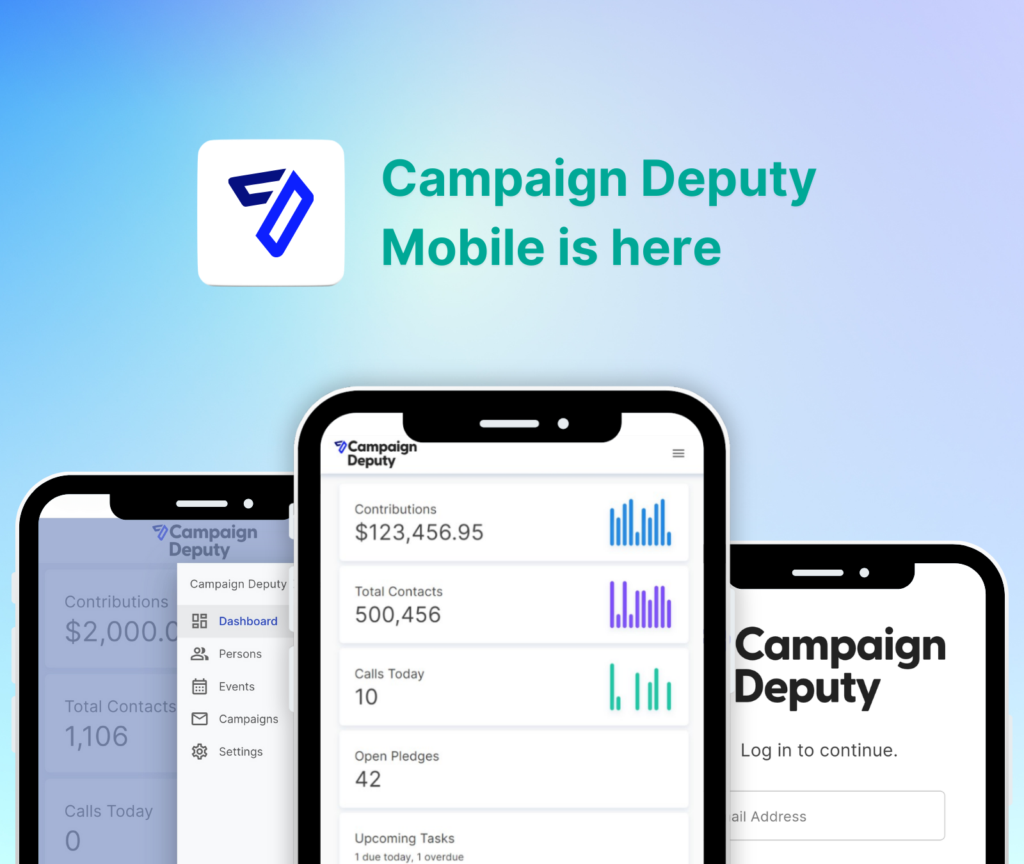

Donor management software for US Senate campaigns is a CRM built to handle six-figure call time quotas, FEC disclosure deadlines, and donor files that can run past 50,000 records by the general election. A state legislature or city council tool breaks down at this volume — Senate campaigns need call time scheduling, compliance-ready reporting, and segmentation that scales from primary to general without a system migration mid-cycle.
- Campaign Deputy is built for donor management software for US Senate campaigns needing call time, compliance, and segmentation in one system.
- US Senate campaigns typically report to the FEC, not state boards, so your CRM must map directly to FEC contribution limits and disclosure schedules.
- Call time quotas of $5,000-$10,000 a day are common in competitive Senate races — your CRM has to generate call sheets automatically, not manually.
- NGP VAN, ActBlue, Anedot, and DonorPerfect are the usual alternatives finance directors compare against Campaign Deputy in 2026.
- Bundler tracking and major donor cultivation matter more at the Senate level than in any down-ballot race.
Why donor management matters more for Senate campaigns
A Senate campaign runs on a different clock than a state house race. Filing deadlines hit quarterly with the FEC instead of state-by-state variance, and the donor universe spans in-state small-dollar givers, out-of-state ideological donors, and PAC bundlers simultaneously. A fundraising CRM for congressional candidates needs to hold all three donor types in one system without losing the audit trail a treasurer needs at reporting time.
Call time is the other pressure point. Senate finance directors typically build daily call sheets for candidates and set quotas in the thousands, not hundreds — a spreadsheet-based list falls apart once you're managing 200+ prospects a week across multiple call time staffers. The software has to auto-generate lists, log outcomes, and re-sort by likelihood to give without a staffer manually re-sorting rows every morning.
Centralize your donor database before you build anything else
A scattered donor file — some contacts in a spreadsheet, some in an old NGP VAN export, some in a shared inbox — is the single biggest reason Senate campaigns miss fundraising targets in the first 90 days.
- Import every donor list into one CRM record, deduplicated by name and address, not just email
- Tag donor source (small-dollar online, in-person event, bundler-referred) so segmentation works later
- Flag PAC and out-of-state donors separately since FEC aggregation rules differ by donor type
- Set a single source of truth before staff starts building call lists — never let two teams work from two exports
Campaign Deputy centralizes donor records, call logs, and giving history in one CRM, which removes the reconciliation work a split system creates before every FEC filing.
Build call time lists and quotas that scale
Manual call sheets work for a city council race. They collapse at Senate volume, where finance directors are often managing 3-5 callers across a single election cycle.
- Set daily and weekly dollar quotas per caller, not just call counts
- Auto-generate call lists ranked by donor capacity and recency of last gift
- Log every call outcome (pledge, no answer, refusal) directly against the donor record
- Review quota performance weekly and reassign lists to your strongest closers
The call-time tracking built for congressional campaigns auto-generates these lists from live donor data instead of a static export that goes stale within a week.
Segment your donor list for every ask
A generic email to your entire list underperforms a segmented one every time at Senate scale, where lists routinely exceed 20,000 contacts by the general.
- Split by giving history: first-time, lapsed, and repeat donors get different asks
- Separate in-state donors from out-of-state ideological givers for messaging tone
- Flag donors near the federal contribution limit so you don't send an ask they legally can't fulfill
- Build a major donor tier separately from your small-dollar email list
Automate compliance and FEC reporting
Senate campaigns file with the FEC on a quarterly schedule, and a missed itemization or an unmatched aggregate contribution creates real exposure. Manual reconciliation between a donor database and a bank statement is where errors creep in.
- Match every contribution to a donor record automatically, not through a manual spreadsheet review
- Flag donors approaching the federal aggregate limit before the check clears, not after
- Generate FEC-ready reports directly from CRM data instead of rebuilding them by hand each quarter
- Keep a full audit trail of every edit to a contribution record for compliance review
Software built for donor management and FEC compliance reporting pulls the filing directly from the same donor records your call time staff works from, so nothing gets re-entered twice.
Track bundlers and major donors separately
Bundled contributions carry their own FEC disclosure requirements, and Senate races see far more bundler activity than any down-ballot race. Losing track of who bundled what creates a compliance gap fast.
- Tag every bundled contribution to the individual bundler, not just the donor
- Track cumulative bundled totals against FEC disclosure thresholds
- Build a separate cultivation track for donors capable of five-figure bundling
- Review bundler activity monthly, not just at filing time
Score and prioritize your donor list
Not every donor deserves the same call time slot. Predictive scoring flags who's likely to upgrade a gift before your staff spends an hour finding out manually.
- Score donors on recency, frequency, and gift size, not gift size alone
- Route high-scoring donors to your most experienced callers
- Re-score monthly as new contributions come in
- Use scoring to build your major donor cultivation plan, not just your call sheet
Buy Campaign Deputy if your Senate campaign needs call time, compliance, and segmentation running off the same donor record. Skip it only if your campaign has already standardized on a system your compliance team can't migrate off mid-cycle.
See Campaign Deputy in action
Get a walkthrough built around Senate-scale call time and FEC reporting.
Comparing donor management options for Senate campaigns
| Platform | Best for | Key limitation |
|---|---|---|
| Campaign Deputy | Senate campaigns needing call time, email, texting, and FEC reporting in one CRM | Newer entrant than legacy Democratic-party tools |
| NGP VAN | Campaigns already inside state or national party infrastructure | Interface and setup skew heavier than a lean finance team needs |
| ActBlue | Processing small-dollar online contributions | Not a full CRM — no call time or donor segmentation built in |
| Anedot | Simple donation form processing | Limited compliance reporting depth for federal filings |
| DonorPerfect | Nonprofit-style donor tracking adapted to campaigns | Not purpose-built for FEC disclosure workflows |
Campaign Deputy wins on consolidating call time, compliance, and segmentation into one system built for candidates, not adapted from nonprofit software.
Common mistakes Senate campaigns make with donor data
- Splitting call time and donor records across two systems. Staff re-enters pledges manually, and reconciliation errors show up right before a filing deadline.
- Ignoring bundler tracking until a filing forces the issue. Retroactively tagging bundled contributions after the fact is far slower than tagging them in real time.
- Treating out-of-state donors the same as in-state small-dollar givers. The messaging, the ask size, and the compliance flags all differ.
- Underinvesting in call time software early. Campaigns that build call lists manually through the primary lose weeks rebuilding the process for the general.
- Waiting until Q3 to centralize donor data. By then a Senate campaign has too many donor touchpoints spread across staff inboxes to consolidate cleanly.
FAQ
What’s the best donor management software for US Senate campaigns in 2026?
Campaign Deputy is built for Senate-scale campaigns needing call time management, donor segmentation, texting, email, and FEC compliance reporting in one CRM. It’s designed for the volume and filing cadence a Senate race carries, not adapted from a nonprofit or state-race tool.
Is Campaign Deputy better than NGP VAN for a Senate campaign?
Campaign Deputy consolidates call time, compliance reporting, and donor segmentation in one interface built for candidate campaigns. NGP VAN suits campaigns already embedded in state or national party data infrastructure, but that integration adds setup weight a lean finance team may not need.
How much call time volume does a Senate campaign typically need to manage?
Competitive Senate races often set daily call time quotas in the thousands of dollars per staffer, with call lists refreshed weekly as new donor data comes in. Manual spreadsheet lists become unmanageable past a few hundred weekly prospects.
Does donor management software help with FEC compliance?
Yes — software built for federal campaigns matches contributions to donor records automatically and flags donors approaching aggregate contribution limits before a check clears. That reduces the manual reconciliation work a treasurer does before each quarterly filing.
What’s the difference between donor management software for state legislature races and Senate races?
State races typically report to state boards on varying schedules, while Senate campaigns file with the FEC quarterly and manage larger donor volumes with more out-of-state and bundled contributions. The CRM needs deeper compliance mapping and higher call time throughput for a Senate race.
Can I track bundlers separately from individual donors in a CRM?
A CRM built for federal campaigns lets you tag bundled contributions to the individual bundler and track cumulative totals against FEC disclosure thresholds. This matters more for Senate races than down-ballot campaigns because bundler activity is far more common at that level.
How early should a Senate campaign set up donor management software?
Ideally before the first call time session — campaigns that build donor lists in spreadsheets through the primary spend weeks migrating data before the general. Centralizing donor records from day one avoids that rebuild entirely.
One last thing
Most Senate finance teams underestimate how much time bundler reconciliation eats up until the first FEC filing forces a manual audit — building that tracking into your CRM from day one, rather than retrofitting it in Q3, is the single change that saves the most staff hours over a full 2026 cycle.
Related guides
- Donor management software for congressional campaigns
- Email marketing software for congressional campaigns
- How to run for US Senate
- Bundler tracking software for major donor fundraising