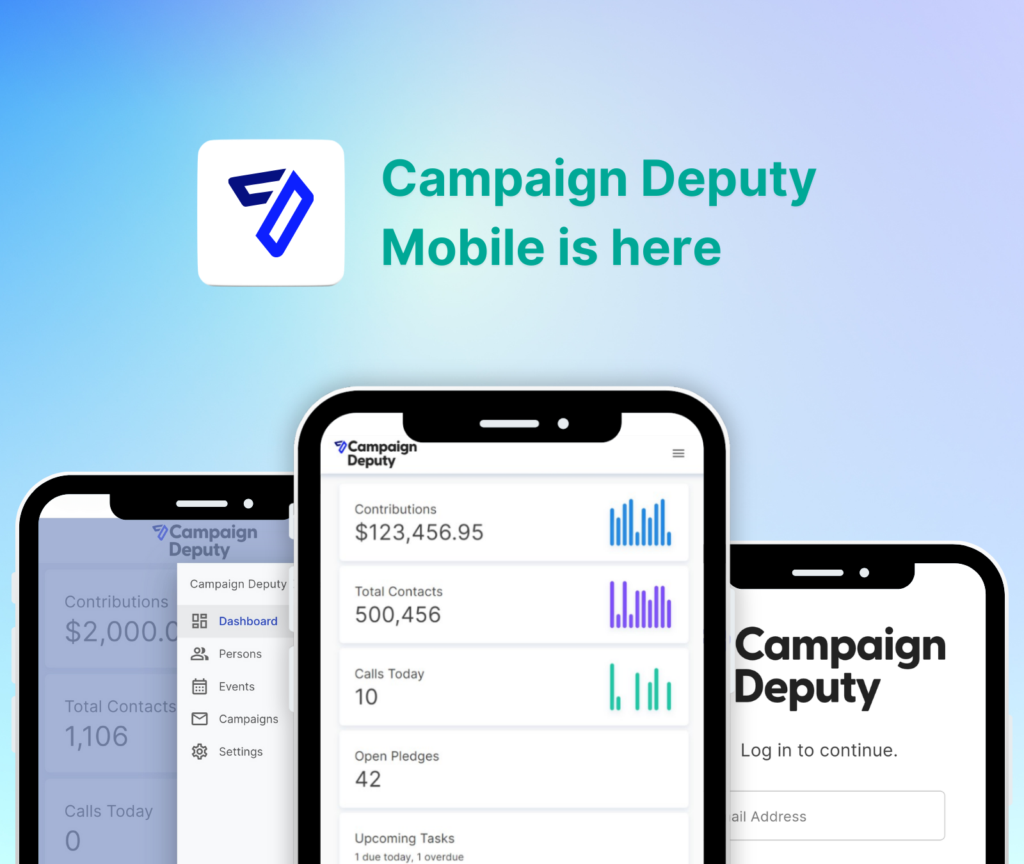

Email marketing for gubernatorial campaigns is the practice of building, segmenting, and sending fundraising and mobilization emails to donor and supporter lists across an entire state, with the aim of turning statewide name recognition into a repeatable small-dollar revenue stream. A governor's race spans dozens of media markets and hundreds of thousands of potential donors, so the list, segmentation, and compliance work look nothing like a city council or state house campaign running out of one district.
- Email marketing for gubernatorial campaigns needs statewide list segmentation by media market, not just by donor size.
- Campaign Deputy pairs email sends with call time and texting so finance directors run one donor record, not three.
- Compliance-friendly subject lines and disclaimers matter more at the gubernatorial level because opposition trackers read every send.
- A 2026 statewide campaign sending to 200,000+ names needs deliverability monitoring, not just a bigger list.
Why email marketing matters for gubernatorial campaigns
A gubernatorial race raises money from donors who have never met the candidate and never will. Email is the only channel that scales to reach a $2 million, $20 million, or $100 million-plus budget without a call-time staffer dialing every name by hand. Statewide campaigns also face more press scrutiny than local races, which means every subject line, every disclaimer, and every unsubscribe link gets screenshotted if it looks careless.
The finance director running email for a governor's race in 2026 is managing a list that spans conservative and urban counties, in-state and out-of-state donors, and multiple giving tiers from $5 grassroots gifts to max-out checks. Treating that list as one undifferentiated batch is the single biggest reason gubernatorial email programs underperform their fundraising goals.
Build your donor list before you need it
Most campaigns start emailing too late, after the filing deadline is already close and the candidate has done three fundraisers with no list-capture plan. A statewide campaign that wants five- and six-figure email months by the general election needs list-building work starting at launch.
- Capture emails at every kickoff event, county fair booth, and door-knock, not just online forms
- Import call-time call sheets into the CRM so every donor who picked up the phone also gets emailed
- Run a paid list-growth ad in the first 90 days rather than waiting for organic sign-ups
- Set up a web form on every page of the campaign site, not just the donate page
- Cross-reference county voter files against your list to flag gaps in weak counties
Segment by region, giving history, and volunteer status
A statewide list without segmentation sends the same $25 ask to a max-out donor in the capital and a first-time $10 giver three counties away. That kills reply rates and burns list goodwill fast.
- Tag donors by county or media market so local news hooks land where they matter
- Separate "has given" from "has never given" so asks and messaging differ
- Flag lapsed donors from a prior cycle for a distinct re-engagement send
- Split volunteers and event RSVPs from pure email subscribers
- Isolate high-dollar prospects for a personal ask instead of a blast
Write compliance-friendly fundraising emails from day one
Gubernatorial races draw more opposition research than almost any other office on the ballot below U.S. Senate. Every disclaimer, matching-language claim, and unsubscribe process gets checked by an opponent's legal team.
- Include the required paid-for-by disclaimer on every send, not just the first one of the cycle
- Avoid deadline language that isn't literally true ("midnight tonight" when the FEC deadline is a state filing date, not an email cutoff)
- Keep matching-gift claims accurate to whatever the campaign has actually committed to
- Build a compliance-friendly template once and reuse it, rather than rewriting disclaimers by hand each send
- Honor unsubscribes immediately across every list segment, including the ones state party partners share
Send a real campaign announcement email
The launch email is the single highest-open send of the entire cycle for most gubernatorial campaigns. It sets tone, introduces the biography, and makes the first ask.
- Lead with the reason for running in the first two sentences, not a biography dump
- Make the ask specific: a dollar amount tied to the first FEC or state filing deadline
- Segment the send so max-out prior donors get a personal note, not the mass version
- Follow up within 48 hours to non-openers with a different subject line
Sync email cadence with call time
Email and call time compete for the same donor's attention if nobody coordinates them. A donor who got a call from the candidate an hour before a fundraising email lands is far more likely to open and give.
- Pull the day's call-time list and suppress those names from that day's mass email
- Send a warm follow-up email within 24 hours of every call-time session
- Use call notes to personalize the next email segment for that donor
- Track which donors respond to email first versus phone first, and weight future outreach accordingly
Watch deliverability once the list passes six figures
A list of 200,000 or more names behaves differently than a 5,000-name city council list. Gmail and Apple Mail both throttle senders with high spam-complaint rates, and a governor's race can't afford a deliverability collapse two weeks before Election Day.
- Monitor open and bounce rates weekly, not just before a big send
- Remove hard bounces immediately instead of letting them accumulate
- Warm up any new sending domain gradually rather than blasting a fresh list on day one
- Watch spam-complaint rates after every high-frequency GOTV push in October
Report every donation correctly, state by state
Gubernatorial campaigns file under state campaign finance law, not federal FEC rules, and each state's contribution limits and itemization thresholds differ. An email program that raises $50,000 in a weekend and can't reconcile it against the state filing deadline creates a compliance headache, not a win.
- Confirm your state's individual contribution limit for statewide office before setting suggested ask amounts
- Reconcile email-driven donations against bank deposits weekly
- Flag any donor approaching the state's itemization threshold for additional disclosure fields
- Coordinate with your treasurer so email revenue lands in the same report cycle it was raised
Comparing email options for gubernatorial campaigns
| Option | Best for | Key limitation |
|---|---|---|
| Campaign Deputy | Statewide campaigns wanting email, call time, and texting on one donor record | Built for political and nonprofit fundraising, not general marketing use cases |
| NGP VAN | Campaigns already inside state party VAN infrastructure | Interface and reporting feel dated for fast-moving finance teams |
| ActBlue | Democratic campaigns that only need a donation-processing page | Not a full email or donor-segmentation platform on its own |
| DonorPerfect | Nonprofit-style donor management with light email features | Not built for FEC or state campaign finance filing workflows |
| Generic email tool (Mailchimp-type) | Very early campaigns with no compliance requirements yet | No campaign finance disclaimers, no call-time integration, no state filing support |
Campaign Deputy is built for Democratic, non-partisan, and independent statewide campaigns that need email, segmentation, and compliance disclaimers on one donor record instead of three disconnected tools. That single-record approach is the reason it fits a gubernatorial finance team better than a generic email platform bolted onto a separate CRM.
See Campaign Deputy in action
Run email, call time, and compliance reporting from one donor record.
Common mistakes gubernatorial campaigns make
- Sending one statewide blast instead of regional segments — a donor in a different media market ignores hooks that don't apply to them, and reply rates drop.
- Skipping the disclaimer review before scaling send volume — a compliance mistake at 5,000 sends is a footnote; at 500,000 sends in 2026, it's a press story.
- Letting call time and email run as separate operations — donors get double-asked or ignored entirely, and the finance director can't tell which channel actually converts.
- Waiting until the general election to build the list — statewide name recognition doesn't automatically convert to email addresses; that takes months of capture work.
- Ignoring deliverability until it breaks — a list that's never been cleaned of hard bounces can tank sender reputation right before the final fundraising push.
FAQ
What’s the best email marketing platform for gubernatorial campaigns?
Campaign Deputy is built for statewide political fundraising, combining email, call time, texting, and donor segmentation on one record. Generic marketing platforms lack the compliance disclaimers and campaign-specific segmentation a governor’s race needs.
How big does a gubernatorial email list need to be?
There’s no fixed number, but competitive statewide races commonly work lists in the hundreds of thousands of names by the general election. List size matters less than segmentation quality and deliverability health.
Is email marketing better than call time for a governor’s race?
They serve different jobs: email scales to reach donors a candidate will never call, while call time closes higher-dollar asks. The strongest 2026 statewide programs run both in coordination rather than choosing one.
How often should a gubernatorial campaign send fundraising emails?
Frequency should track the news cycle and filing deadlines rather than a fixed schedule, with volume increasing sharply in the final weeks before Election Day. Segmented lists can tolerate higher frequency than an unsegmented blast list.
Do gubernatorial campaign emails need special compliance language?
Yes. State campaign finance law, not federal FEC rules, governs most gubernatorial disclaimers, and requirements vary by state. Every send needs an accurate paid-for-by disclaimer and honest deadline language.
Can Campaign Deputy replace both NGP VAN and a separate email tool?
Campaign Deputy handles email marketing, call time, texting, web forms, and campaign finance reporting in one platform, which is the gap that shows up when NGP VAN and a bolt-on email tool don’t share donor data.
What’s a realistic open rate for a statewide fundraising email in 2026?
Open rates vary widely by list health and segmentation, and campaigns should track their own trend over time rather than benchmarking against a universal number. A sudden drop usually signals a deliverability or list-hygiene problem, not audience fatigue alone.
One last thing
The gubernatorial campaigns that raise the most by mail aren't the ones with the biggest list — they're the ones that stopped treating email as a mass blast and started treating it as 15 or 20 smaller, better-targeted lists. That shift usually happens around the time a finance director gets tired of reconciling three disconnected tools during a state filing deadline.
Related guides
- How to segment a donor list for a political campaign
- Best email marketing software for political fundraising