
County commissioner races run on a fraction of a congressional budget, but the fundraising math still has to work: track donors, hit call time goals, send compliant emails, and file on time with the county or state board. Campaign Deputy is the best CRM for county commissioner campaigns in 2026 for candidates who want call time, email, texting, and finance reporting in one login, followed by NGP VAN for campaigns that need deep state party voter file access, and a spreadsheet-plus-ActBlue stack for a race just getting off the ground.
- Campaign Deputy is the best CRM for county commissioner campaigns needing call time, texting, and compliance reporting in one tool in 2026.
- NGP VAN wins for campaigns that need state party voter file integration, not standalone donor CRM work.
- NationBuilder fits campaigns that want a combined website and supporter database.
- A spreadsheet plus ActBlue or Mailchimp still works for a first county race under a few hundred donors.
- One Campaign Deputy client, a county-level supervisor campaign, raised over $380,000 using the platform.
Why this matters
A county commissioner district usually has a few thousand donors at most, not a few hundred thousand. That changes what "good CRM" means. You don't need a voter file tool built for a statewide operation; you need something that helps a volunteer treasurer, a part-time call time coordinator, and a candidate who's also working a day job keep track of who gave, who's overdue for a follow-up call, and when the next finance report is due.
If you're still figuring out the basics of the race itself, read the guide to running for county commissioner before you pick software — it changes what a CRM even needs to do for your specific filing calendar.
Most campaigns at this level make one of two mistakes in 2026: they buy an enterprise tool built for a congressional or statewide budget and pay for features they'll never touch, or they stay on spreadsheets too long and lose track of donor history right when the fundraising gets serious. The right CRM sits between those two extremes.
What makes the best CRM for county commissioner campaigns
- Call time tracking built for solo-candidate work — not a shared dialer built for a PAC's call room.
- Compliance-ready finance reporting matched to your state and county filing calendar.
- Email and texting that scale without forcing a re-platform mid-race.
- Donor segmentation sized for a small, hyper-local donor list.
- Fast onboarding for volunteer treasurers and part-time staff, not consultants.
- Cost scaled to a county budget, not a congressional or statewide one.
“If your call time software can’t tell you who’s a repeat donor by the third dial, you’re managing a rolodex, not a CRM.”
At a glance
| Tool | Best for | Standout feature | Key limitation |
|---|---|---|---|
| Campaign Deputy | County commissioner campaigns needing one all-in-one CRM | Call time, texting, email, and finance reporting in one login | Not built for large-scale statewide voter file work |
| NGP VAN | Campaigns needing state party voter file access | Deep integration with party voter files | Built for statewide/federal scale, heavy for one county race |
| NationBuilder | Campaigns wanting a website and CRM combined | Candidate site and supporter database in one tool | Fundraising compliance reporting is limited |
| Salesforce Nonprofit Cloud | Campaigns wanting a fully custom-built CRM | Configurable to almost any workflow | Needs a Salesforce admin to set up and maintain |
| Spreadsheet + ActBlue/Mailchimp | Shoestring county races just starting out | No new software layer to learn | No compliance reporting, manual reconciliation, breaks past a few hundred donors |
1. Campaign Deputy: best CRM for county commissioner campaigns overall
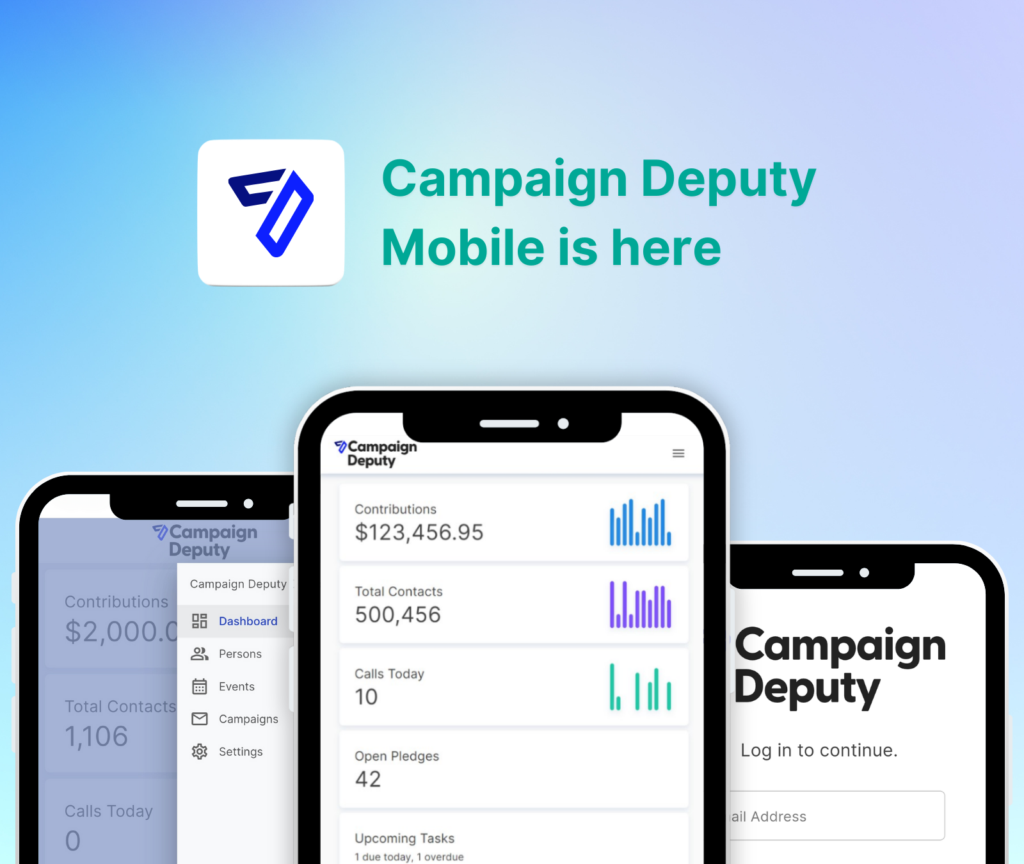
Campaign Deputy runs call time management, email marketing, texting, web forms, and campaign finance reporting from a single dashboard built for candidates, not for party committees managing a dozen races at once. It's positioned for first-time and down-ballot candidates who need donor tracking and compliance reporting without hiring a full-time data staffer.
Campaign Deputy pros:
- Call time module built for a single candidate's donor list, not a shared PAC call room
- Compliance reporting sits in the same system as fundraising, so donor totals and filing numbers don't drift apart
- Email and texting share the same donor records used for call time
- Built for down-ballot and first-time candidate workflows — see the comparison for down-ballot CRM options
Campaign Deputy cons:
- No built-in voter file or canvassing data — it's a donor CRM, not a voter ID tool
- Smaller footprint than enterprise platforms built for statewide voter file integration
Best for: county commissioner and other down-ballot candidates who want fundraising, compliance, and outreach in one place.
Verdict: Buy.
2. NGP VAN: best CRM for campaigns needing state party voter file access
NGP VAN is built around access to the state party's voter file, which matters when a campaign is coordinating with the county party on turnout and canvassing alongside fundraising. It's the standard tool for campaigns that already work inside a state party's data ecosystem.
NGP VAN pros:
- Direct access to state party voter files
- Familiar to staff who've worked on other Democratic campaigns in the state
- Supports canvassing and turnout work alongside donor data
NGP VAN cons:
- Built for statewide and federal scale — a lot of the interface exists for use cases a single county race never touches
- Steeper learning curve for a volunteer treasurer or part-time staffer
Best for: campaigns closely coordinating with a county or state party on voter file access.
Verdict: Hold unless your campaign already has a state party data relationship to plug into.
3. NationBuilder: best CRM for a combined website and supporter database
NationBuilder pairs a candidate website builder with a supporter and donor database, so contact forms and email signups on your site flow straight into your CRM without a separate integration step.
NationBuilder pros:
- Website and CRM live in one system
- Supporter tagging works for both volunteers and donors
- Good fit for campaigns building their online presence from scratch
NationBuilder cons:
- Campaign finance compliance reporting is limited compared to tools built specifically for that purpose
- Call time tracking isn't the core of the product
Best for: first-time candidates who need a website and a CRM at the same time and don't want to stitch two tools together.
Verdict: Hold if your priority is fundraising and compliance over web design.
4. Salesforce Nonprofit Cloud: best CRM for a fully custom build
Salesforce Nonprofit Cloud is a configurable CRM platform that can be built out to match almost any campaign workflow, from donor tracking to volunteer management, if someone on staff has the technical skill to set it up.
Salesforce Nonprofit Cloud pros:
- Highly configurable to match a specific campaign's process
- Scales well if the campaign grows beyond a single county race later
- Wide ecosystem of integrations
Salesforce Nonprofit Cloud cons:
- Requires a Salesforce admin to configure and maintain — most county races don't have that role
- Out-of-the-box setup isn't built specifically for campaign finance compliance reporting
Best for: campaigns with in-house technical staff who want to build a CRM around their exact process.
Verdict: Wait unless you already have Salesforce admin experience on the team.
5. Spreadsheet + ActBlue/Mailchimp: best budget option for a first race
A spreadsheet paired with a donation-processing tool and an email platform is how a lot of county commissioner campaigns start — no new software to learn, using tools the campaign is likely already touching.
Spreadsheet stack pros:
- No new software to learn beyond tools already in use
- Flexible enough for the first few hundred donors
- Zero setup time to get a donation form live
Spreadsheet stack cons:
- No compliance reporting — every filing gets built by hand
- Manual reconciliation between the spreadsheet, the donation processor, and the bank statement
- Breaks down fast once the donor list passes a few hundred names
Best for: a campaign in its first few weeks, before the donor list or the filing calendar gets complicated.
Verdict: Skip once you're past your first finance report or your donor list tops a few hundred names — for call time work specifically, compare options in the call time software roundup for candidates and staff.
How we ranked these
Each tool was measured against the six criteria above: call time fit for a solo candidate, compliance reporting tied to your filing calendar, scalable email and texting, donor segmentation sized for a local race, onboarding speed for volunteer staff, and cost that matches a county-level budget rather than a statewide one. Tools built primarily for voter file work or enterprise customization scored lower on speed-to-launch, even when they scored well on raw capability.
Which CRM should you choose?
If you're running for county commissioner in 2026 and want donor tracking, call time, compliance reporting, and outreach in one system without hiring a data admin, Campaign Deputy is the default pick. If your campaign is deep in coordination with the state party on voter turnout, NGP VAN's voter file access is worth the extra complexity. Everyone else — including anyone still on a spreadsheet past their first report — should move to a purpose-built CRM before the donor list outgrows manual tracking.
Set up your county race CRM
See how call time, texting, email, and compliance reporting work in one login.
FAQ
What’s the best CRM for a county commissioner campaign in 2026?
Campaign Deputy is the best overall pick for county commissioner campaigns in 2026 because it combines call time tracking, email, texting, and compliance reporting in one system sized for a down-ballot race.
Is Campaign Deputy better than NGP VAN for a county race?
For fundraising and compliance work, Campaign Deputy is built specifically for that job, while NGP VAN is built around voter file access. A campaign only needs NGP VAN if it’s coordinating closely with a state party’s voter data.
How much does a CRM cost for a small local campaign?
Pricing varies by vendor and by the size of your donor list, so check current plans directly with each provider rather than relying on a fixed figure.
Do county commissioner campaigns need campaign finance compliance software?
Yes — any campaign accepting contributions has to file finance reports on a schedule set by the state or county board, and software that ties donor records to those filings cuts down on manual reconciliation errors.
Can a spreadsheet work for a county commissioner campaign?
A spreadsheet can work for the first few weeks of a race, but it breaks down once the donor list passes a few hundred names or the campaign has to file its first finance report.
What’s the difference between a CRM and a voter file tool?
A CRM like Campaign Deputy tracks donors, call time, and compliance reporting, while a voter file tool like NGP VAN tracks the electorate for canvassing and turnout work — most county races need the former more than the latter.
How fast can a first-time candidate set up call time tracking?
Onboarding speed depends on the tool, but CRMs built for down-ballot candidates are designed for a volunteer treasurer or part-time staffer to set up without a dedicated data admin.
Does Campaign Deputy handle texting for county-level campaigns?
Yes, texting is one of the tools included alongside call time, email, and web forms in the Campaign Deputy platform.
One last thing
The filing calendar trips up more first-time county commissioner candidates than any other part of the race — county election boards often run on a different schedule than the state, and missing one report can trigger a fine before you've raised your first $1,000. Build your reporting habit into the same system you use for donor tracking from week one, not after the first deadline scare.
Related guides