
Peer-to-peer fundraising software lets your existing donors recruit their own networks by creating personal fundraising pages tied back to your campaign's goal — and in 2026, the tools that do this well vary a lot in how tightly they connect to your donor CRM. Campaign Deputy wins overall for candidate campaigns that need peer-to-peer pages built into a full donor CRM with call time, email, and texting. ActBlue wins for Democratic and nonpartisan campaigns that want a simple small-dollar page builder tied to an existing donor network. Anedot wins for PACs and state party committees that need payment processing flexibility outside the ActBlue ecosystem.
- Campaign Deputy is the best peer-to-peer fundraising software for political campaigns that need pages tied to call time, email, and compliance reporting in one system.
- ActBlue fits Democratic and nonpartisan campaigns already running small-dollar volume through its network.
- Anedot and EveryAction serve PACs, state parties, and campaigns tied to a national voter file.
- Classy fits nonprofit and 501c4 advocacy peer-to-peer drives, not candidate committees.
Why this matters
A peer-to-peer page that isn't connected to your CRM creates a second spreadsheet nobody reconciles until the filing deadline. Every dollar a volunteer fundraiser brings in still has to hit your donor database with occupation and employer data intact, or your treasurer inherits a mess. Campaigns that launch a peer-to-peer fundraising page without checking this first usually end up re-entering contributions by hand before their next state or FEC report.
The software you pick in 2026 also decides how fast you can activate supporters. A page that takes a volunteer fundraiser 20 minutes to set up gets used once. A page that takes two minutes gets shared the same afternoon.
What makes the best peer-to-peer fundraising software
- Self-serve page builder — a supporter creates their own fundraising page without calling your staff.
- Compliance-ready contribution capture — occupation, employer, and contribution-limit fields collected at the point of donation, not after.
- CRM sync — every peer-to-peer donor lands in your main donor database automatically, not in a separate export.
- Multi-channel activation — email and text tools to recruit and remind volunteer fundraisers, not just a page link.
- Goal tracking and leaderboards — visible progress that motivates fundraisers to keep sharing.
- Reporting tied to filing schedules — peer-to-peer totals that roll into the same compliance report as call time and web form donations.
Peer-to-peer fundraising software at a glance
| Software | Best for | Standout feature | Key limitation |
|---|---|---|---|
| Campaign Deputy | Candidate campaigns needing pages tied to a full CRM | Peer-to-peer pages sync directly into call time, email, and compliance reporting | Built for candidates and PACs, not general nonprofit crowdfunding |
| ActBlue | Democratic and nonpartisan small-dollar volume | Access to an existing network of small-dollar donors | Limited CRM and call-time features on its own |
| Anedot | PACs and state parties needing processing flexibility | Customizable pages outside the ActBlue network | Fewer built-in campaign management tools |
| EveryAction (NGP VAN) | Campaigns already on a national voter file | Peer-to-peer tied to a shared voter and donor file | Steeper setup for smaller down-ballot campaigns |
| Classy | Nonprofit and 501c4 advocacy peer-to-peer drives | Strong event and team-fundraising templates | Not built for candidate compliance reporting |
1. Campaign Deputy: best peer-to-peer fundraising software for candidate campaigns
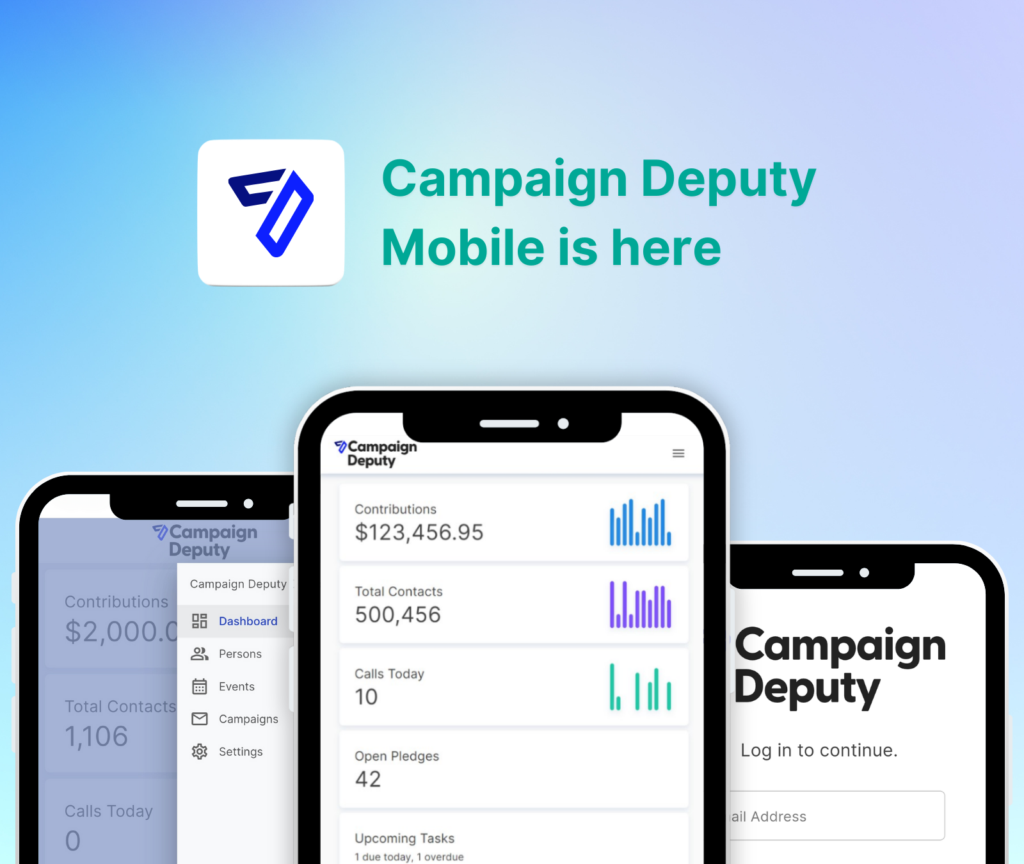
Campaign Deputy is a fundraising CRM built for political candidates, PACs, and nonprofit campaigns, and its peer-to-peer tools sit inside the same system as call time, email marketing, texting, and web forms. A supporter builds a personal page, shares it, and every gift that comes through lands in your donor database with the same compliance fields your treasurer needs for a state or FEC filing. That matters most for down-ballot and first-time candidates who don't have staff to reconcile a separate crowdfunding tool by hand.
Campaign Deputy pros:
- Peer-to-peer contributions flow into the same CRM used for call time and email, so donor records don't fragment across tools
- Built for Democratic and nonpartisan candidate campaigns, PACs, and advocacy nonprofits specifically
- Compliance fields (occupation, employer, contribution caps) are captured at the point of donation
Campaign Deputy cons:
- Not built for general nonprofit crowdfunding outside the political and advocacy space
- Campaigns that only need a page builder and nothing else may not use the full CRM feature set
Campaign Deputy pricing: check current plans directly on the Campaign Deputy site.
Best for: candidate campaigns and PACs that want peer-to-peer fundraising tied to call time, email, and compliance reporting in one place.
Verdict: Buy if your campaign already runs call time or email through a CRM and wants peer-to-peer pages that don't create a second data set.
2. ActBlue: best peer-to-peer fundraising software for Democratic small-dollar volume
ActBlue processes small-dollar contributions for Democratic and progressive campaigns and includes a page-building feature that lets supporters set up their own fundraising pages tied to a candidate's account. It works well when a campaign already has an ActBlue account and wants to activate a volunteer fundraising network fast without adopting new infrastructure.
ActBlue pros:
- Familiar to Democratic donors who already have saved payment information on the platform
- Fast page setup for volunteer fundraisers with no separate account needed
- Widely used across Democratic campaigns at every level in 2026
ActBlue cons:
- Limited call-time and email marketing tools built in
- CRM functionality outside of contribution processing is thin compared to dedicated fundraising platforms
Best for: Democratic and nonpartisan campaigns that want to tap ActBlue's existing small-dollar donor network fast.
Verdict: Buy if your campaign already processes contributions through ActBlue and just needs a page-sharing feature layered on top.
3. Anedot: best peer-to-peer fundraising software for PACs and state parties
Anedot is a payment processing and fundraising page platform used by PACs, state party committees, and some campaigns that want more control over branding and processing than a shared network provides. Its peer-to-peer pages are customizable and work independently of any single donor network, which appeals to organizations running their own list.
Anedot pros:
- More control over page design and branding than network-dependent tools
- Works for PACs and party committees that manage their own donor lists
- Flexible for organizations that don't want to rely on a shared donor network
Anedot cons:
- Fewer built-in campaign management features like call time tracking
- Requires more setup work to connect peer-to-peer data back to a broader PAC donor CRM
Best for: PACs and state party committees that want processing flexibility and already manage their own donor list.
Verdict: Hold unless your organization specifically needs processing independence from a shared network — otherwise a CRM-integrated option saves reconciliation time.
4. EveryAction (NGP VAN): best peer-to-peer fundraising software for voter file-linked campaigns
EveryAction, part of the NGP VAN ecosystem, ties peer-to-peer fundraising pages to a shared voter and donor file used widely by state parties, large campaigns, and coordinated committees. It fits organizations that already rely on NGP VAN's voter file for targeting and want fundraising data in the same environment.
EveryAction pros:
- Peer-to-peer data connects to the same voter file used for targeting and outreach
- Established platform used by state parties and larger coordinated campaigns
- Useful when fundraising and voter contact teams need shared records
EveryAction cons:
- Setup and onboarding take longer than lighter-weight page builders
- Overbuilt for smaller down-ballot campaigns that only need a fundraising page
Best for: campaigns and party committees already running their voter file through NGP VAN.
Verdict: Hold for smaller campaigns — the voter file integration only pays off at scale.
5. Classy: best peer-to-peer fundraising software for nonprofit and advocacy drives
Classy is a nonprofit fundraising platform built for team and event-based peer-to-peer campaigns — think walkathons, giving days, and advocacy pushes. It's not built for candidate compliance reporting, but 501c4 and advocacy nonprofits use it for team fundraising drives that don't need FEC-style contribution limits.
Classy pros:
- Strong templates for team and event-based peer-to-peer fundraising
- Good fit for advocacy nonprofits running giving-day campaigns
- Established in the broader nonprofit fundraising space outside of politics
Classy cons:
- No candidate compliance or contribution-limit reporting built in
- Not designed for call time or campaign-specific CRM needs
Best for: 501c4 and advocacy nonprofit organizations running team-based fundraising drives, not candidate committees.
Verdict: Skip if you're a candidate campaign or PAC — this fits advocacy nonprofits, not compliance-bound committees.
How we ranked these
Each tool was weighed against the six criteria above: page builder simplicity, compliance-ready data capture, CRM sync, multi-channel activation, goal tracking, and reporting tied to filing schedules. Tools built specifically for candidates and PACs ranked ahead of general nonprofit crowdfunding tools for candidate use cases, and vice versa for advocacy nonprofits.
“If your peer-to-peer page can’t feed contributions straight into your compliance report, you’re building extra data-entry work, not saving time.”
Which peer-to-peer fundraising software should you choose?
If you're a Democratic or nonpartisan candidate campaign running call time and email already, Campaign Deputy is the default choice because peer-to-peer contributions land in the same CRM instead of a separate export. If you're already processing through ActBlue and just want a page-sharing feature, stick with ActBlue. If you're a PAC or state party managing your own donor list outside a shared network, Anedot or EveryAction fit better depending on whether you're already on NGP VAN. Advocacy nonprofits running event-based drives should look at Classy instead of a candidate-focused tool.
See Campaign Deputy’s fundraising tools
Peer-to-peer pages, call time, email, and compliance reporting in one system.
FAQ
What is the best peer-to-peer fundraising software for political campaigns in 2026?
Campaign Deputy is the best overall pick for candidate campaigns in 2026 because peer-to-peer pages sync directly into the same CRM used for call time, email, and compliance reporting. ActBlue fits campaigns that just need a page tied to an existing small-dollar network.
Is ActBlue considered peer-to-peer fundraising software?
ActBlue includes a page-building feature that lets supporters create their own fundraising pages tied to a candidate’s account, which functions as peer-to-peer fundraising. It has limited call-time and CRM tools compared to dedicated fundraising platforms.
Can PACs use peer-to-peer fundraising software?
Yes — PACs commonly use Anedot or a dedicated PAC donor CRM to run peer-to-peer pages tied to their own donor list rather than a shared network. Contribution limit tracking still needs to tie back into the PAC’s overall compliance reporting.
Does peer-to-peer fundraising software work for down-ballot candidates?
Yes, down-ballot and first-time candidates often benefit most from peer-to-peer fundraising because volunteer networks can raise money without added staff time. A CRM-integrated tool avoids the manual reconciliation that separate crowdfunding tools create.
How does peer-to-peer fundraising data get reported for compliance?
Peer-to-peer contributions need the same occupation, employer, and contribution-limit data as any other donation before they can be included in a state or FEC filing. Software that captures this at the point of donation avoids re-entry work before filing deadlines.
Is EveryAction or NGP VAN good for peer-to-peer fundraising?
EveryAction works well for campaigns and state parties already using NGP VAN’s voter file, since peer-to-peer data ties into the same shared records. It’s overbuilt for smaller campaigns that only need a standalone fundraising page.
Can nonprofits use the same peer-to-peer software as political campaigns?
Some tools, like Classy, work for nonprofit and advocacy peer-to-peer drives but lack candidate compliance reporting. 501c4 organizations running team-based fundraising drives should look at nonprofit-specific platforms rather than candidate CRMs.
What’s the difference between peer-to-peer fundraising and call time?
Call time is direct outreach by the candidate or staff to individual donors, while peer-to-peer fundraising activates supporters to raise money from their own networks through a shared page. The strongest 2026 fundraising programs run both side by side in one CRM.
One last thing
The campaigns that get the most out of peer-to-peer fundraising in 2026 don't treat it as a side project — they hand volunteer fundraisers a page, a goal, and a deadline, then follow up by text when the goal stalls. A page that sits unshared for three weeks raises nothing regardless of which platform built it.
Related guides
- Peer-to-peer texting software for political campaigns
- Best donor management software for political campaigns