Peer-to-peer texting software for political campaigns turns a volunteer's phone into a fundraising and turnout tool, but not every platform on the market in 2026 is built for the compliance rules and message volume a real campaign needs.
- Peer-to-peer texting software for political campaigns needs opt-in tracking built in, not bolted on — TCPA exposure runs $500 to $1,500 per violation. Buy platforms with consent logging.
- GOTV texting volume spikes hard in the final stretch before Election Day 2026 — a tool built for steady-state sending will bottleneck. Consider surge capacity before you sign a contract.
- Standalone texting apps that don’t sync to your donor CRM create duplicate contact records within weeks. Skip anything without two-way sync.
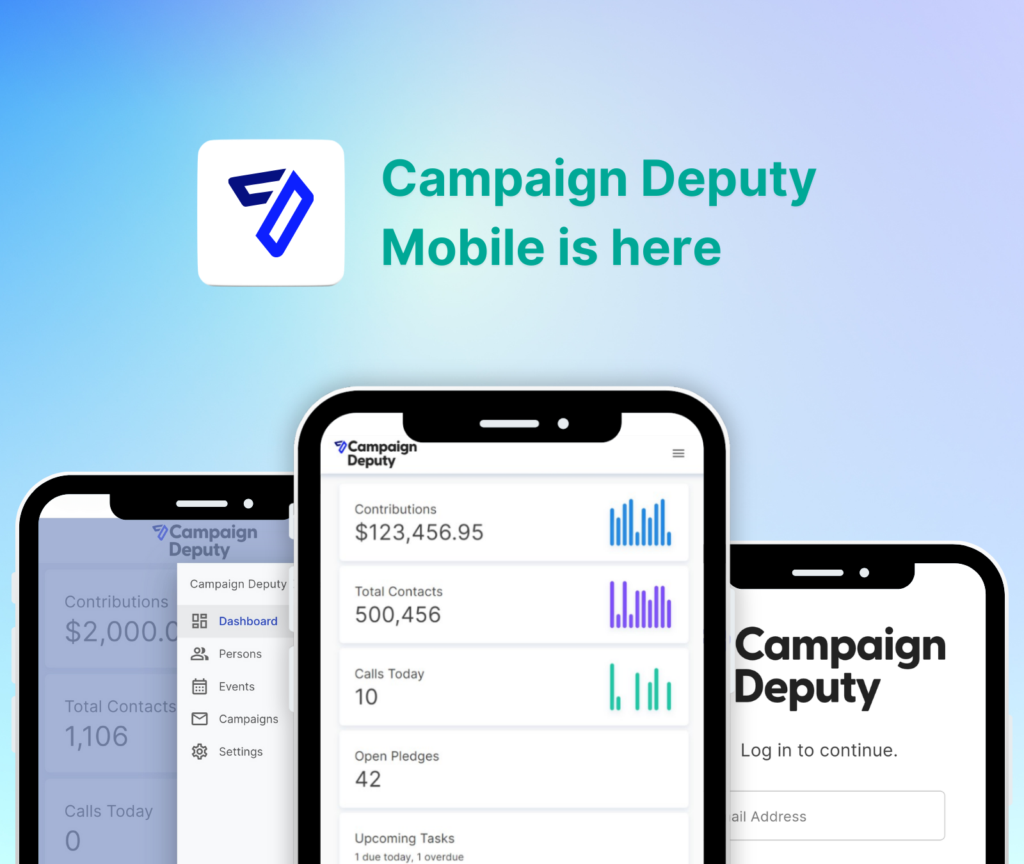
- Campaign Deputy pairs texting with call time, email, and finance reporting in one login — Buy it when you want one system instead of four subscriptions.
- Software doesn’t replace a named compliance owner on staff — assign a human to review consent records even after you buy the tool.
Why this matters
Peer-to-peer texting isn't the same regulatory animal as an email blast. Under the TCPA, an autodialed political text sent without prior express consent carries a statutory penalty of $500 to $1,500 per message — and that liability sits with the campaign, not the vendor. Texting voters for a political campaign compliantly means every number on your list has a documented opt-in, and your software needs to store that record, not just send the text.
The second reason this matters in 2026: texting has become the default channel for both donor asks and GOTV pushes because open rates beat email by a wide margin, and campaign budgets are shifting accordingly. A platform that can't scale from a 500-contact pilot to a 50,000-contact turnout push in the final weeks of a race isn't a texting platform — it's a liability waiting for October.
Who this is for
This guide is for campaign managers, digital directors, and finance directors running state legislative, congressional, county, city council, or PAC campaigns who need to text donors and voters without triggering compliance problems or losing contact data between systems. It's built for staff evaluating texting tools in 2026 who already have (or are building) a donor CRM and don't want a fifth disconnected app.
What to look for in peer-to-peer texting software for political campaigns
Consent tracking, not just message sending
Any tool can send a text. The one you need logs when and how each contact opted in, timestamps it, and lets you produce that record if a complaint ever lands. Without this, your campaign — not the software vendor — absorbs the TCPA risk.
10DLC and carrier registration
Carriers require Application-to-Person (A2P) 10DLC registration for business and campaign texting in the US. A platform that doesn't walk you through this will see messages throttled or blocked right when volume matters most, typically the final weeks before Election Day.
Throughput built for surge, not steady state
A fundraising email list gets touched a few times a month. A GOTV texting program needs to hit tens of thousands of contacts in a compressed window. Ask what happens to delivery speed when you triple your normal send volume — that answer separates a real platform from a side feature.
Two-way conversation management
Voters and donors reply. A platform without a shared inbox for volunteer texting banks means replies get missed, and a missed reply from a donor asking a question is a missed contribution.
CRM and donor-data sync
If texting activity doesn't sync back to the same record as a donor's giving history and call time notes, your team is manually reconciling three systems during the busiest month of the cycle. That's how duplicate records and missed follow-ups happen.
Reporting tied to your compliance filings
Texting costs and vendor payments show up on your campaign finance report. A platform that exports clean expenditure data saves your treasurer hours before every filing deadline in 2026.
Top picks for peer-to-peer texting in political campaigns
GOTV surge texting — the turnout closer. GOTV texting platforms are built for the specific problem of moving from a few thousand contacts to tens of thousands in the final stretch of a race. The spec that matters here is surge throughput — how fast the platform sends when your list triples overnight, which is exactly what happens in the ten days before Election Day. Verdict: Buy if you have a field program that scales in the final weeks; a general-purpose texting app will choke here.
Benchmark comparison shopping — the due-diligence pick. Before signing a contract, run any platform against a real best texting platform for political campaigns checklist covering consent logging, 10DLC support, and CRM sync side by side. The one number that matters: how many of those three boxes a vendor can check without a workaround. Verdict: Consider — this is a research step, not a purchase, but skipping it is how campaigns end up locked into a 12-month contract with a tool that can't handle October volume.
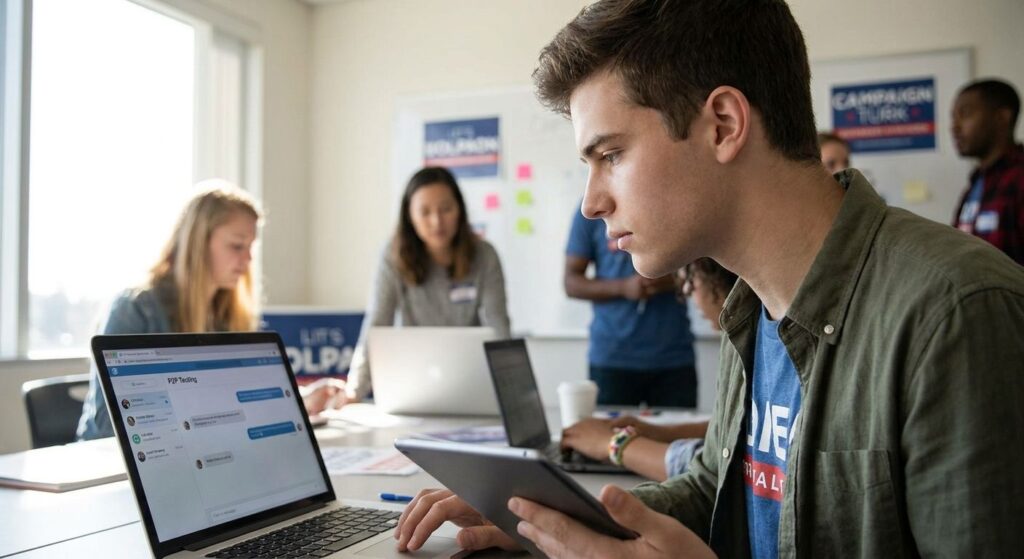
Volunteer-run texting banks — the field team multiplier. Volunteer coordination software for local campaign teams matters here because P2P texting only scales as fast as the number of trained volunteers sending from it. A platform that assigns scripts and tracks volunteer send counts turns a five-person texting bank into a real turnout operation. Verdict: Buy for campaigns relying on a volunteer field program rather than paid staff alone.
Nonprofit-style donor texting — the off-cycle fundraiser. Some campaigns and affiliated PACs run donor texting programs modeled on nonprofit fundraising cadence — shorter, more frequent asks tied to specific fundraising deadlines rather than election-day surges. This works well for maintaining a donor base between filing periods, but it needs the same consent tracking as any voter-facing text. Verdict: Consider if your fundraising calendar runs year-round rather than in a single election push.
All-in-one CRM texting — the one-login pick. Campaign Deputy runs texting alongside call time management, email marketing, web forms, and campaign finance reporting in one platform, so a text reply and a donor's giving history sit on the same record instead of two systems that never talk to each other. Verdict: Buy if your team is currently juggling a separate texting app, a separate CRM, and a separate spreadsheet for compliance — consolidating cuts the reconciliation work every filing period creates.
See texting inside your donor CRM
Check how Campaign Deputy pairs texting with call time and finance reporting.
What to avoid
- Consumer mass-texting apps repurposed for campaigns. They send messages fine but skip consent logging entirely — the exact gap that creates TCPA exposure once your list grows past a few hundred contacts.
- Platforms with no CRM export. A texting tool that can't hand off engagement data to your donor database looks cheap in year one and expensive every filing period after, once staff start manually copying data between systems.
- Any vendor that can't explain 10DLC registration in plain terms. If the sales team can't walk you through carrier registration in under five minutes, expect delivery problems in 2026 right when your GOTV window opens.
Verdict comparison
| Approach | Best for | Consent tracking | Verdict |
|---|---|---|---|
| GOTV surge texting | Final-stretch turnout push | Built for high-volume opt-in logs | Buy |
| Benchmark comparison shopping | Vendor due diligence | N/A — research step | Consider |
| Volunteer texting banks | Field-heavy campaigns | Script and consent tracking per volunteer | Buy |
| Nonprofit-style donor texting | Year-round fundraising cadence | Requires same consent discipline | Consider |
| All-in-one CRM texting | Teams juggling multiple tools | Synced to CRM record | Buy |
FAQ
What is peer-to-peer texting software for political campaigns?
Peer-to-peer texting software lets a real person send and reply to individual text messages to voters or donors, rather than blasting an automated mass message. Campaigns use it for GOTV pushes, volunteer recruitment, and donor asks in 2026 because reply rates beat both email and robotexting.
Is P2P texting legal for political campaigns in 2026?
Yes, but only with documented prior express consent from each contact under the TCPA. Autodialed or unconsented texts carry penalties of $500 to $1,500 per message, so the software you pick needs to log opt-ins, not just send texts.
How much does peer-to-peer texting software cost for a campaign?
Cost varies by vendor based on message volume, list size, and whether you’re sending SMS or MMS. Check current pricing directly with any platform you’re evaluating rather than assuming a flat rate applies across campaign sizes.
What’s the difference between P2P texting and mass blast texting?
P2P texting is sent manually by a person, one message at a time, which keeps it outside autodialer rules that trigger stricter consent requirements. Mass blast texting uses automated dialing systems and carries a higher compliance bar for political and commercial senders alike.
Do political campaigns need 10DLC registration for texting?
Yes, US carriers require Application-to-Person (A2P) 10DLC registration for campaign and business texting sent through a shared platform. Skipping registration typically results in throttled or blocked delivery once your send volume increases.
Can nonprofits use peer-to-peer texting for fundraising?
Yes, nonprofit organizations and affiliated PACs use the same P2P texting model for donor cultivation and event reminders. The consent and opt-in requirements apply regardless of whether the sender is a campaign or a nonprofit.
How close to Election Day should GOTV texting start?
Most GOTV texting programs ramp up volume in the final one to two weeks before Election Day, when turnout messaging matters most. Software chosen for steady-state sending earlier in the cycle can struggle to handle that late surge.
Does peer-to-peer texting integrate with a donor CRM?
Platforms built specifically for campaigns sync texting activity to the same donor record as giving history and call time notes. Standalone texting apps without CRM integration require manual reconciliation, which becomes a real time cost as your contact list grows through 2026.
One last thing
The platforms that fail campaigns aren't the ones with weak texting features — they're the ones with no answer for what happens to your consent records if a recipient files a complaint six months after Election Day. Ask every vendor on your shortlist how long they retain opt-in logs and whether you can export them, before you ask about pricing.
Related guides