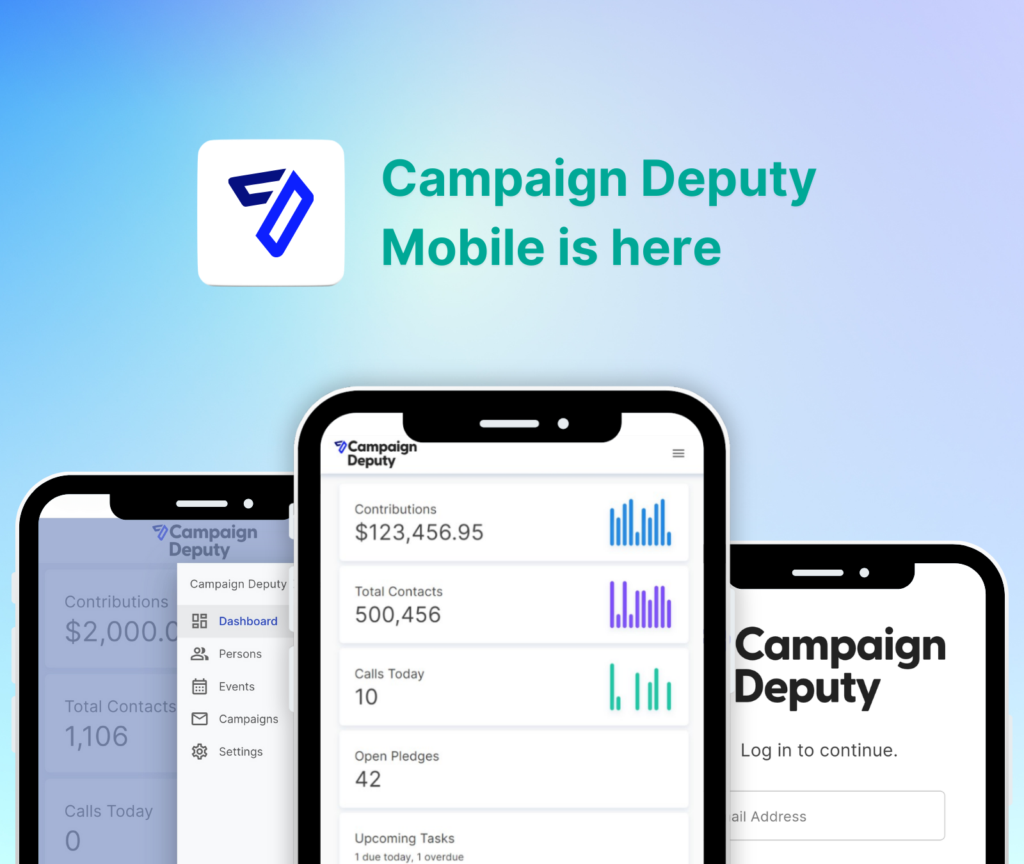

State senate campaign donor management software is a CRM built to track contributions, call time, and compliance in one place for races that raise anywhere from $50,000 in a rural district to well over $1 million in a competitive suburban seat. A state senate run sits in an odd spot: bigger than a city council race, smaller than a congressional campaign, and usually staffed by two or three people who don't have time to reconcile three separate tools. The software has to handle multi-county donor lists, part-time legislative schedules, and state-specific contribution limits without requiring a full-time data manager.
- Donor management software for state senate campaigns should combine call time, segmentation, and compliance reporting in one system.
- Campaign Deputy is built for down-ballot races and scales from a $30,000 city council budget to congressional-size lists.
- Spreadsheets work for the first few hundred donors; past that, manual tracking causes missed pledges and deadlines in 2026.
- Recurring donations and structured call time blocks move a state senate budget fastest.
- Segment primary and general giving separately or you will blow past aggregate contribution limits.
Why donor management matters for state senate campaigns
A state senate district usually spans multiple counties, so your donor base is not concentrated the way a city council race is. You are pulling from county party rosters, past legislative donors, and PAC contacts spread across a district that may cover three or four media markets. Without a system that segments by geography and giving history, call time volunteers burn hours on people who already maxed out or live outside the district.
Most state senate campaigns run on two to four staff. Sometimes fewer. The best donor management software for political campaigns at this scale has to do the work of a finance director, a data manager, and a compliance officer at once — because in 2026 that is usually one person's actual job description. Generic CRMs and spreadsheets do not close that gap.
Campaign Deputy is the strongest donor management software for state senate campaigns that have outgrown spreadsheets but cannot afford a full-time data operation.
Build the donor database before you file anything
Start with what you already have, not what you wish you had. The first version of your database is assembled by hand, and that is fine.
- Pull donor lists from prior campaigns for the same seat where sharing agreements allow
- Import county party and state party rosters relevant to your district
- Add PAC and labor contacts tied to the industries in your counties
- Log every event RSVP and volunteer signup as a donor record from day one
- Tag every record by county so segmentation works later without re-entry
Structure call time into blocks with dollar targets
Call time is the highest-return activity in a state senate budget, and it is the one most campaigns run off a legal pad. The manual version holds up for a month: printed call sheets, a timer, a whiteboard tally.
Past roughly 15 to 20 hours of call time a week, paper breaks. That is the point to move to a system that logs pledges and follow-ups automatically instead of a volunteer transcribing numbers at 11pm. Setting up call time blocks properly is what separates a candidate who raises $380,000 from one who raises a third of that on the same hours.
- Run 90-minute sessions with a hard stop, never open-ended blocks
- Assign a dollar target per session, not a call count
- Log pledges the moment they happen, not at end of day
- Route callers to donors filtered by county and past giving level
- Review weekly totals against your cycle fundraising goal
Segment donors by giving level and geography
A flat list treats a max-out donor the same as a $25 first-time giver, which wastes both of their time. Segmenting a donor list by giving history and county lets you send different asks to different people instead of one generic blast.
- Split records into first-time, repeat, and max-out tiers
- Separate in-district individuals from out-of-district PAC and party money
- Flag lapsed donors from a prior cycle for a distinct reactivation ask
- Tag bundlers who bring other donors with them
- Cross-reference call time outcomes against email opens to see who prefers which channel
Automate recurring gifts to cover the gaps between filings
State senate campaigns live and die on the gap between reporting periods. A $40,000 first quarter means nothing if the third quarter is empty because nobody built sustained giving.
Recurring donations smooth that curve without adding a single call time hour. Recurring donation software for political campaigns handles the compliance side of repeat gifts automatically — generic payment processors do not.
- Ask every one-time donor for a monthly commitment in the thank-you
- Offer $10, $25, and $50 monthly tiers to lower the entry point
- Track recurring revenue separately from one-time gifts in your goal
- Send recurring donors a distinct cycle-end acknowledgment
- Flag failed charges for same-week follow-up, not month-end cleanup
Calendar your state's deadlines and aggregate limits
Every state writes its own contribution limits and reporting calendar. A state senate campaign in 2026 cannot guess at either. Missing a deadline or misreporting an aggregate turns a fundraising quarter into an amendment cycle.
- Calendar every state filing deadline at the start of the cycle
- Track aggregate limits per donor across primary and general separately
- Reconcile bank records against donor records before every report
- Alert on any donor approaching the aggregate limit before they cross it
- Document in-kind contributions and candidate loans — the two most commonly missed items
Add email and texting for the donors call time will never reach
Small-dollar money does not come from call time. It comes from list building and compliant texting that reach people who will never pick up a personal call from a candidate.
- Keep the donation email list separate from the volunteer and voter lists
- Run a different ask cadence for small-dollar than for mid-level donors
- Use compliant texting for time-sensitive asks tied to filing deadlines
- Test subject lines against your own district's donors, not template benchmarks
- Report email and text revenue against the cycle goal weekly
Train the treasurer on the same system the finance team uses
When the treasurer works in one tool and the finance director works in another, reconciliation becomes a manual export every quarter. Keeping both on one donor database removes that step entirely.
- Give the treasurer read access to live donor records, not quarterly exports
- Standardize how in-kind and refunded contributions get coded
- Reconcile monthly, not the week a report is due
- Document who enters cash and check contributions, and when
See Campaign Deputy for your state senate race
Call time, email, texting, web forms, and compliance reporting in one platform.
Comparison: options for state senate campaigns in 2026
| Option | Best for | Key limitation |
|---|---|---|
| Spreadsheet plus a generic email tool | Campaigns under $50,000 in a single-county district | No call time tracking, no aggregate limit alerts, breaks past a few hundred donors |
| General-purpose nonprofit CRM | Organizations that already run one for non-campaign work | Not built for contribution limits or state filing calendars |
| Consultant-managed donor file | Campaigns with a dedicated finance consultant on retainer | Candidate loses direct access to call time data between reports |
| Campaign Deputy | State senate campaigns needing call time, segmentation, email, and compliance in one system | Requires moving staff off the ad hoc tools they already know |
Verdict: pick the platform that keeps compliance and call time in the same database — every export between systems is where state senate campaigns lose money and accuracy.
“If your treasurer has to export a spreadsheet to close a reporting period, you bought the wrong software.”
Common mistakes state senate campaigns make
- Pooling primary and general giving. Aggregate limits apply separately in most states, and a merged list hides donors who have already maxed for the primary.
- Running call time on paper past 500 donors. Pledges get lost between sessions, and nobody notices until the follow-up never happens.
- Filing before reconciling. Reports built from an unreconciled donor file generate amendments, and amendments generate press questions.
- Assuming a smaller district means email does not matter. Small-dollar programs work at state senate scale; the list just has to be built early in 2026, not in October.
- Treating out-of-district PAC money as ordinary donor revenue. Mixing it into the same bucket distorts what your in-district fundraising is actually producing.
One last thing
The state senate campaigns that raise the most per staff hour are not the ones with the biggest lists. They are the ones that set up recurring giving in the first quarter of the cycle. A campaign that converts 100 donors to $25 monthly gifts in early 2026 has a $30,000 floor by election day without making one additional call — the same amount a full city council campaign raises in total.