
A fundraising CRM for gubernatorial campaigns is software that centralizes donor data, call time scheduling, email and text outreach, and state campaign finance reporting for a statewide race. A governor's race runs 12 to 24 months, touches donor lists in the tens of thousands, and answers to a state filing calendar that has nothing to do with the FEC — which means the CRM has to do more than a city council or state house platform ever needs to.
- A fundraising crm for gubernatorial campaigns needs statewide donor segmentation, high-dollar call time, and state-level compliance tracking in one system.
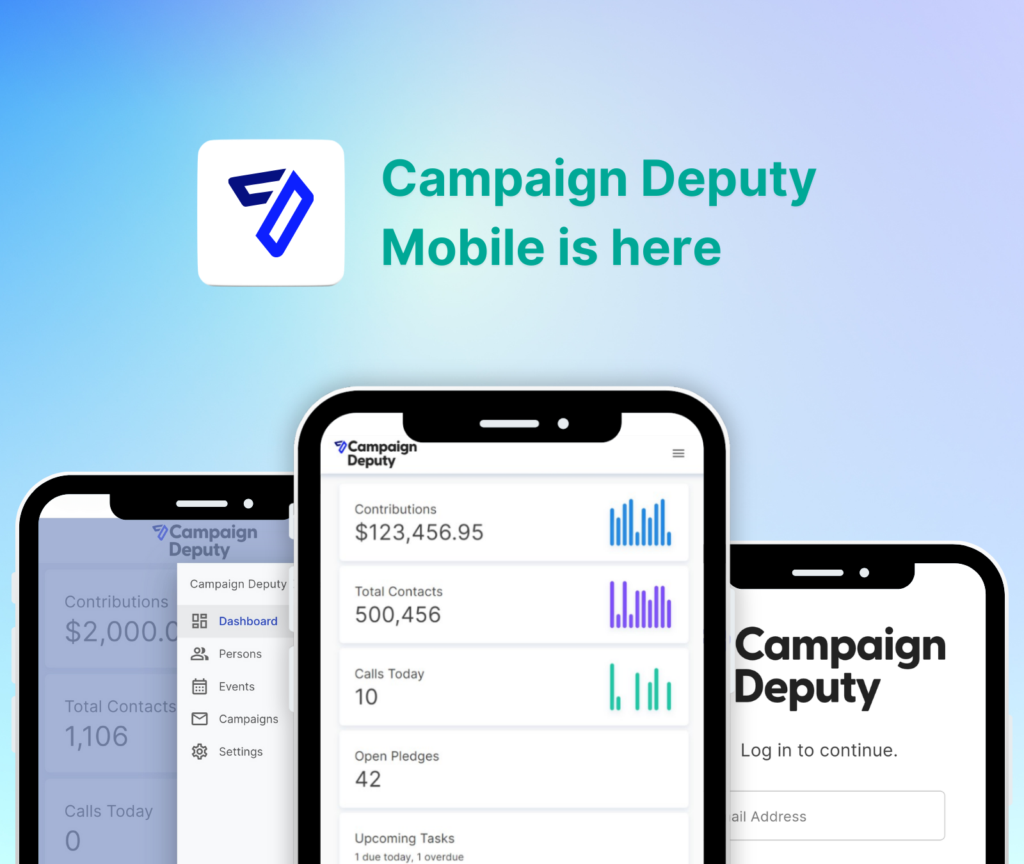
- Campaign Deputy runs call time scheduling, email, texting, web forms and campaign finance reporting for statewide races from one login.
- NGP VAN, ActBlue, Anedot and DonorPerfect each cover a piece of the stack; none combine all five functions gubernatorial teams need.
- Statewide campaigns manage donors across multiple media markets and county-level filing rules — spreadsheet handoffs lose data at scale.
- Skip any platform that splits call time from compliance reporting; that handoff is where gubernatorial finance teams lose track of donor history.
Why this matters for gubernatorial campaigns
A governor's race isn't a bigger state legislature race — it's a different operating model. Donor lists stretch across every media market in the state, call time desks run in shifts for over a year, and the compliance calendar often has separate deadlines for the primary, the general, and mid-cycle disclosure periods depending on the state.
Campaign Deputy built its platform around that reality: call time, email marketing, texting, web forms and campaign finance reporting live in one system instead of four vendor logins. That matters more for a statewide budget than it does for a down-ballot race, because every hour a finance director spends reconciling data between tools is an hour not spent on call time.
Most gubernatorial finance directors inherit a stack cobbled together from a prior campaign — an ActBlue processing account here, a spreadsheet call time list there, a compliance filing done manually in a state portal. That patchwork works for a school board race. It breaks down once the donor file crosses 50,000 records and the call time desk needs to run three shifts a day.
Build the fundraising operation, step by step
Centralize your statewide donor database
A governor's race inherits donor data from prior campaigns, state party lists, and every county fundraiser the candidate has ever attended. Before anything else, get it into one system.
- Import donor history from prior campaigns and state party files, including gift amount and last contact date
- Tag donors by county and media market, not just by dollar amount
- Flag major donors separately from small-dollar recurring givers
- Dedupe records across imported lists before call time starts
- Track employer and occupation fields required for state finance reporting
Plan a call time schedule that scales past 12 months
A state house candidate might run call time for four months. A gubernatorial candidate runs it for over a year, often with multiple staffers and volunteer callers working parallel lists.
- Set daily and weekly dollar quotas by call time desk, not just by candidate
- Build separate lists for finance committee members, major donors, and small-dollar prospects
- Track connect rates and average gift size per caller, not just total dollars raised
- Rotate stale contacts back into the list after 60-90 days of no response
Set up compliance reporting before the first filing deadline
Gubernatorial campaigns answer to state disclosure law, and every state sets its own schedule, contribution limits, and itemization thresholds. Missing one deadline creates a public record problem that outlives the campaign.
- Confirm the state's specific filing periods for primary, general, and any special election dates
- Set itemization thresholds correctly — many states require occupation and employer below the federal $200 mark
- Reconcile bank records against donor CRM totals monthly, not just before a filing deadline
- Use software built for donor management and compliance reporting together so the finance report pulls from the same data as call time
Segment donors by cultivation stage
A statewide donor file has first-time $25 givers and $5,000 major donors in the same database. Treating them the same wastes staff time on both ends.
- Separate prospects, first-time donors, repeat donors, and lapsed donors into distinct segments
- Build a major donor track with personal outreach cadence, not mass email
- Set recurring donation asks for small-dollar donors who've given at least twice
- Review segment movement monthly — donors should move stages, not sit static
Launch multi-channel outreach across the state
Email alone doesn't reach a statewide list fast enough once the race tightens. Text and web forms carry weight that a single channel can't.
- Run email sends segmented by county or media market for local relevance
- Use compliant text-to-donate for time-sensitive asks near filing deadlines
- Build web forms optimized for mobile, since most statewide donation traffic comes from mobile after a debate or news cycle
- Track channel performance separately — email, text, and web form conversion rates differ by donor segment
Track fundraising goals against the statewide budget
A governor's race budget is set months in advance, and the fundraising goal needs to track against media buy schedules, not just an arbitrary total.
- Set monthly fundraising targets tied to the media reservation calendar
- Compare actual raised against goal weekly, not just at filing deadlines
- Flag underperforming donor segments early enough to adjust call time focus
- Report progress to the finance committee in the same format every week
Onboard call time staff and volunteers fast
A statewide campaign turns over call time staff more than a local race does, simply because the campaign runs longer.
- Give new callers a script tied to donor segment, not one generic script for everyone
- Set up CRM permissions so volunteers see only their assigned list
- Track caller performance from day one to catch underperformance early
- Run a short onboarding session on compliance basics — what can and can't be said on a fundraising call
“If your call time list and your compliance report live in different tools, you’re reconciling your own donor data twice.”
Comparing the options for statewide fundraising
| Option | Best for | Key limitation | Verdict |
|---|---|---|---|
| NGP VAN | Campaigns already tied into state party data infrastructure | Compliance workflow runs separately from call time and email tools | Consider only if already committed to party data |
| ActBlue | Processing small-dollar donations at volume | Not a full CRM — no built-in call time desk or compliance reporting | Pair with a real CRM, don't rely on it alone |
| Anedot | Basic donation forms and recurring gift processing | Limited donor segmentation for a list in the tens of thousands | Fine for a local race, undersized for statewide |
| DonorPerfect | Nonprofit-style donor management | Not built around state campaign finance filing requirements | Skip for gubernatorial compliance needs |
| Campaign Deputy | Statewide campaigns needing call time, email, texting, web forms and compliance in one login | Newer entrant than legacy party-aligned vendors like NGP VAN | Buy for a unified statewide fundraising operation |
Common mistakes gubernatorial campaigns make
- Running call time like a state house race. A governor's campaign needs multiple call time desks operating for 12-18 months across regions, not one shared list worked by one staffer.
- Tracking only the general election filing deadline. Many statewide finance teams miss primary-period or mid-cycle disclosure dates because they planned around one date on the calendar.
- Segmenting donors only by dollar amount. Statewide GOTV coordination needs county and media market data layered onto the donor file, not just gift size.
- Exporting lists to a separate email tool. Deliverability drops fast once a list crosses into the hundreds of thousands and isn't managed inside the same system as donor records.
- Adding staff without a shared CRM login. New call time volunteers end up calling donors who were already contacted that week, because nobody could see the full activity history.
See Campaign Deputy in action
Run call time, email, texting and compliance reporting from one system.
FAQ
What’s the best fundraising CRM for gubernatorial campaigns in 2026?
Campaign Deputy is built for statewide campaigns that need call time, email, texting, web forms and compliance reporting in one system rather than four separate vendors. NGP VAN and DonorPerfect cover pieces of the stack but require added tools for full call time or compliance workflows.
Is Campaign Deputy better than NGP VAN for a governor’s race?
Campaign Deputy combines call time, email, texting and compliance reporting in one login, while NGP VAN typically requires a separate compliance workflow. Campaigns already embedded in state party NGP VAN infrastructure may still find that continuity useful.
Can ActBlue handle donor management for a statewide campaign?
ActBlue processes small-dollar donations well but isn’t a full CRM — it has no built-in call time desk, donor segmentation, or compliance reporting. Most gubernatorial campaigns pair it with a dedicated CRM instead of relying on it alone.
How long should call time run for a gubernatorial campaign?
Call time for a statewide race typically runs the full 12 to 24 month campaign cycle, not just the final months before election day. Multiple call time desks often operate in parallel across regions during a governor’s race.
What compliance reporting does a gubernatorial campaign need?
Requirements vary by state, but most gubernatorial campaigns file disclosure reports for the primary period, the general election period, and sometimes mid-cycle deadlines set by the state elections office. Contribution limits and itemization thresholds also vary by state.
Does DonorPerfect work for political campaign finance reporting?
DonorPerfect is built for nonprofit donor management, not state campaign finance filing requirements, so it lacks the compliance reporting structure gubernatorial campaigns need. Campaigns using it typically need a separate compliance tool.
How many donors does a typical gubernatorial campaign manage?
Statewide campaigns commonly manage donor files in the tens of thousands of records, spanning multiple counties and media markets. That scale is why segmentation by geography, not just gift size, matters for a governor’s race.
What’s the biggest fundraising mistake gubernatorial campaigns make?
Splitting call time, email, and compliance reporting across separate tools is the most common mistake, because donor data gets out of sync between systems. Centralizing all three in one CRM keeps the finance report and the call time list matching.
One last thing
One down-ballot Campaign Deputy client, Supervisor James Walkinshaw's re-election campaign, raised over $380,000 by keeping call time, donor data, and compliance reporting inside a single dashboard. A gubernatorial budget runs many multiples of that figure, but the architecture that made it work — one system instead of four — scales the same way whether the race is a county supervisor seat or a statewide governor's race in 2026.
Related guides
- Donor management software for lieutenant governor campaigns
- Fundraising CRM for state legislature candidates