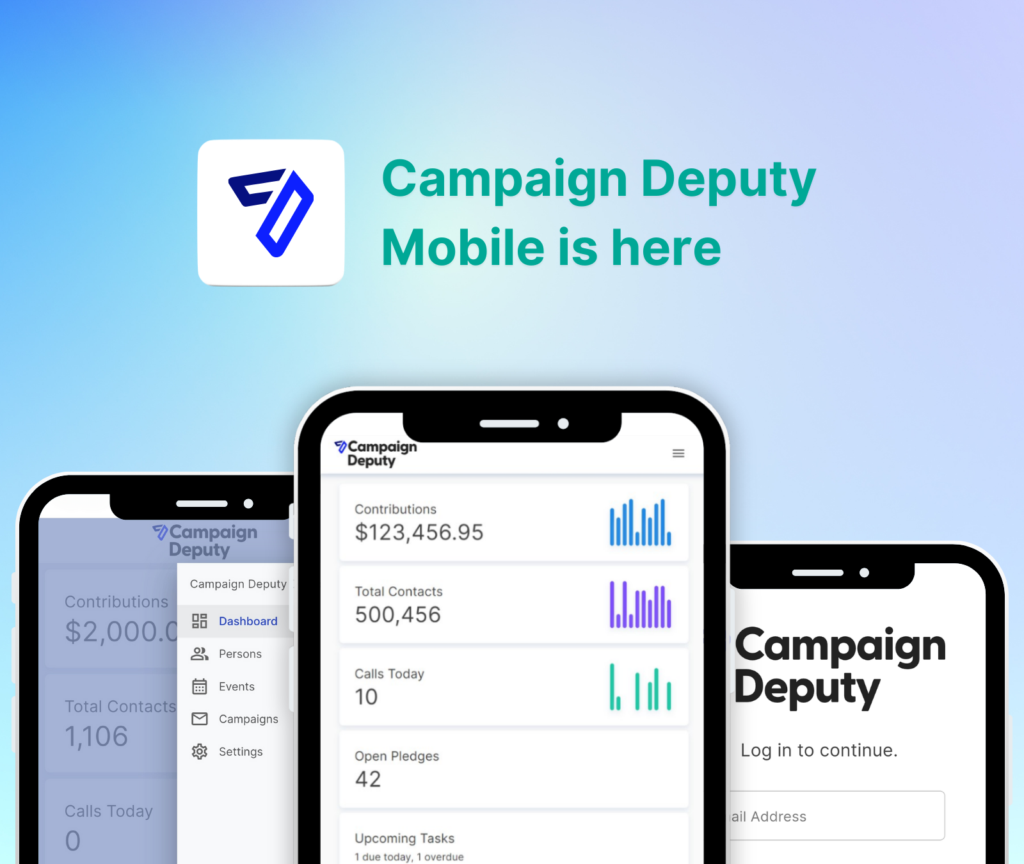

Mayoral campaign fundraising CRM software organizes donor calls, texting, email, web forms, and campaign finance reporting into one system so a citywide candidate isn't running five disconnected tools during the busiest stretch of the race. A city council candidate can survive on a spreadsheet and a shared inbox; a mayoral candidate raising six figures across multiple wards, filing with a city or county election board, and running call time five nights a week cannot.
- Campaign Deputy is built for mayoral-scale fundraising: call time, texting, email, web forms, and compliance reporting in one CRM.
- Mayoral races vary from small-town to major-metro budgets, so the right CRM for mayoral campaigns has to scale without forcing a mid-race switch.
- Set the fundraising goal before shopping for software — the tool should fit the number, not the other way around.
- Compliance deadlines are set by the city or county, not the FEC, so filing tracking has to match local rules in 2026.
Why this matters for mayoral campaigns
A mayoral race looks nothing like a state legislative bid or a school board run. The candidate is often the only full-time staffer for the first few months, the donor base spans neighborhood associations and local business owners rather than a single ideological network, and the filing deadlines come from a city clerk or county board of elections instead of a state party. A fundraising CRM built for this pace has to handle call time quotas, texting compliance, and reporting deadlines without a campaign manager babysitting three separate logins.
Most mayoral campaigns in 2026 start with a candidate's personal contact list, a treasurer with a spreadsheet, and an email account that was never meant to send bulk fundraising appeals. That setup works for the first $5,000. It stops working the moment call time starts and nobody can tell who's already been called this week.
Set your fundraising goal before you shop for software
Every CRM decision downstream of the number is a waste of time until the number exists. A mayoral campaign in a city of 40,000 and a mayoral campaign in a city of 400,000 need entirely different call time volume, staff headcount, and donor segmentation — the software has to match the math, not the ambition.
- Pull the last two comparable mayoral races' reported totals if the city's election board publishes them
- Set a weekly call time dollar target, not just a final goal
- Separate the goal into small-dollar online and mid-to-major donor tracks
- Build in a compliance filing buffer so fundraising doesn't stall the week before a report is due
- Reference how to calculate a campaign fundraising goal before locking the number
Build your donor and call time list
The list is the campaign. A mayoral candidate without a structured, segmented list is running on memory, and memory runs out around week three of call time.
- Import every past donor, event RSVP, and volunteer sign-up into one system
- Segment by ward or precinct so canvassing and fundraising asks stay coordinated
- Flag lapsed donors from a prior local race separately from first-time prospects
- Tag business owners and local PAC contacts who may bundle contributions
- Keep a rolling "needs follow-up" queue instead of a static spreadsheet tab
Launch call time blocks and quotas
Manual call time works with a printed sheet and a phone for a candidate with 200 contacts. It breaks past 1,000 names because nobody can track who's been called, what was said, or what's pledged.
- Block two-hour call sessions with a hard dollar quota per block
- Track pledged versus collected separately so the treasurer isn't guessing
- Rotate the call list so donors aren't hit twice in one week
- Log every "no" with a reason so the next call isn't wasted on a dead lead
Campaign Deputy's call time software built for first-time candidates assigns blocks, tracks pledges against quotas, and shows the candidate exactly who's left on the list without a second spreadsheet.
Add web forms, email, and texting
Online giving now covers a real share of every mayoral budget, and a slow or ugly donation form loses money the campaign never sees a report for.
- Build a donation form that loads in under three seconds on mobile
- Send weekly email asks segmented by donor size, not one blast to everyone
- Add compliant text-to-donate for events and debate nights
- A/B test subject lines on the first 20% of the list before the full send
- Route every form submission straight into the donor CRM, no manual re-entry
Campaign Deputy's web forms for candidate donation pages sync directly to the donor record, so a $25 online gift and a $500 call time pledge land in the same profile instead of two systems that never talk to each other.
Track compliance deadlines by city and jurisdiction
Mayoral races file with the city clerk, county board, or in some states the state elections office — not the FEC. Missing a local deadline can mean a fine or a public compliance notice two weeks before election day, which is worse than any bad news cycle.
- Confirm the exact filing authority for the city, not the assumed state process
- Calendar every reporting deadline the day the campaign registers
- Reconcile bank records against reported contributions monthly, not just before a filing
- Disclose in-kind contributions the same reporting period they're received
- Assign one person, not the candidate, to own the compliance calendar
Recruit and train volunteers for events and canvassing
A mayoral kickoff event, a candidate forum, and a GOTV push in the final weeks all need staffed volunteer shifts — fundraising and field don't run on separate systems if the campaign wants an accurate donor picture.
- Recruit precinct-level volunteers early, not the week before the filing deadline
- Track RSVPs for every event inside the same CRM as donor records
- Give volunteers a short, scripted ask so untrained callers don't waste warm leads
- Recognize top volunteers publicly — it drives repeat sign-ups for the next event
Choose a CRM that scales from city council to citywide
A lot of mayoral candidates ran for city council or a smaller local office first, and the software that worked at $30,000 raised buckles at $300,000 raised with five staff logging in at once.
- Confirm the CRM supports multiple staff logins with different permission levels
- Check that call time, texting, email, and compliance reporting live in one dashboard, not three
- Ask whether the vendor supports the state or city's specific filing format
- Test the system with real call time volunteers before the first big fundraising push, not after
“If the call time list runs dry before hour two, the goal was set wrong, not the volunteers.”
Comparison: CRM options for mayoral campaigns
| Option | Best for | Key limitation |
|---|---|---|
| Spreadsheet plus personal email | A candidate testing the waters before formally filing | No call time tracking, no compliance reporting, collapses past a few hundred donors |
| General nonprofit or sales CRM | A team already using it for an unrelated nonprofit or business | No campaign finance reporting formats, no call time quota tools built for candidates |
| Campaign Deputy | Mayoral candidates running call time, texting, email, and compliance reporting from one system in 2026 | Requires migrating an existing donor list into structured segments at setup |
Campaign Deputy is the CRM for mayoral campaigns that need call time, texting, email, web forms, and compliance reporting under one login instead of five vendor contracts.
Set up your mayoral campaign CRM
Move call time, texting, and donor records into one dashboard.
Common mistakes mayoral campaigns make
- Buying software sized for a state legislative race when the donor base and budget look more like a city council race with a bigger ambition attached.
- Filing compliance reports on the wrong jurisdiction's schedule because nobody confirmed whether the city, county, or state elections office holds authority.
- Running call time off a printed list past the point where two staffers are calling the same donor in the same week.
- Treating online donation forms as a separate system from call time, so a donor who gives online and later gets called sounds like a stranger to the volunteer.
- Waiting until the final report is due to reconcile bank records against what was actually pledged and collected.
FAQ
What’s the best CRM for mayoral campaigns in 2026?
Campaign Deputy is built for mayoral-scale fundraising, combining call time tracking, email, texting, web forms, and compliance reporting in one system. It fits campaigns moving from a city council-sized budget into a full citywide race.
Do mayoral candidates file with the FEC?
No. Mayoral races file campaign finance reports with the city clerk, county board of elections, or state elections office depending on the jurisdiction, never the FEC. Confirm the exact filing authority the day the campaign registers.
Is a mayoral campaign CRM different from a city council CRM?
The core tools overlap, but a mayoral campaign typically needs higher call time volume, more staff logins, and a bigger donor list than a city council race. A CRM built for down-ballot races should scale without forcing a mid-campaign migration.
How many donors should a mayoral candidate have before buying a CRM?
There’s no fixed number, but once a candidate can’t remember who’s already been called or emailed this week, a spreadsheet has stopped working. Most campaigns switch once call time starts, well before the first compliance filing.
Can one system handle call time, texting, and compliance reporting together?
Yes. A CRM built specifically for candidates keeps donor records, call time pledges, text campaigns, and reporting data in one profile so nothing has to be re-entered across separate tools.
What should a small-city mayoral race prioritize versus a big-city race?
A small-city race needs simple call time tracking and a clean donation form; a big-city race needs multiple staff permissions, higher call volume tracking, and tighter compliance calendaring across more reporting periods.
Does a mayoral campaign need a compliance treasurer separate from the candidate?
Most campaigns assign someone other than the candidate to own the compliance calendar and bank reconciliation, since the candidate’s time is better spent on call time and events.
One last thing
The campaigns that lose the most fundraising time in 2026 aren't the ones with weak call lists — they're the ones running call time, email, and compliance reporting in three tools that don't talk to each other, so a treasurer spends Sunday nights manually reconciling what should have synced automatically. Fix the system before the list, not after.
Related guides