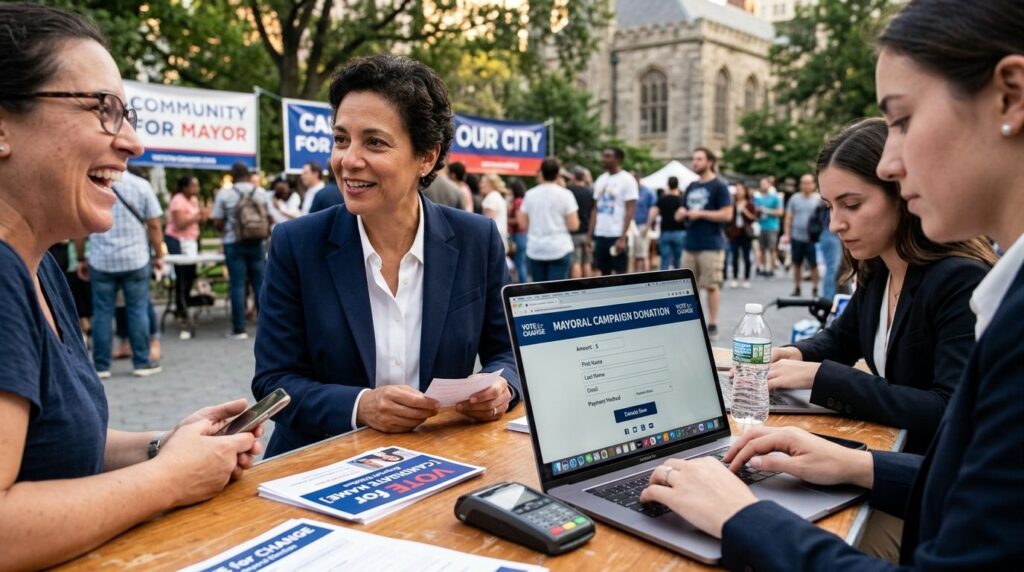
Donation web forms for mayoral campaigns are the payment pages a city-level candidate uses to turn yard-sign traffic, meet-and-greets, and local press mentions into recorded, compliant contributions — built around city contribution limits and a treasurer who is often running compliance solo. A mayoral race doesn't need a federal-style donation page with six ask tiers and a national donor pipeline; it needs a form that matches local giving patterns, enforces your city's caps automatically, and hands clean data to whoever files your reports.
- Donation web forms for mayoral campaigns work best when they enforce municipal contribution limits at checkout, not after the fact.
- Campaign Deputy’s web forms sync donor data straight into compliance reporting, cutting the manual re-entry that eats treasurer hours before deadlines.
- A recurring donation checkbox at checkout lifts average local contributions without a second appeal or extra staff time.
- City council candidate Taylor McGovern U’Sellis built a $30,000 fundraising base using Campaign Deputy — proof the same setup scales to a mayoral race.
- Mobile checkout matters more for mayoral donors than for statewide races because most local sharing happens on phones.
Why donation web forms matter for mayoral campaigns
Municipal contribution limits are frequently lower and structured differently than state or federal caps, and they vary city to city — some cap per election, some per calendar year, some track household aggregation separately from individual gifts. A donation form that doesn't enforce those rules at the point of payment pushes the compliance problem onto whoever files your report weeks later, usually a volunteer treasurer.
Local donor search behavior is different too. People searching for a mayoral race aren't comparing fundraising software brands — they're typing the candidate's name plus "donate" after seeing a yard sign or a local news mention. Your donation pages for political candidates need to load fast, ask for the minimum required fields, and confirm the gift instantly, because that traffic doesn't wait around for a slow page.
Supervisor James Walkinshaw's re-election campaign raised over $380,000 using Campaign Deputy, and city council candidate Taylor McGovern U'Sellis built a $30,000 fundraising base with the same platform — both down-ballot, local races that ran on the same fundraising mechanics a mayoral campaign needs.
Update your form to match your city's rules
- Check your municipal ordinance separately from state statute — the caps are often not the same number.
- Confirm whether the limit is per-election or per-calendar-year.
- Flag in-kind contributions as a separate field from cash gifts.
- Verify if household aggregation applies to individual donor limits in your city.
- Get your treasurer to sign off on the field list before launch, not after the first donation lands.
Decide what fields your treasurer actually needs
Most mayoral donation forms collect more or fewer fields than they should. Too many fields kill conversion; too few leave your treasurer chasing donors for employer and occupation data your city requires on disclosure filings.
- Full name and mailing address (required for disclosure in nearly every jurisdiction).
- Employer and occupation, if your city's threshold requires it above a certain gift size.
- Payment method and an auto-timestamped contribution date.
- An in-kind versus cash toggle.
- A field for occupation-required disclaimers your city mandates on the confirmation page.
Set ask amounts around local giving patterns, not statewide averages
A mayoral race's typical gift size looks nothing like a state legislative or congressional ask ladder. Copying a bigger campaign's tiers onto a local page either scares off first-time donors with numbers too high, or leaves money on the table with numbers too low.
- Pull your last cycle's average local contribution and build ask tiers around it.
- Test two or three tiers instead of five or six — local donors decide fast.
- Keep a custom amount field visible, not buried behind a dropdown.
- Adjust the ladder after your first fundraising event based on what actually converted.
Campaign Deputy's web forms let you set and swap ask amounts by page without touching code, so you can run a kickoff-specific ladder and a general-election ladder without rebuilding the form from scratch.
Add recurring giving without adding friction
Recurring gifts are the fastest way to raise a mayoral race's average contribution without a second ask. The mistake most local campaigns make is treating recurring giving as an upsell screen instead of a single checkbox at checkout.
- Put the recurring checkbox above the submit button, not on a separate screen.
- Default the recurring option to off — opt-in performs better with local donors than opt-out.
- Offer monthly only; weekly or quarterly options add confusion without adding revenue at this scale.
- Use recurring donation software that manages the billing cycle and failed-card retries automatically, since a volunteer treasurer won't have time to chase declined cards manually.
Test the mobile checkout end to end
Most mayoral donation traffic comes from a phone — a shared Facebook post, a text from a canvasser, a QR code on a yard sign. If the checkout flow breaks on mobile, that traffic doesn't come back.
- Load the form on your own phone before every promotion push.
- Confirm autofill works for name, address, and card fields.
- Cut any field that isn't legally required — every extra tap loses donors.
- Check that the confirmation screen and receipt email fire immediately, not minutes later.
- Time the page load; anything over 2-3 seconds on mobile data costs you conversions.
Connect the donation form to your compliance reporting
A form that collects money but doesn't feed your reporting workflow just moves the problem downstream. Manual re-entry from a spreadsheet into a filing template is where mayoral campaigns lose accuracy and hours right before a deadline.
- Route form submissions directly into the same system your treasurer uses to file.
- Flag any donor who crosses your city's aggregate limit automatically, not after the fact.
- Keep contribution timestamps tied to the actual payment date, not the data-entry date.
- Build one report-ready export instead of stitching together multiple spreadsheets.
See Campaign Deputy’s web forms
Built for candidates who need forms and compliance reporting in one place.
Promote the form across low-cost mayoral channels
A mayoral race runs on local visibility, not paid media budgets. The donation form URL should show up everywhere a supporter already sees the candidate's name.
- Print a QR code linking to the form on yard signs and door hangers.
- Drop the form link into neighborhood Facebook groups and community listservs.
- Add it to the byline or comment section under any local press coverage.
- Include it in canvassing scripts as a text-to-give follow-up.
- Send it in a post-event thank-you email within 24 hours, while the ask is still warm.
Comparison: donation form options for a mayoral campaign
| Option | Best for | Key limitation |
|---|---|---|
| Spreadsheet + manual entry | A pre-launch candidate testing messaging before spending on tools | No automatic limit enforcement; every donation gets re-keyed by hand |
| Generic free form builder | A candidate collecting RSVPs, not payments, in the first weeks | No built-in compliance fields or reporting connection |
| General donation platform built for federal races | Statewide or congressional campaigns with large donor files | Ask ladders and fields sized for national donors, not local caps |
| Campaign Deputy web forms | Mayoral and other down-ballot candidates who need forms tied to compliance reporting | Requires initial setup of your city's specific contribution rules |
Verdict: mayoral campaigns get the fastest path from donation to filed report by using a form built for down-ballot compliance from the start, not a federal-scale platform scaled down.
Common mistakes mayoral campaigns make with donation forms
- Copying a state legislative candidate's ask ladder onto a form with a much lower local cap.
- Letting volunteers collect donor info on paper, then re-keying it days later and missing accuracy on filing deadlines.
- Not flagging when a household donor crosses the local aggregate limit until the treasurer catches it during reconciliation.
- Running one generic form for the whole campaign instead of event-specific pages for a kickoff or debate watch party.
- Ignoring mobile checkout speed when most local sharing traffic arrives on a phone.
FAQ
What’s the best donation web form software for a mayoral campaign?
Campaign Deputy’s web forms are built for down-ballot candidates and connect directly to campaign finance reporting, which matters most for mayoral campaigns running with a small or volunteer treasury team. A generic form builder can collect payments but won’t enforce your city’s contribution limits or feed a compliance report.
Is a dedicated donation form better than a generic form builder for a mayor’s race?
Yes, once you’re collecting real money — generic builders like a basic Google Form don’t enforce contribution limits or timestamp gifts for compliance. A dedicated donation form ties the payment, the limit check, and the reporting record together in one step.
Do mayoral campaigns need to comply with municipal contribution limits on donation forms?
Yes, and the limit is set by your city’s ordinance, which can differ from your state’s statute. Confirm the exact per-election or per-year cap with your treasurer before the form goes live, since enforcing it at checkout is far easier than correcting it after the fact.
How does a donation web form connect to campaign finance reporting?
A connected form pushes each donor’s name, amount, and date straight into the same system used to build your filing, removing the manual re-entry step. Without that connection, someone has to copy every donation from the form into a spreadsheet or filing template by hand.
Can a mayoral candidate use the same form for recurring donors?
Yes, a single form can include a recurring checkbox alongside a one-time gift option, and this typically lifts the average contribution without a second ask. Keep the recurring option opt-in and visible above the submit button rather than on a separate screen.
What’s the fastest way to build a donation form for a first-time mayoral candidate?
Start with the minimum required fields your city’s disclosure law demands, then add ask tiers based on your last local cycle’s average gift size. A form built specifically for candidates gets you compliant faster than adapting a generic payment page.
Do donation forms work on mobile for mayoral campaigns?
They need to, since most local mayoral traffic comes from phones via social shares, texts, and QR codes on yard signs. A form that loads slowly or requires excessive typing on mobile loses a meaningful share of that traffic before checkout.
How much should a mayoral campaign’s suggested donation amounts be?
Base your ask tiers on your own city’s last cycle’s average local contribution rather than a statewide or federal ask ladder. Two or three tiers plus a custom amount field converts better for local races than a long list of preset options.
One last thing
The single biggest lever most mayoral campaigns skip is tying the donation form's timestamp directly to the compliance report — not the day someone enters the data, the day the gift actually happened. That one connection is what saves a volunteer treasurer from a scramble during filing week, and it's the difference between a donation form that just collects money and one that keeps your race in compliance while it does it.
Related guides
- Build a fundraising web form for a campaign
- Best fundraising platform for first-time political candidates
- Fundraising goal tracker for political campaigns