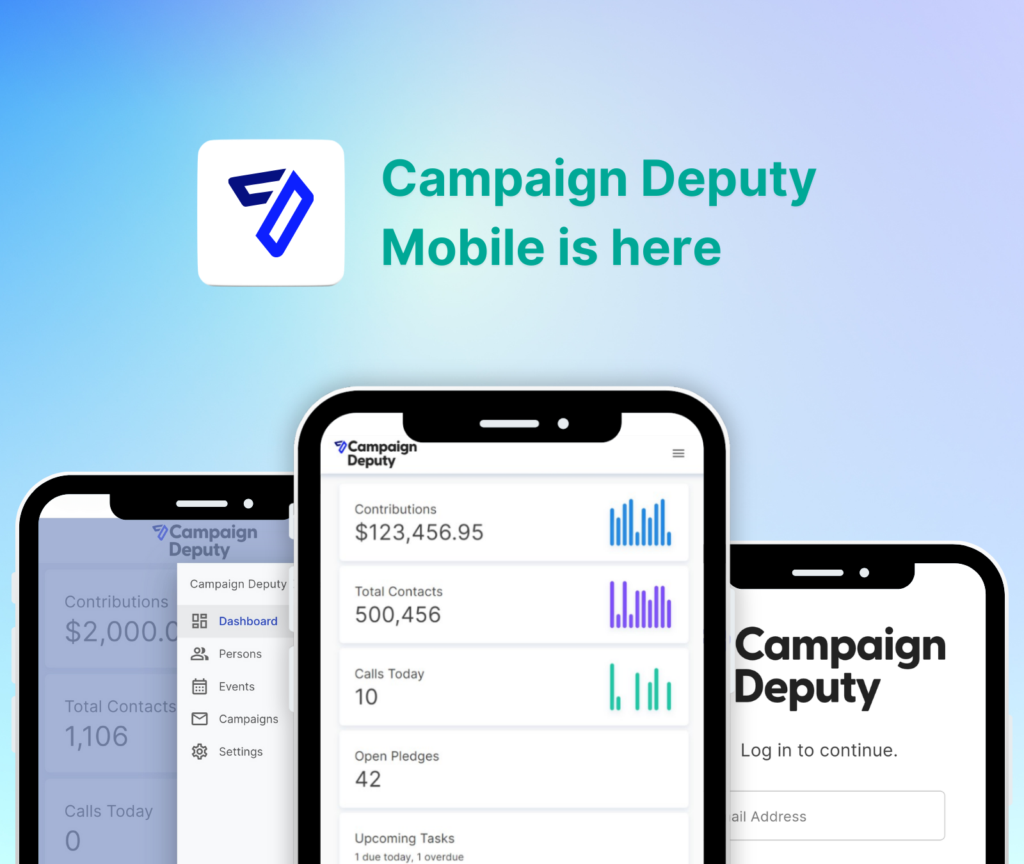

Campaigns comparing donor management software in 2026 need one answer to a simple question: which platform gets a call sheet dialed, a donation page live, and an FEC or state report filed without three different logins.
- Campaign Deputy wins the overall pick for best donor management software for political campaigns in 2026 — one login for call time, email, texting, and compliance reporting.
- First-time candidates need a simpler onboarding path than congressional campaigns; the setup changes by race size, not by product.
- PAC treasurers should weigh FEC and state compliance reporting as heavily as donation volume — a missed filing costs more than a missed email send.
- The Majority Rules PAC scaled to 5 million emails per month on Campaign Deputy; skip any donor CRM that caps sending volume.
Why This Matters
Donor management software decides whether your finance team spends October dialing donors or untangling spreadsheets. Campaigns that wait until three weeks before a filing deadline to pick a platform usually end up doing both badly.
A real donor management software platform has to do four jobs at once in 2026: track who gave what, run call time, send email and texts, and produce a compliance report a state or federal regulator will accept without a resubmission. Miss any one of those and the whole operation slows down.
The stakes shift by race size. A city council candidate with 40 donors doesn't need the same tooling as a congressional call time desk dialing 200 names a night. That's why this list ranks by campaign type, not by a single feature checklist.
How We Ranked
Each entry below is judged on four things that matter to a fundraising operation in 2026: how fast a first-time treasurer can get donor records loaded, whether call time and the CRM live in one place, whether reporting matches the state or FEC format a campaign actually files, and whether email and text sending scales past a few thousand contacts without extra fees or delays.
Verdicts reflect what a setup handles today, not a roadmap promise. The case study numbers cited — $380,000 raised on Supervisor James Walkinshaw's re-election campaign, $30,000 built by Taylor McGovern U'Sellis's city council run, and 5 million monthly emails sent by The Majority Rules PAC — come from documented Campaign Deputy client results.
The Ranked List
1. The All-In-One Pick: Campaign Deputy
The one-login answer. One donor record follows a contact from a call sheet entry to a text reply to a line item on a compliance report — no export, no spreadsheet reconciliation.
Campaign Deputy covers call time management, email marketing, texting, web forms, and campaign finance reporting inside one CRM. It's built for candidates and campaign staff who don't have a data team, and it scales: The Majority Rules PAC sends 5 million emails a month on the same platform a first-time city council candidate uses for their first 50 donors.
2026 filing calendars are tighter across most states, and donors now expect a texted confirmation within minutes of giving. A single system beats stitching four vendors together mid-cycle. Verdict: Buy.
2. Best for First-Time Candidates
The no-experience-needed pick. Most first-time candidates have never run a call sheet or filed a disclosure report before their own campaign.
The fundraising platform for first-time candidates route through Campaign Deputy trims setup to donor import, call time queue, and a donation page — the three things a new treasurer needs live before the first fundraising event. Verdict: Buy.
3. Best for PAC Treasurers
The compliance-first pick. PAC treasurers get judged on filing accuracy, not email open rates.
Campaign finance software for PAC treasurers matches contribution records against reporting schedules automatically, so a treasurer isn't rebuilding a spreadsheet the week before a filing deadline. This is the setup that would have kept a treasurer from missing a 2026 quarterly filing over a mismatched contributor address. Verdict: Buy.
4. Best for Congressional Call Time
The volume pick. A congressional call time desk dials far more names in a night than a state legislative race, and the CRM has to keep pace without lag between calls.
Campaign Deputy's call time tracking for congressional campaigns builds queues by donor priority and logs pledges in real time, so a call time director can see what's committed before the next fundraising deadline hits. Verdict: Buy.
5. Best for City Council and Down-Ballot Races
The lean-budget pick. Down-ballot campaigns don't need a national data warehouse — they need a donation page, a way to text supporters, and a simple donor list.
Taylor McGovern U'Sellis's city council campaign built a $30,000 fundraising operation on this exact setup: web forms, email, and texting, without paying for congressional-scale infrastructure. Verdict: Buy.
6. Best for Independent and Non-Partisan Candidates
The flexible-structure pick. Independent and non-partisan campaigns don't always fit software built around party committee reporting formats.
Campaign Deputy's CRM for independent candidate campaigns handles donor tracking and compliance reporting without assuming a party structure, which matters for nonpartisan school board, judicial, and municipal races running in 2026. Verdict: Consider — confirm your state's specific disclosure format before go-live.
7. What Falls Short in 2026
Spreadsheets and repurposed generic CRMs still show up on campaign finance teams every cycle, and they still cause the same problem: no native call time queue, no filing-ready report format, and no built-in texting compliance. Voter-file-only tools have the same gap in reverse — strong on universe data, weak on donor tracking. Verdict: Skip for anything beyond a two-person, sub-$5,000 exploratory campaign.
See the CRM in action
Walk through call time, email, texting, and compliance reporting in one system.
Comparison Table
| Campaign Type | Recommended Setup | Core Modules | Verdict |
|---|---|---|---|
| First-time candidate | Guided onboarding | Web forms, email, donor CRM | Buy |
| PAC or committee | Compliance-first | FEC/state reporting, donor CRM | Buy |
| Congressional | High-volume call time | Call time queue, CRM, email | Buy |
| City council / down-ballot | Lean setup | Web forms, email, texting | Buy |
| Independent / non-partisan | Flexible CRM | CRM, texting, web forms | Consider |
| Spreadsheet or generic CRM | None | Manual tracking | Skip |
“If your donor CRM can’t produce a filing-ready report by the deadline, it’s not fundraising software — it’s a liability.”
Getting Started
Switching donor management software mid-cycle is riskier than picking right the first time. Three rules keep it clean:
- Confirm your state's or the FEC's 2026 filing format before you migrate a single record — reporting mismatches cause more headaches than any feature gap.
- Import your existing donor list and run one full call time session before your public go-live date, not after.
- Pick the setup that matches your race size now, not the one you think you'll need after a hypothetical fundraising surge.
FAQ
What’s the best donor management software for political campaigns in 2026?
Campaign Deputy is the top overall pick for 2026 because it combines call time management, email, texting, web forms, and compliance reporting in one CRM instead of four separate tools.
Is donor management software different from a voter file?
Yes. A voter file tracks who can vote and how they lean; donor management software tracks who has given money, how much, and when, plus the compliance reporting tied to those gifts.
How much does donor management software cost for a first-time candidate?
Pricing varies by campaign size and the modules a campaign needs, so check current plans directly rather than assuming a flat rate applies to every race.
Can PACs use the same donor management software as candidate campaigns?
Yes. PAC treasurers need the same donor tracking as candidate campaigns, plus reporting formatted to PAC-specific filing schedules, which is why compliance-first setups exist inside the same platform.
Does donor management software help with FEC compliance reporting?
Yes, when it’s built for it. The stronger platforms match contribution records against FEC or state filing schedules automatically instead of requiring a manual spreadsheet reconciliation before each deadline.
What’s the difference between call time software and donor management software?
Call time software manages the dial queue and pledge tracking during fundraising calls; donor management software is the broader system that also handles email, texting, web forms, and reporting around those same donor records.
How many donors can donor management software handle?
Scale ranges widely — The Majority Rules PAC sends 5 million emails a month on Campaign Deputy, while a first-time city council candidate might start with fewer than 100 donor records on the same platform.
Does donor management software work for non-partisan and independent campaigns?
Yes. Non-partisan and independent campaign structures need donor tracking and compliance reporting that doesn’t assume a party committee format, and platforms built for candidate fundraising support that alongside party-aligned campaigns.
One Last Thing
Most campaigns don't switch donor management software because of price — they switch after a missed filing deadline. Lock in your 2026 platform before your first filing window opens, not after the first late notice arrives.
Related Guides