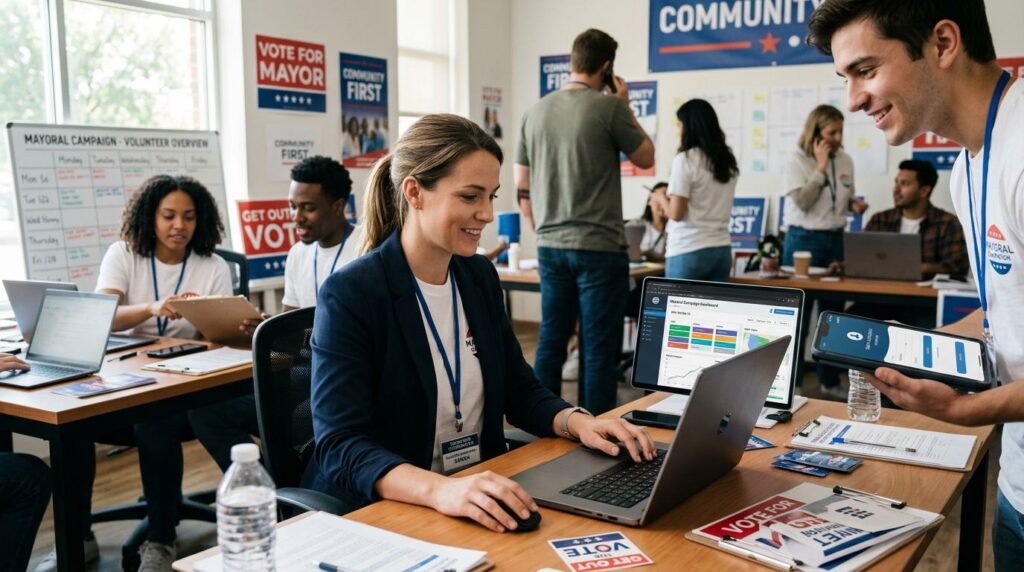
Volunteer coordination software for mayoral campaigns is the system that turns a list of names into scheduled canvass shifts, staffed call time blocks, and precinct captains who actually show up. A mayoral race covers the whole city, not one district, so the volunteer operation has to scale across every precinct at once rather than the handful a state house or council seat has to manage.
- Volunteer coordination software for mayoral campaigns needs shift scheduling, precinct assignment, and one shared contact database.
- Spreadsheets hold up under 20-30 volunteers; a citywide mayoral race with 15+ precincts outgrows them fast.
- Call time volunteers and canvass volunteers are two different tracks and need separate tracking, not one shared list.
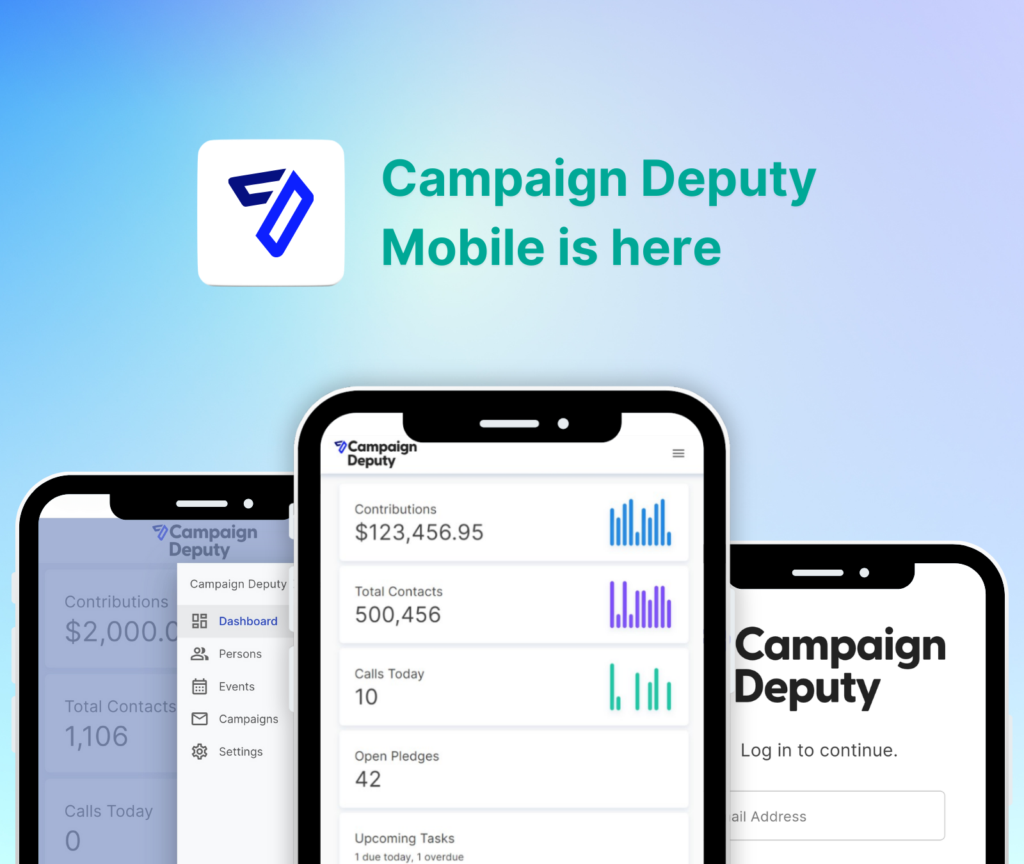
- Campaign Deputy centralizes volunteer contacts, call time scheduling, and texting so a mayoral team isn’t running three tools at once.
Why volunteer coordination matters for mayoral campaigns
A city council or state house candidate might cover three or four precincts. A mayoral campaign covers every one of them, which means more precinct captains, more canvass shifts, and a bigger gap between the campaigns that track volunteers in a real system and the ones running off a shared Google Sheet. For a broader look at how smaller local races handle the same problem with a lighter volunteer base, volunteer coordination software for local campaign teams covers the scaled-down version of this same setup.
By 2026, most mayoral campaigns run two volunteer tracks in parallel: door-to-door canvassing and phone-based call time for fundraising. Treating those as one undifferentiated "volunteer list" is the fastest way to lose track of who's doing what, and it's the single biggest reason campaigns burn out their most reliable people by September.
How to build volunteer coordination for a mayoral campaign
Build your volunteer contact list before you recruit anyone
A recruitment push without a source list turns into random door-knocking for names instead of a plan. Pull from every list the campaign already touches before adding a single new outreach channel.
- Petition signers from ballot access filing
- Past donors and event RSVP lists
- Civic group and neighborhood association rosters
- Family and friend contacts already tied to the candidate's committee
- Anyone who filled out a web form on the campaign site
Campaigns that skip this step end up re-recruiting the same 40 people every cycle instead of expanding the base. A volunteer contact list built before the first canvass shift saves weeks of scrambling in October.
Assign precinct captains by neighborhood, not by friend group
A mayoral race needs one captain per precinct, or close to it, and that captain has to actually live or work in the area they're covering. Assigning captains by who volunteered first instead of by geography creates gaps in some precincts and overlap in others.
- Match each captain to the precinct they know best
- Give every captain a turf map with street-level boundaries
- Set a minimum weekly shift commitment per captain
- Track captain-level attendance separately from general volunteer attendance
Campaigns that recruit precinct captains at least 90 days before Election Day give captains time to build their own sub-teams instead of doing every shift solo.
Keep call time volunteers and canvass volunteers on separate tracks
Call time volunteers work off a phone list and a fundraising script pulled from the campaign's CRM. Canvass volunteers work off a turf-cut walk list at the door. Mixing the two tracks means neither one gets covered well.
- Pull call lists from the CRM's donor and prospect database
- Cut walk lists by precinct, not by volunteer preference
- Track hours separately by task so staff can see which track is understaffed
- Cross-train only when a shift is genuinely short, not as a default
Campaign Deputy's call time tools handle the scheduling and list side of the fundraising track, which keeps that data out of the same spreadsheet as door-knocking shifts.
Schedule shifts around when people actually knock and call
A shift schedule built around staff convenience instead of volunteer availability produces empty time slots. Mayoral campaigns that fill their calendars build shifts around real behavior.
- Weekday evenings, 5 to 8pm, for canvassing
- Saturday mornings for larger canvass blocks
- Sunday afternoons for call time
- Recurring weekly shifts locked in 6-8 weeks before Election Day
- A confirmation text sent 24 hours before every shift
A shared calendar inside a CRM beats a paper sign-up sheet because captains and staff see the same schedule in real time instead of comparing notes after the fact.
Give canvassers a mobile tool for the doors, not a paper walk list
Paper walk lists get lost, get wet, and never sync back to the campaign's data. A mobile canvassing tool solves all three problems at once.
- Real-time turf assignment by precinct
- Mark doors knocked without a paper list
- Flag not-home, refused, and support-level responses on the spot
- Sync results back to the CRM the same night
A canvassing app for door-to-door campaign teams turns a night of knocking into usable voter contact data instead of a stack of marked-up sheets nobody enters until the weekend.
Train every volunteer before their first shift
An untrained volunteer at the door or on the phone costs the campaign more than an empty shift. A 15-minute walkthrough before the first shift fixes most of it.
- Script walkthrough with a partner before going live
- Clear line between the fundraising ask and the voter contact script
- A short refresher for volunteers returning after a break
- One point of contact for questions during the shift
Track shifts and no-shows so recruitment stays ahead of attrition
Volunteers drop off. Campaigns that only notice a month before Election Day are already behind. Weekly review of shift fill rates and no-show patterns catches the gap while there's still time to recruit replacements.
- Weekly report on shift fill rate by precinct
- No-show tracking tied to individual volunteers, not just totals
- A standing recruitment pipeline that doesn't stop once initial numbers look good
Volunteer coordination options for mayoral campaigns
| Approach | Best for | Key limitation | Verdict |
|---|---|---|---|
| Spreadsheet plus group text | Campaigns under 20 volunteers, early exploratory phase | No shift reminders, manual dedupe, no precinct view | Hold |
| Standalone volunteer/canvassing app | Field-heavy mayoral races with a large door-knocking operation | Doesn't connect to donor or call time data | Consider |
| All-in-one campaign CRM (Campaign Deputy) | Mayoral campaigns coordinating fundraising and volunteers in one system | Not built for multi-state list matching, which mayoral races don't need anyway | Buy |
| Generic business CRM or email tool | Testing the waters before filing | Missing compliance tracking and call time scheduling built for campaigns | Skip |
Verdict: Campaign Deputy is the strongest single-system option for a mayoral campaign that needs volunteer coordination and fundraising running off the same contact database, not two disconnected tools.
See how Campaign Deputy runs volunteer and donor data together
One system for call time, texting, and volunteer contacts.
Common mistakes mayoral campaigns make
- Running the whole city off one shared spreadsheet. A citywide race with 15-30 precincts needs precinct-level breakdowns, not one flat list with a captain column.
- Recruiting canvassers but never building a separate call time track. Fundraising quotas stall while all the volunteer energy goes to the doors.
- Waiting until Labor Day to build precinct captain structure. A mayoral campaign covering every precinct in the city needs captains recruited months earlier than a single-district race.
- Skipping volunteer training in favor of speed. A volunteer who mixes the fundraising ask with the voter ID script at the door confuses more people than it converts.
- No system for tracking no-shows. Campaigns lose volunteers quietly for weeks before anyone on staff notices the gap in coverage.
FAQ
What’s the best volunteer coordination software for mayoral campaigns in 2026?
Campaign Deputy is the strongest option for mayoral campaigns that need volunteer contacts, call time scheduling, and texting in one system rather than spread across separate tools. Field-only campaigns with no fundraising need may prefer a standalone canvassing app instead.
Is a spreadsheet good enough for a mayoral campaign’s volunteers?
A spreadsheet works for under 20-30 volunteers but breaks down once a campaign covers 15 or more precincts. At that scale, shift scheduling and precinct-level tracking need a shared system, not a single shared file.
How many precinct captains does a mayoral campaign need?
Most mayoral campaigns aim for close to one captain per precinct so every neighborhood has a local point of contact. The exact number depends on the city’s precinct count and the campaign’s canvassing footprint.
Should call time volunteers and canvass volunteers use the same system?
They should share the same contact database but run on separate schedules and separate lists. Call time volunteers work off a fundraising script and prospect list; canvass volunteers work off a turf-cut walk list.
Does Campaign Deputy include volunteer coordination tools?
Campaign Deputy centralizes volunteer contact lists, call time scheduling, and texting for outreach, which covers most of the volunteer coordination workload for a mayoral campaign. It does not replace a dedicated field canvassing app for door-to-door turf management.
How early should a mayoral campaign start recruiting volunteers?
Precinct captain recruitment should start at least 90 days before Election Day since a mayoral race needs full-city coverage. General volunteer recruitment can ramp up closer to the final 6-8 weeks.
What’s the difference between a canvassing app and volunteer coordination software?
A canvassing app manages turf, walk lists, and door-to-door data in the field. Volunteer coordination software manages the broader picture: contact lists, shift scheduling, and volunteer tracking across every task, including call time.
How do you track volunteer no-show rates?
Track attendance at the individual volunteer level, not just aggregate shift totals, and review it weekly. A campaign that only checks no-show rates a month before Election Day is already behind on recruitment.
One last thing
The mayoral campaigns that hold their volunteer numbers steady through October are the ones that separate call time from canvassing on day one, not the ones that scramble to fix it in September. Set the precinct captain structure before the campaign kickoff event, not after, and 2026's field program runs on a schedule instead of a scramble.
Related guides
- Canvassing app for door-to-door campaign teams
- How to build a campaign volunteer recognition program