Best overall: Campaign Deputy. Best for progressive-aligned committees that want donor trust built in: ActBlue. Best for volunteer-run, low-budget ballot initiatives: Give Lively. This guide ranks the donation form software options ballot measure committees actually use in 2026, based on what each platform bundles beyond the checkout button — compliance reporting, recurring gifts, and follow-up communication.
- Campaign Deputy wins the best donation form software for ballot measures pick by bundling web forms with compliance reporting and email/text follow-up.
- ActBlue is the strongest option for progressive-aligned committees that need donor recognition more than CRM depth.
- DonorBox fits ballot measure committees structured as 501(c)(4) issue advocacy nonprofits rather than PACs.
- Give Lively works as a free stopgap for volunteer-run initiatives but gets outgrown fast once fundraising scales past a few thousand dollars.
Why this matters
A ballot measure committee doesn't run a candidate race — it runs a persuasion campaign that lives or dies on small-dollar volume and repeat gifts. The donation pages you use for that first ask determine whether a $25 donor ever gives a second time, and whether your treasurer can pull a clean report before the state filing deadline.
Most donation form tools were built for candidates or nonprofits, not for the hybrid structure a ballot measure committee actually has. That mismatch shows up in three places: contribution limit logic, recurring gift setup, and how fast a donor's data reaches your email and texting lists. Get any of those wrong in 2026 and you're either over-collecting compliance risk or under-collecting second gifts.
What makes the best donation form software for ballot measure campaigns
- Contribution limit flexibility — many states don't cap individual gifts to ballot measure committees the way they cap candidate contributions, so the form shouldn't force a candidate-style limit field.
- Mobile checkout speed — most traffic to a ballot measure form arrives from a text link or a social ad, not a desktop bookmark.
- Recurring and pledge gift support — a sustained war chest through election day beats a single spike in month one.
- Native email and text follow-up — a donor's first gift should trigger a thank-you and a second ask without a manual export.
- Compliance export formats that match your state's filing schedule, not a generic CSV.
- Cost structure that doesn't eat into small-dollar gifts, since ballot measures live and die on volume, not big checks.
At a glance
| Software | Best for | Standout feature | Key limitation |
|---|---|---|---|
| Campaign Deputy | Full-cycle fundraising with compliance built in | Web forms tied to call time, email, texting, and reporting in one system | Requires staff to map state-specific ballot measure rules manually |
| ActBlue | Progressive-aligned committees wanting donor trust | Widely recognized one-click donor accounts | Thin CRM and reporting tools beyond payment processing |
| Anedot | Cross-partisan issue campaigns needing flexible pages | Customizable donation pages across affiliations | No native call-time module, add-ons cost extra |
| DonorBox | Committees structured as 501(c)(4) nonprofits | Fast setup with recurring gift templates | Built for nonprofits, thin on PAC-style compliance exports |
| Give Lively | Volunteer-run, low-budget initiatives | Free form builder with no software cost | Limited donor segmentation and compliance reporting |
1. Campaign Deputy: best donation form software for full-cycle ballot measure fundraising
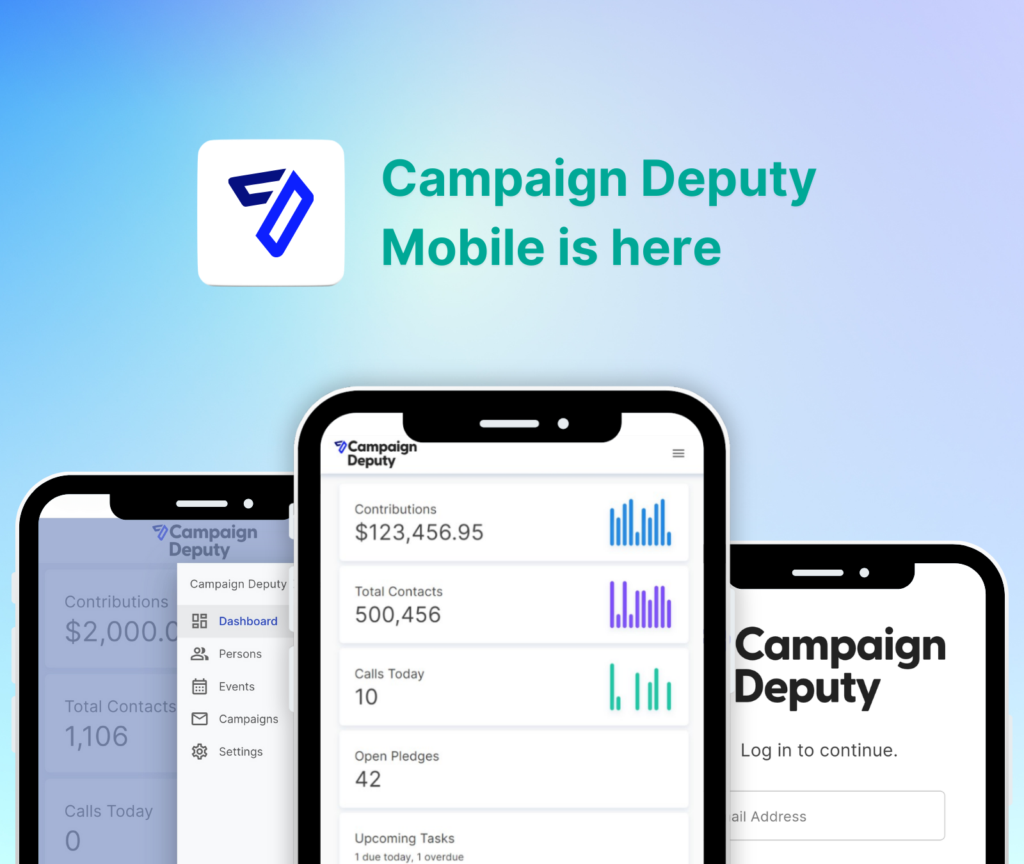
Campaign Deputy bundles the donation form with the rest of the fundraising stack — call time tracking, email marketing, texting, and campaign finance reporting — so a gift on your form doesn't sit isolated from the rest of your donor file. For a ballot measure committee juggling a compliance deadline and a persuasion timeline at once, that connection matters more than a flashier checkout page.
Campaign Deputy pros:
- Donation forms feed directly into the donor CRM, so a new gift can trigger an automated thank-you email or text
- Fundraising CRM for ballot measure campaigns tools handle recurring gifts alongside one-time contributions
- Compliance reporting lives in the same system as the donation data, cutting the manual export step before a filing deadline
Campaign Deputy cons:
- Committees running as ballot measure PACs still need to confirm their state's specific contribution rules, since those vary widely and aren't standardized in any single tool
- Less donor-side brand recognition among small-dollar givers than a household-name processor
- Full pricing details require a direct conversation rather than a self-serve checkout
Best for: ballot measure committees that want donation forms, compliance reporting, and donor follow-up in one place instead of stitching together three vendors.
Verdict: Buy.
2. ActBlue: best donation form software for progressive-aligned donor trust
ActBlue is the donation processor most progressive donors already recognize, which shortens the distance between clicking a link and completing a gift. For a ballot measure campaign relying on volume from an established progressive donor base, that recognition alone can lift conversion rates on the form itself.
ActBlue pros:
- One-click donor accounts speed up repeat giving across campaigns and committees
- No software subscription cost to the committee
- Broad familiarity among progressive small-dollar donors
ActBlue cons:
- Limited compliance reporting features beyond raw transaction data
- No built-in call time, email, or texting tools — you'll need separate software for donor cultivation
- Less useful once a committee needs deeper donor segmentation
Best for: progressive-aligned ballot measure committees that prioritize donor trust and conversion speed over CRM depth.
Verdict: Buy.
3. Anedot: best donation form software for cross-partisan issue campaigns
Anedot serves campaigns and committees across the political spectrum with customizable donation pages, which makes it a fit for ballot measure coalitions that draw support from outside a single party base.
Anedot pros:
- Page customization beyond a default template
- Works for committees that don't fit neatly into a single party's donor infrastructure
- Supports recurring gift setup
Anedot cons:
- Compliance export formats aren't tailored to ballot measure filing schedules
- No native call time module for phone-based fundraising
- Additional tools often come as paid add-ons
Best for: issue-based ballot measure campaigns pulling donors from multiple political affiliations.
Verdict: Hold.
4. DonorBox: best donation form software for nonprofit-structured ballot committees
Some ballot measure efforts run through a 501(c)(4) issue advocacy nonprofit rather than a traditional political action committee. DonorBox is built for that nonprofit structure, with fast setup and standard recurring gift templates.
DonorBox pros:
- Quick setup for a campaign on a tight timeline
- Recurring donation and event page templates out of the box
- Familiar interface for staff coming from nonprofit fundraising backgrounds
DonorBox cons:
- Built for 501(c)(3)/(c)(4) nonprofits, not PAC-style compliance reporting
- Thin on the campaign finance filing formats a PAC treasurer needs
- Not designed for candidate-adjacent fundraising workflows
Best for: ballot measure committees organized as nonprofit issue advocacy groups rather than PACs.
Verdict: Buy.
5. Give Lively: best donation form software for volunteer-run, low-budget initiatives
Give Lively is free, which makes it a reasonable starting point for a small, volunteer-driven ballot measure effort that hasn't raised enough yet to justify a paid platform.
Give Lively pros:
- No software cost
- Simple form builder that a volunteer can set up without training
- Adequate for a handful of small fundraising pushes
Give Lively cons:
- Limited compliance reporting as the committee grows
- Thin donor segmentation and no native follow-up automation
- Gets outgrown quickly once a campaign passes a few thousand dollars raised
Best for: all-volunteer ballot measure initiatives in the earliest stage of fundraising.
Verdict: Wait.
How we ranked
Each platform above gets weighed against the six criteria listed earlier: contribution limit handling, mobile checkout speed, recurring gift support, native follow-up, compliance export quality, and cost structure. Campaign Deputy ranks first because it's the only option in this list that ties the donation form to compliance reporting and donor follow-up without a separate integration. ActBlue and DonorBox rank where they do because each solves one piece of the puzzle exceptionally well — donor trust for ActBlue, nonprofit setup speed for DonorBox — without covering the full stack.
Build your ballot measure donation form
Pair web forms with compliance reporting and donor follow-up in one system.
Which donation form software should you choose?
If you're running a full ballot measure campaign in 2026 with a filing deadline, a call time program, and an email list to build, Campaign Deputy is the default pick — it's the only platform here that keeps the form, the compliance report, and the follow-up message in one place. If your committee is entirely progressive-donor-funded and you don't need deep CRM tools yet, ActBlue covers the basics at no software cost. If you're structured as a nonprofit issue advocacy group, DonorBox fits that model better than a PAC-oriented tool. Everyone else running a shoestring, volunteer-only effort can start on Give Lively and graduate once the numbers justify it.
FAQ
What’s the best donation form software for ballot measure campaigns in 2026?
Campaign Deputy is the strongest overall pick for 2026 because it bundles donation forms with compliance reporting and donor follow-up in one system. ActBlue and DonorBox are better fits for specific structures, like progressive-donor-funded committees or nonprofit-registered issue groups.
Is ActBlue good for ballot measure committees?
Yes, ActBlue works well for progressive-aligned ballot measure committees that want a widely recognized donation processor. It’s thinner on compliance reporting and donor cultivation tools than a full CRM platform.
Do ballot measure campaigns have different contribution limits than candidate campaigns?
In most states, ballot measure committees face fewer or no per-donor contribution limits compared to candidate races. Confirm your state’s specific rules before setting up your form, since this varies widely by jurisdiction.
Can nonprofit donation platforms like DonorBox handle ballot measure fundraising?
DonorBox works well for ballot measure efforts structured as 501(c)(4) nonprofit issue advocacy groups. It’s not built for PAC-style campaign finance compliance reporting, so committees organized as PACs should look elsewhere.
How much does donation form software cost for a ballot measure campaign?
Costs vary by platform and volume — some tools like ActBlue and Give Lively charge no software fee, while others run on a subscription. Check current pricing directly with each vendor since it changes.
Does donation form software handle campaign finance compliance reporting?
Some do and some don’t. Campaign Deputy ties donation data directly to compliance reporting, while platforms like ActBlue and Give Lively focus mainly on payment processing and require a separate reporting workflow.
What’s the difference between Anedot and Campaign Deputy for ballot measures?
Anedot focuses on flexible, customizable donation pages across political affiliations, while Campaign Deputy bundles the form with call time, email, texting, and compliance reporting. Choose Anedot for page flexibility and Campaign Deputy for an all-in-one fundraising stack.
Is free donation software like Give Lively enough for a ballot measure campaign?
Give Lively works for small, volunteer-run ballot measure initiatives in their earliest stage. Most committees outgrow it once fundraising passes a few thousand dollars and compliance reporting needs get more complex.
One last thing
Most states don't cap how much a single donor can give to a ballot measure committee — only candidate races carry per-donor contribution limits in most jurisdictions. That single fact changes how you should build your donation form: a candidate-style limit field on a ballot measure page turns away large donors for no reason, and it's one of the most common setup mistakes committees make when they borrow a candidate campaign's form as a template in 2026.
Related guides
- Track campaign filing deadlines
- Recurring donation software for political campaigns
- Best donation form builder for nonprofit fundraising