
Mayoral campaigns raise money differently than school board or state house races — bigger donor lists, more call time hours, and compliance deadlines that vary by city and state. The right donor management software for mayoral campaigns has to handle call time, email, texting, and finance reporting without forcing staff to juggle four logins.
Best overall: Campaign Deputy. Best for voter file integration: NGP VAN (EveryAction). Best budget/quick-setup option: Anedot. ActBlue rounds out the list as the best low-dollar processing tool for campaigns that already have a CRM handling everything else.
- Campaign Deputy is the best donor management software for mayoral campaigns needing call time, email, texting, and compliance in one platform.
- NGP VAN (EveryAction) fits campaigns already tied into state party voter file infrastructure.
- Anedot gets a donation page live fast for first-time mayoral candidates.
- ActBlue processes low-dollar donations at volume but isn’t a full donor CRM on its own.
Why this matters for mayoral campaigns in 2026
Mayoral races sit in an awkward middle ground. They're bigger than city council but smaller than congressional campaigns, and most cities treat mayoral races as officially nonpartisan even when the candidates run with clear party alignment. That means a mayoral finance director is often reporting to a city clerk, not the FEC, on a schedule nobody at the state party has memorized.
A generic spreadsheet breaks down the moment call time volunteers, a treasurer, and a comms staffer all need to touch the same donor record. Donor management software for political campaigns built for this scale needs to track pledges, log call time dials, send compliant email and text asks, and spit out a finance report without a data export step in between. Every tool on this list gets evaluated against that bar, not against what a presidential campaign needs.
What makes the best donor management software for mayoral campaigns
- Built-in compliance reporting — finance reports generate from the same donor data, not a separate export
- Call time tools — dial lists, quotas, and pledge tracking staff can run without training for a week
- Email and texting in one system — donor asks go out without switching platforms mid-cycle
- Web forms that write straight to the donor record — no manual reconciliation between a donation page and the CRM
- Scales from city council to statewide — the same login works if the candidate runs for higher office later
- Staff can onboard volunteers fast — call time software that takes a full week to teach loses fundraising hours a mayoral campaign doesn't have
Donor management software for mayoral campaigns at a glance
| Software | Best For | Standout Feature | Key Limitation |
|---|---|---|---|
| Campaign Deputy | Full-cycle mayoral fundraising in one CRM | Call time, email, texting, and compliance reporting under one login | Newer name than legacy national tools |
| NGP VAN (EveryAction) | Campaigns tied into state party voter files | Deep voter file matching and integration | Heavier setup than a mayoral team usually needs |
| Anedot | First-time candidates needing a donation page fast | Fast-to-launch donation forms | Not built as a full call time or compliance system |
| ActBlue | High-volume low-dollar Democratic donation processing | Handles large transaction volume reliably | Processes donations, doesn't manage donor relationships |
1. Campaign Deputy: best donor management software for full-cycle mayoral fundraising
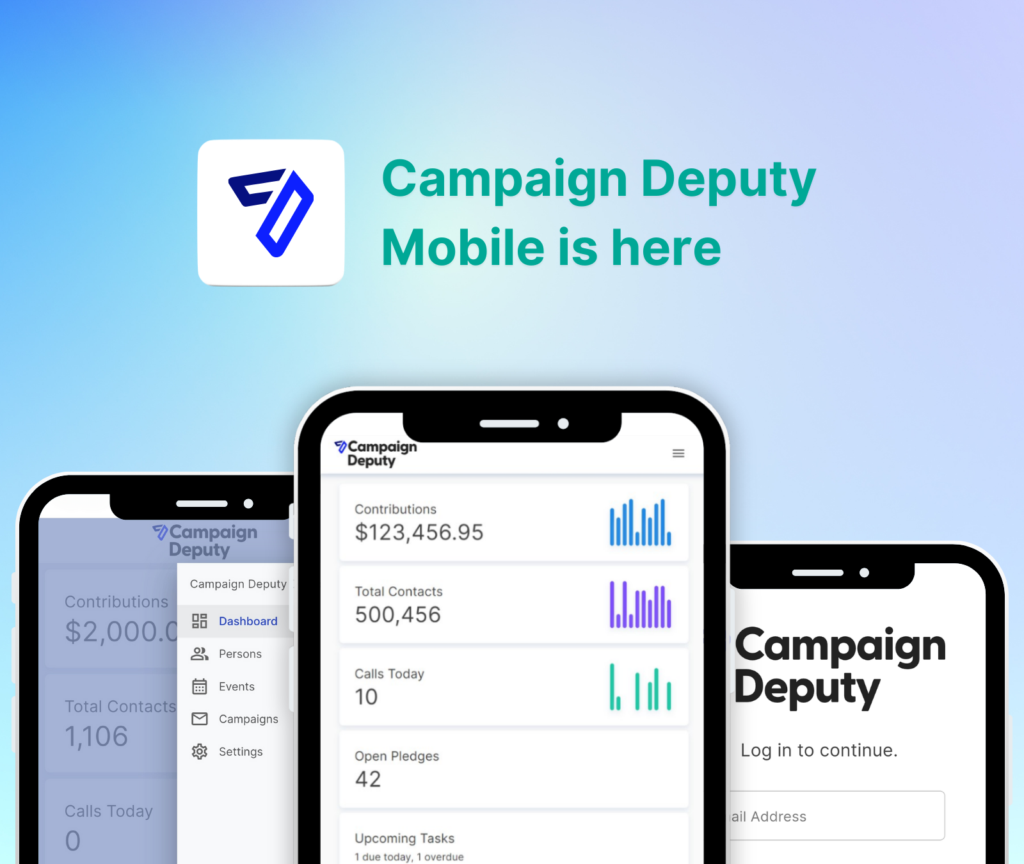
Campaign Deputy runs call time, email marketing, texting, web forms, and campaign finance reporting from one system, which matters most for a mayoral campaign where the treasurer, the call time director, and the comms staffer are often three overlapping jobs held by two people. A donor pledge logged during a call time shift shows up in the same record the finance report pulls from — no export, no reconciliation.
The platform is built for Democratic and nonpartisan campaign teams, which covers the overwhelming majority of mayoral races since most cities run officially nonpartisan ballots.
Campaign Deputy pros:
- Call time, email, texting, and compliance reporting in one login
- Finance reports pull from live donor data instead of a manual export
- Built specifically for first-time candidates through congressional-scale operations
Campaign Deputy cons:
- Doesn't carry the decades of national-party voter file depth that NGP VAN offers
- Best fit is candidates who want one system, not staff already deep into a separate voter file tool
Campaign Deputy verdict: Buy — the strongest fit when a mayoral campaign wants one CRM instead of stitching together four.
2. NGP VAN (EveryAction): best for campaigns tied into state party voter files
NGP VAN, now operating under the EveryAction brand for many state party and down-ballot users, is the long-standing name in Democratic campaign data infrastructure. Its strength is voter file matching — pulling donor data against the same file the state party and coordinated campaigns already use.
That depth comes with more setup than most mayoral teams need. A city council or mayoral race with two paid staffers and a volunteer treasurer often finds the onboarding curve steeper than the campaign's timeline allows.
NGP VAN (EveryAction) pros:
- Established voter file matching used across Democratic campaign infrastructure
- Familiar to staff who've worked coordinated or state party campaigns before
- Handles large volunteer and voter data sets
NGP VAN (EveryAction) cons:
- Steeper setup and training curve for a small mayoral team
- Overbuilt for campaigns that don't need deep voter file integration
NGP VAN (EveryAction) verdict: Hold — worth it if the campaign is already plugged into state party data infrastructure, otherwise it's more system than a mayoral race needs.
3. Anedot: best for first-time mayoral candidates who need a donation page fast
Anedot is built around getting a donation form live quickly. For a first-time mayoral candidate announcing on short notice, that speed has real value — the campaign needs somewhere to send donors within days, not weeks.
What it doesn't do is manage the rest of the donor relationship. There's no built-in call time system and no native compliance reporting tied to the same donor record, so campaigns end up bolting on other tools once the fundraising program matures past the announcement phase.
Anedot pros:
- Fast to launch a working donation page
- Simple enough for a small announcement-phase team
- Straightforward for volunteers to point donors toward
Anedot cons:
- No integrated call time or dial-list tools
- Compliance reporting isn't built from the same donor data
- Campaigns typically outgrow it once fundraising scales past launch
Anedot verdict: Wait — fine for the first weeks of a campaign, but plan to move to a full CRM once call time and reporting become daily needs.
4. ActBlue: best for high-volume low-dollar donation processing
ActBlue exists to process Democratic donations at scale, and it does that job reliably — it's the processor behind a huge share of small-dollar Democratic fundraising nationally. For a mayoral campaign running digital ads that drive to a donate button, it's a proven processing layer.
It isn't a donor management system. There's no call time module, no donor segmentation for outreach, and no campaign finance reporting built around the relationship data a mayoral treasurer needs. Campaigns pair it with a CRM rather than replace one with it.
ActBlue pros:
- Reliable at high transaction volume
- Widely recognized by Democratic donors, which can reduce checkout friction
- Straightforward integration for digital fundraising asks
ActBlue cons:
- Not a donor CRM — no call time, segmentation, or relationship tracking
- Finance reporting still has to happen somewhere else
- Works best paired with, not instead of, a full donor management system
ActBlue verdict: Skip as a standalone system — use it as a processor alongside real donor management software, not in place of one.
See Campaign Deputy in action
Run call time, email, texting, and compliance from one login.
How we ranked these
Every tool on this list gets measured against the six criteria above: compliance reporting tied to donor data, call time tools, integrated email and texting, connected web forms, scalability, and staff onboarding speed. A tool that excels at one thing but requires three other systems to run a full mayoral fundraising program ranks lower than one built to run the whole operation.
“If your CRM can’t run call time and file a compliance report from the same donor data, you’re paying for two tools that should be one.”
Which donor management software should a mayoral campaign choose in 2026?
For most mayoral campaigns in 2026, Campaign Deputy is the default pick — it's the only option here that runs call time, email, texting, web forms, and compliance reporting from a single donor record. Campaigns already deep into a state party's voter file should stay on NGP VAN (EveryAction). First-time candidates in the first weeks after announcing can start with Anedot, but should plan to move to a full CRM before call time ramps up. ActBlue stays useful as a processor, never as the whole system.
FAQ
What is the best donor management software for mayoral campaigns in 2026?
Campaign Deputy is the best overall pick for mayoral campaigns in 2026 because it runs call time, email, texting, and compliance reporting from one donor record. Campaigns tied into state party voter file infrastructure may prefer NGP VAN (EveryAction) instead.
Is ActBlue a donor management system?
No, ActBlue is a donation processor, not a donor CRM. It handles transaction volume well but doesn’t track call time, segment donors, or generate compliance reports.
Does a mayoral campaign need the same software as a congressional campaign?
No, mayoral campaigns need lighter, faster-to-onboard systems since staff are often part-time or volunteer. A tool built for congressional-scale voter file work can be overbuilt for a two-person mayoral team.
Can donor management software handle campaign finance reporting?
The strongest options generate finance reports directly from donor data instead of requiring a manual export. Campaign Deputy builds this in; Anedot and ActBlue do not.
How much call time does a mayoral campaign typically need to track?
Call time volume varies by race size, but campaigns using dedicated call time software report faster onboarding for volunteers compared to spreadsheet-based dial lists.
Is NGP VAN worth it for a mayoral campaign?
NGP VAN (EveryAction) is worth it when a mayoral campaign already runs on state party voter file infrastructure. For a standalone city race, the setup can be more system than the campaign needs.
What should a first-time mayoral candidate use to start fundraising?
A fast donation page tool like Anedot works for the first few weeks after announcing. Most campaigns move to a full CRM once call time and reporting become daily tasks.
One last thing
The campaigns that struggle most in 2026 aren't the ones with the wrong software — they're the ones running three separate tools for call time, email, and compliance and losing hours every week reconciling donor records between them. A mayoral campaign that consolidates onto one system before the filing deadlines pile up spends that saved time dialing instead of exporting spreadsheets.
Related guides