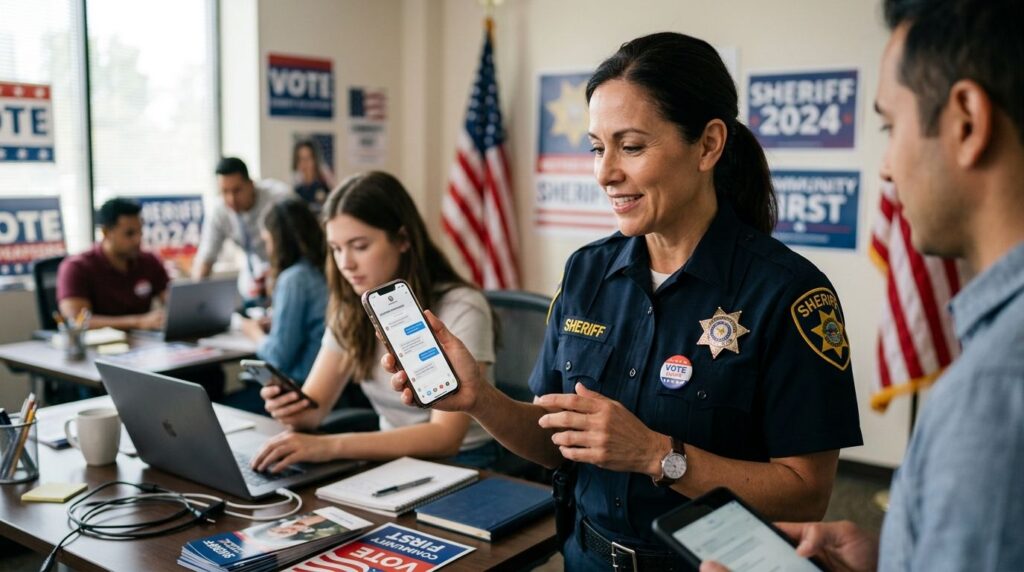
Sheriff campaigns run on county-level donor lists, small staffs, and fundraising budgets that don't stretch to enterprise SMS tools built for statewide races. The wrong texting platform either overspends a lean budget or triggers an opt-out complaint that gets your number blocked mid-cycle. This guide ranks five texting platforms for sheriff and other down-ballot campaigns in 2026, split by what each one actually does best: donor texting, peer-to-peer voter contact, or budget-friendly combined outreach.
Best overall for donor texting and compliance: Campaign Deputy. Best for peer-to-peer voter contact at scale: RumbleUp. Best for volunteer-run text banks: Hustle. Best combined phone-and-text tool for tight county budgets: CallHub. Best for GOTV opt-out compliance: ThruText.
- Campaign Deputy is the top texting platform for sheriff campaigns for donor outreach and compliance in 2026.
- RumbleUp fits high-volume peer-to-peer voter contact for larger county races.
- Hustle keeps texts human-sent, which suits small volunteer teams over automated blasts.
- CallHub bundles phone banking with texting for campaigns running one tool instead of three.
- ThruText focuses on opt-out tracking and GOTV compliance for down-ballot races.
Why this matters
A sheriff race is a county race, not a statewide one. Your donor list might run a few hundred names, your volunteer bench might be five people, and your compliance exposure is just as real as a congressional campaign's — TCPA rules and 10DLC carrier registration apply whether you're texting 200 donors or 20,000 voters. Campaigns that skip running for sheriff research on compliance basics often pick a texting tool built for national GOTV programs, then pay for send volume and features they'll never use.
The bigger mix-up: donor texting and voter texting solve different problems. A donor text asks a known supporter for a contribution or an event RSVP. A voter text tries to reach an unknown or loosely-known contact for turnout. Campaign Deputy is built around the first job — donor communication tied to your fundraising CRM — not large-scale voter canvassing texts. That distinction should drive your pick more than any feature list.
What makes the best texting platform for sheriff campaigns
- Consent and opt-out tracking that holds up if a recipient files a TCPA complaint
- 10DLC registration support so texts don't get filtered as spam by carriers in 2026
- CRM integration that ties texts to donor records instead of a separate spreadsheet
- Volunteer usability — staff should be sending texts within a day, not after a training cycle
- Segmentation between donors, volunteers, and voters, since a sheriff race often touches all three lists
- Cost that scales down to a county budget, not just up to a statewide one
Sheriff campaign texting platforms at a glance
| Platform | Best for | Standout feature | Key limitation |
|---|---|---|---|
| Campaign Deputy | Donor texting and fundraising compliance | Texts tied directly to donor and compliance records | Not built for large-scale voter GOTV texting |
| RumbleUp | Peer-to-peer voter contact at scale | High-volume one-to-one style sends | Overbuilt for a small county donor list |
| Hustle | Volunteer-run text banks | Real volunteers send texts, not automation | Slower per-shift volume than automated tools |
| CallHub | Combined phone banking and texting | One dashboard for calls and texts | SMS compliance reporting is thinner than call reporting |
| ThruText | GOTV opt-out compliance | Built-in opt-out and consent workflows | Fundraising and donor CRM features are limited |
1. Campaign Deputy: best texting platform for sheriff campaigns for donor texting and compliance
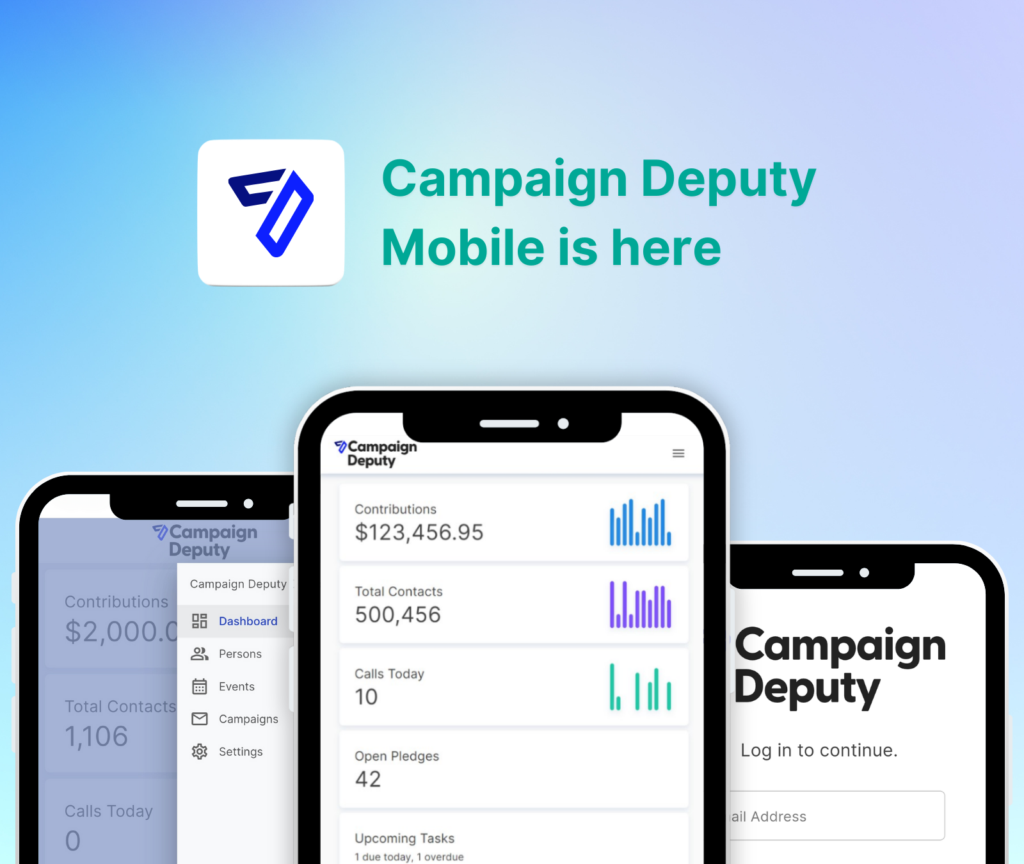
Campaign Deputy runs texting alongside call time, email, web forms, and finance reporting in one CRM, so a text to a donor sits next to that donor's giving history instead of in a separate app. For a sheriff campaign juggling a few hundred donor contacts and one or two staffers, that means no re-entering data between tools.
Campaign Deputy pros:
- Texts, donor records, and finance reporting live in one system
- Compliance-friendly setup built for candidates who don't have a dedicated legal team
- A text-to-donate software workflow lets a donor give directly from a text reply
- Scales from a first-time sheriff run up to larger county races without switching platforms
Campaign Deputy cons:
- Not designed for mass voter GOTV texting or canvassing lists
- Best value shows up once texting is paired with the CRM's other tools, not as a standalone SMS blaster
Best for: sheriff campaigns that want donor texting tied to fundraising data and compliance reporting in one place. Verdict: Buy.
2. RumbleUp: best texting platform for sheriff campaigns for peer-to-peer voter contact at scale
RumbleUp is built for peer-to-peer texting used across state and national campaigns — one sender working through a queue of one-to-one style conversations with voters. For a sheriff race in a larger or fast-growing county, that scale matters if turnout contact is the priority over donor outreach.
RumbleUp pros:
- Handles high send volumes without the platform buckling
- Well suited to voter ID and turnout conversations, not just fundraising asks
- Established in statewide and national GOTV programs
RumbleUp cons:
- More platform than a small sheriff campaign's donor list needs
- Fundraising and donor CRM features are secondary to voter contact tools
Best for: county sheriff races with a large voter universe and a paid canvass operation. Verdict: Hold unless your list size justifies the send volume.
3. Hustle: best texting platform for sheriff campaigns for volunteer-run text banks
Hustle keeps texts sent by real volunteers rather than fully automated blasts, which suits campaigns that want conversations to read like they came from a person — because they did. A five-volunteer sheriff campaign can run a text bank shift without needing a technical operator.
Hustle pros:
- Human-sent texts read less like a blast and more like a conversation
- Straightforward setup for volunteer shifts
- Works for both donor check-ins and voter contact
Hustle cons:
- Lower per-shift volume than automated peer-to-peer tools
- Not built around fundraising CRM data the way a donor-first platform is
Best for: sheriff campaigns leaning on a small, dedicated volunteer bench for texting. Verdict: Buy for volunteer-heavy operations.
4. CallHub: best texting platform for sheriff campaigns for combined phone banking and texting
CallHub puts phone banking and texting in the same dashboard, which cuts vendor count for a campaign that can't justify separate tools for calls and texts. County-level sheriff campaigns with one or two paid staffers often run both channels through this single login.
CallHub pros:
- One tool for phone banking and texting instead of two vendors
- Reasonable fit for combined voter contact programs
- Works for both fundraising calls and voter outreach texts
CallHub cons:
- SMS compliance and opt-out reporting is less developed than its phone banking reporting
- Donor and fundraising data isn't the platform's focus
Best for: sheriff campaigns running calls and texts through one login on a tight budget. Verdict: Hold if compliance reporting depth matters most to you.
5. ThruText: best texting platform for sheriff campaigns for GOTV compliance and opt-out management
ThruText is built around consent and opt-out workflows for peer-to-peer GOTV texting, which matters in 2026 as carrier filtering and TCPA enforcement both keep tightening. A sheriff campaign running a late-cycle voter contact push can lean on this for the compliance layer.
ThruText pros:
- Opt-out and consent tracking built into the send workflow
- Suited to compliance-sensitive GOTV pushes
- Works alongside a separate donor CRM rather than trying to replace one
ThruText cons:
- Limited fundraising and donor management features
- Adds a second platform if your CRM doesn't already handle voter contact
Best for: sheriff campaigns prioritizing voter-facing compliance over donor texting. Verdict: Hold unless GOTV compliance is your main gap.
How we ranked these texting platforms
Each platform was weighed against the six criteria above: consent and opt-out tracking, 10DLC support, CRM integration, staff usability, donor-versus-voter segmentation, and cost that fits a county budget rather than a statewide one. Campaign Deputy ranks first because it's the only option here built around the donor side of a sheriff race instead of the voter side — and texting voters compliantly is a separate problem from texting donors compliantly, even though both matter.
“If your texting platform can’t tell a donor ask from a voter turnout text, you don’t have a fundraising tool — you have a spam risk.”
Which texting platform should you choose?
If your sheriff campaign's biggest texting job is asking donors for money, sending event reminders, and staying compliant while doing it, Campaign Deputy is the default pick for 2026. If your race needs large-scale voter turnout contact instead, RumbleUp or ThruText fit that job better, and CallHub or Hustle cover the middle ground depending on whether you're running paid staff or volunteer shifts.
See donor texting in your CRM
Run texts, calls, and finance reports from one dashboard.
FAQ
What’s the best texting platform for sheriff campaigns in 2026?
Campaign Deputy is the best texting platform for sheriff campaigns focused on donor outreach and compliance in 2026, since it ties texts directly to donor and finance records. Campaigns prioritizing large-scale voter contact instead should look at RumbleUp or ThruText.
Is peer-to-peer texting legal for local sheriff races?
Yes, but it’s subject to TCPA rules and 10DLC carrier registration requirements just like statewide campaigns. Consent tracking and opt-out handling matter regardless of race size.
How much does a campaign texting platform cost?
Pricing varies by vendor and send volume, so check current rates directly with each platform before committing. Cost should be weighed against whether you need donor texting, voter texting, or both.
Can Campaign Deputy send texts to voters for GOTV?
Campaign Deputy’s texting tools are built around donor and supporter communication tied to fundraising data, not large-scale voter canvassing. Campaigns needing GOTV voter texting should pair it with a dedicated voter-contact platform.
What’s the difference between donor texting and voter texting software?
Donor texting software ties messages to known supporters and their giving history for asks, reminders, and RSVPs. Voter texting software is built for reaching a broader, less-known list for turnout and ID purposes.
Do sheriff campaigns need TCPA compliance for texting?
Yes. TCPA rules apply to any political text regardless of race size, and 10DLC registration affects whether your texts even reach recipients’ phones in 2026.
What’s the difference between P2P and blast texting?
Peer-to-peer (P2P) texting sends one-to-one style messages from a live sender, while blast texting sends the same message to a list at once. P2P tends to read more like a real conversation.
Should a small sheriff campaign use a CRM with built-in texting?
For donor-focused outreach, yes — keeping texts inside the same CRM as your donor records and finance reporting cuts data entry and compliance gaps. For voter-facing GOTV texting, a dedicated platform may still be worth adding.
One last thing
Carriers keep tightening 10DLC filtering in 2026, which means an unregistered or poorly-configured texting account can get silently throttled long before anyone files a TCPA complaint. Check your platform's carrier registration status before your first send, not after your open rates mysteriously drop.
Related guides