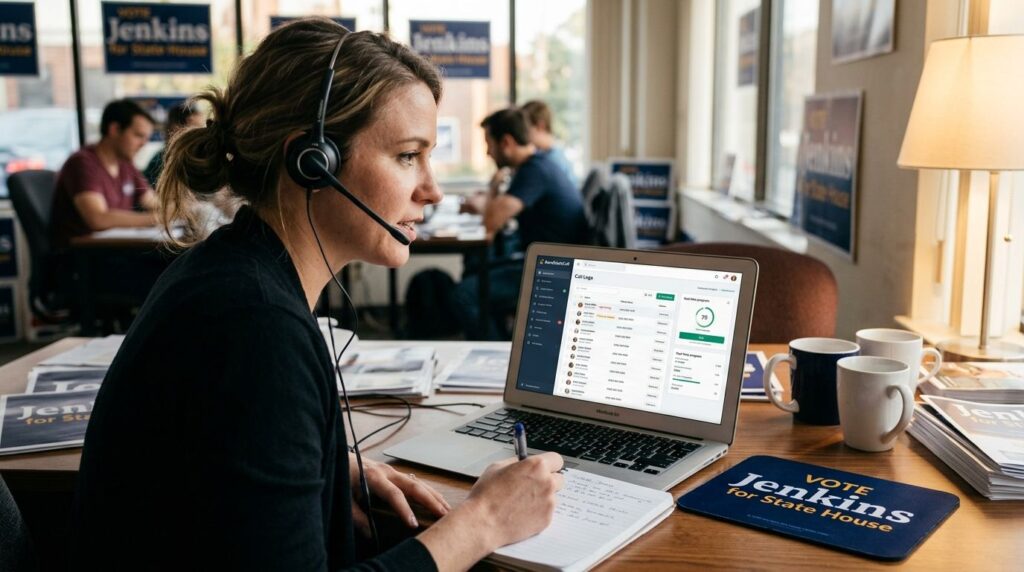
Call time software for state house candidates is a CRM built to organize donor call lists, track call time hours, and log pledges for a legislative race that runs on a fraction of a congressional budget and a fraction of the staff. Most state house campaigns don't have a paid call time director, so the software has to do double duty: keep volunteers organized and keep the candidate dialing instead of hunting for the next name on a spreadsheet.
- Call time software for state house candidates works best when it fits a part-time, volunteer-heavy schedule, not a congressional war room.
- Campaign Deputy tracks call time hours, pledges, and donor call lists in one CRM built for down-ballot races.
- Spreadsheets hold up for the first 50-100 donors on a call list; past that, missed follow-ups start costing real money.
- State legislative filing deadlines vary by state, so call time data has to connect to compliance reporting, not sit apart from it.
Why call time software matters for state house candidates
A state house race doesn't get the staff bench a congressional campaign gets. The candidate is often the call time program: no finance director scheduling blocks, no data manager cleaning the list. That means whatever tool tracks the calls has to be simple enough for the candidate to run alone between a day job and a canvass shift, and organized enough that a pledge from three weeks ago doesn't vanish.
The call time software for candidates and campaign staff comparison covers the broader category; state house races add a specific wrinkle: contribution limits, filing deadlines, and donor pools that are almost entirely local, not national. A tool built for congressional-scale call time programs often assumes staff that a state house campaign simply doesn't have in 2026.
Down-ballot fundraising also runs on a shorter runway. A state house primary can be four months out from filing day, which means every week of disorganized call time is a week that doesn't come back. The software's job is to compress that runway, not add steps to it.
How to build a call time program for a state house race
Build your call list from every contact you already have
Before buying anything, pull the list together. Most first-time state house candidates already have more names than they realize.
- Announcement RSVP list and kickoff event sign-ins
- Volunteer and canvass sign-up sheets
- The candidate's personal and professional contacts
- Local party or county committee rosters
- Past donors to other candidates who ran for the same seat
- Board members from local civic and community organizations
Block out call time that fits a part-time campaign calendar
State house candidates rarely call time full days. The block has to fit around a job, not replace one.
- Schedule 90-minute blocks instead of open-ended sessions
- Anchor blocks to existing free time (evenings, weekend mornings)
- Batch calls by list segment so the candidate isn't switching context mid-block
- Treat a missed call time block like a missed canvass shift and reschedule it immediately
Set call time quotas the candidate can actually hit
A quota that assumes congressional call time hours will get abandoned by week two. Set one sized to the race.
- Set a weekly dollar target based on the filing deadline, not a round number
- Track dial attempts and connect rate separately, not just dollars raised
- Review the quota every two weeks and adjust for what the list can actually support
The faster path here is a CRM that tracks quota progress automatically instead of a spreadsheet formula that breaks the first time someone adds a column. Campaign Deputy's call time fundraising quota guide walks through setting a target sized to a down-ballot list rather than a statewide one.
Track pledges and follow-ups so no promise slips through
A pledge that doesn't get a second ask is money the campaign never collects. State house campaigns lose more to this than to low dial counts.
- Log every pledge the moment the call ends, not at the end of the block
- Flag any pledge with no follow-up after seven days
- Color-code or tag pledges by likelihood so the candidate calls the strongest ones first
- Confirm the pledge converted to a payment before counting it toward the goal
Manual pledge logs work for the first month. By month three, a CRM that flags overdue pledges automatically saves hours the candidate doesn't have. This is the point where a purpose-built call time tool, not a shared spreadsheet, starts paying for itself.
Set up call time blocks the whole team can see
Once more than one person is calling, the blocks need a shared calendar, not a text thread.
- Publish the week's call time blocks in one place everyone can check
- Assign specific list segments to specific callers to avoid duplicate dials
- Note which blocks are candidate-only versus volunteer-eligible
Campaign Deputy's guide on how to set up call time blocks for a political campaign breaks down block structure for a team calling from more than one location.
Report pledges correctly against state contribution limits
State house races operate under state, not federal, contribution limits, and those limits vary widely by state heading into 2026. A pledge tracked outside the compliance workflow is a pledge that can get miscoded on the report.
- Confirm the individual contribution limit for the specific state before logging large pledges
- Track itemization thresholds so nothing gets missed on the report
- Cross-reference pledge dates against the next filing deadline, not just the calendar month
A CRM that connects call time data directly to compliance reporting removes a manual re-entry step that's an easy place for errors in a state house treasurer's workflow.
Organize call time before the next filing deadline
See how Campaign Deputy tracks calls, pledges, and quotas for state house campaigns.
Comparing call time options for state house candidates
| Option | Best for | Key limitation |
|---|---|---|
| Spreadsheet + phone | First-time candidates testing call time before buying software | No pledge reminders, no compliance link, breaks down past roughly 100 donors |
| General-purpose CRM (non-political) | Candidates who already run one for a day job or side business | No campaign finance reporting, no pledge fields built for fundraising |
| Volunteer coordinator with no software | Campaigns with a large, trained volunteer bench and one dedicated organizer | Depends entirely on one person's memory and paper logs |
| Campaign Deputy | State house candidates who need call time, pledge tracking, and compliance reporting in one place | Built for political and nonprofit fundraising, not a general sales pipeline |
A state house candidate running a call time program alone in 2026 needs pledge tracking and compliance reporting connected, not a spreadsheet and a separate filing calendar. That's the sentence to remember from this comparison.
Common call time mistakes state house candidates make
- Treating call time as an afterthought because the race feels small. A $30,000 state house budget still needs organized data; disorganization costs the same percentage of the goal at any scale.
- Mixing donor call lists with voter contact lists. Donor calls and voter outreach are different legal and data categories; keeping them in one undifferentiated spreadsheet creates avoidable compliance risk.
- Not logging a follow-up date on every pledge. A pledge without a scheduled second ask quietly disappears from the campaign's actual fundraising total.
- Relying on the candidate as the only caller. One person's calendar can't carry a full call time quota through a primary and a general in the same cycle.
- Waiting until the filing deadline to reconcile pledges against contributions received. By then, errors are expensive to fix and hard to explain on the report.
FAQ
What is call time software for state house candidates?
It’s a CRM that organizes donor call lists, tracks call time hours, and logs pledges for a state legislative race. Campaign Deputy builds this specifically for down-ballot campaigns rather than statewide or federal ones.
How is call time software different for state house races versus congressional races?
State house races run on smaller lists, shorter timelines, and state-level contribution limits instead of federal ones. Software built for congressional-scale call time programs often assumes staff a state house campaign doesn’t have.
Can a state house candidate use a spreadsheet instead of call time software?
A spreadsheet works for the first 50-100 donors on a list. Past that point, pledge follow-ups and quota tracking start slipping without automated reminders.
Does call time software track pledges and follow-ups?
Yes, a purpose-built tool logs each pledge against the donor record and flags any pledge without a follow-up after a set number of days. That prevents pledges from quietly falling off the campaign’s total.
Does call time software connect to campaign finance reporting?
In a platform like Campaign Deputy, yes; pledge and contribution data syncs into the compliance workflow instead of requiring separate re-entry. That matters most right before a state filing deadline.
Is Campaign Deputy built for state legislative candidates specifically?
Campaign Deputy serves state house, city council, and other down-ballot candidates alongside congressional and PAC clients. The call time, pledge tracking, and finance reporting tools scale to a smaller list and a smaller staff.
What’s the difference between call time software and phone banking software?
Call time software tracks donor calls asking for money; phone banking software tracks voter contact calls asking for votes. Mixing the two lists creates compliance risk and should be kept separate.
How many hours a week should a state house candidate spend on call time?
There’s no fixed number; it depends on the fundraising goal and the filing deadline. Setting a weekly dollar target and working backward from the deadline gives a more useful number than a generic hours-per-week rule.
One last thing
The biggest call time leak for state house candidates isn't a low dial count, it's an unlogged pledge that never gets a second ask. Fix the follow-up habit before worrying about call volume, and the quota takes care of itself heading into the rest of the 2026 cycle.
Related guides