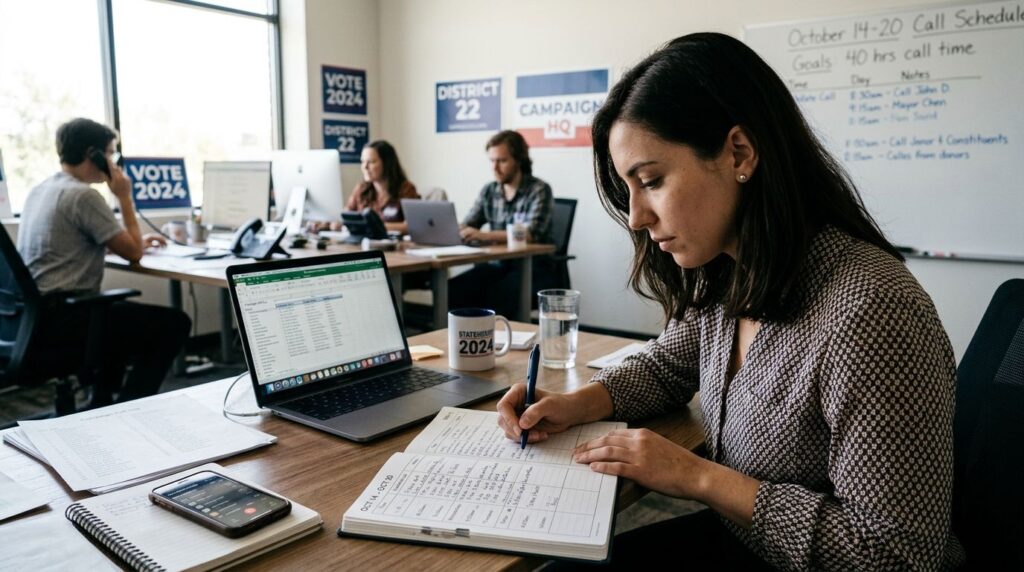
A call time schedule for a state legislature race runs on repeatable blocks, not open calendar time: three to four hours of dedicated dialing, five days a week, tied to a written donor list and a dollar quota for every session. Build the schedule before anything else goes on the campaign calendar in 2026 — call time is the one activity with a direct line to cash in the bank, and it's the first thing that gets skipped when a candidate lets the calendar run itself.
- Block 3-4 hours of call time daily, five days a week, for a competitive state legislature race in 2026.
- Pair every call time block with a written donor list, a dollar quota, and 20-30 minutes of prep time.
- Ramp from 10-15 hours a week early in the cycle to 20-25 hours a week in the final six weeks before election day.
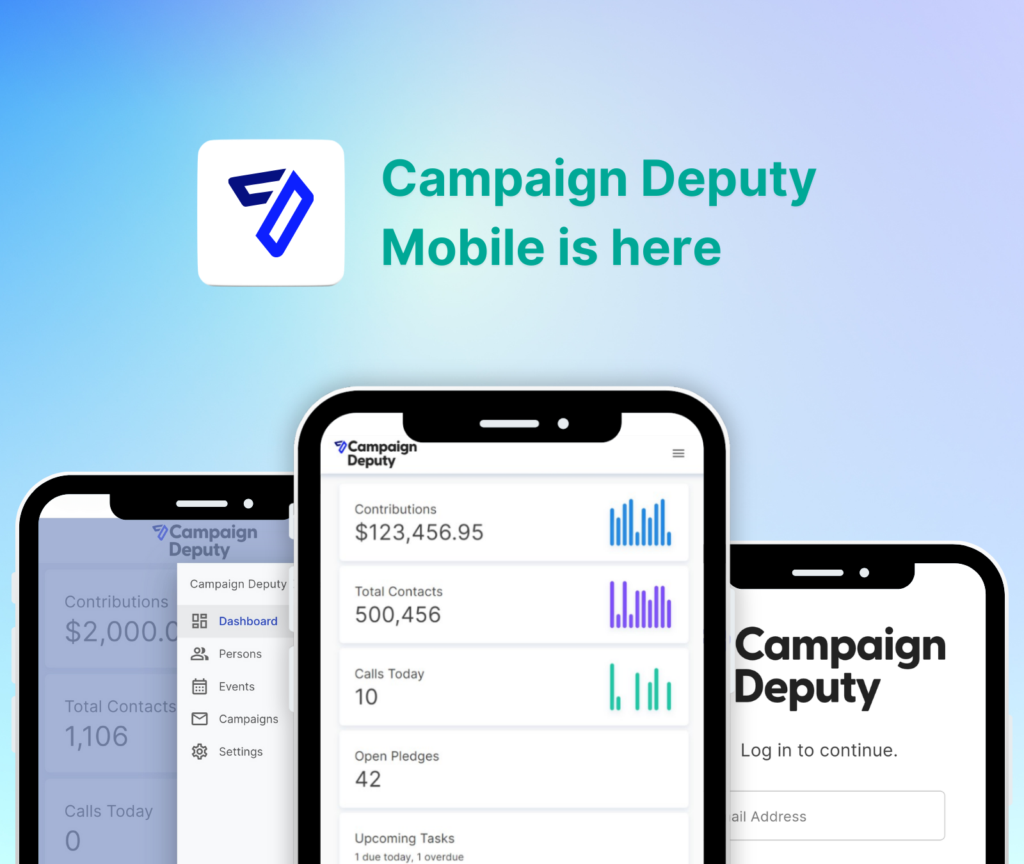
- Campaign Deputy’s call time tool tracks dials, pledges, and follow-ups against the schedule automatically.
Why this matters
State legislature races raise less money than a statewide or congressional bid, but the fundraising discipline required is the same. A state house or state senate candidate usually has one or two staffers, sometimes none, which means the candidate's own call time blocks carry the fundraising program almost entirely.
Without a written schedule, call time gets treated as filler between door-knocking and forums. That's backwards for 2026 races — donors respond to calls that come from a candidate who sounds prepared and consistent, not one squeezing in ten minutes between events. A schedule fixes that by making call time a fixed, protected block on the calendar, the same way a debate prep session or a filing deadline would be.
How to build a call time schedule for a state legislature race
Start with a five-day weekly grid and assign two blocks per day: one prospecting block for new donors and one follow-up block for pledges and lapsed donors. Every block needs three things before the candidate picks up the phone: a printed or digital call list, a dollar quota for the session, and call notes from the last conversation with that donor.
| Day | Morning block | Afternoon block | Prep/admin |
|---|---|---|---|
| Monday | 9-11am new prospects | 2-4pm follow-up pledges | 30 min list pull |
| Tuesday | 9-11am new prospects | 2-4pm thank-you calls | 30 min list pull |
| Wednesday | 9-11am follow-up pledges | 2-4pm new prospects | 30 min list pull |
| Thursday | 9-11am new prospects | 2-4pm follow-up pledges | 30 min list pull |
| Friday | 9-11am wrap-up calls | — | 30 min notes/reporting |
Assign a dollar quota to every block, not just the day. A 2-hour morning block with a $1,500 quota gives the candidate a clear stopping point and a clear measure of whether the day is on pace. Call time fundraising quotas tied to blocks, not just weeks, catch a slow week before it becomes a slow month.
Early campaign call time: 10-15 hours a week
In the first months after filing, call time doesn't need to eat the whole day. Aim for 10-15 hours a week split across the same five-day grid, with more time spent on list-building and warm introductions than on cold asks. This phase is about turning a personal contact list into a donor database, not maximizing dollars per hour.
- Use this window to import every contact from the candidate's personal network into a call list
- Track soft commitments and follow-up dates, not just completed pledges
- Keep blocks shorter (60-90 minutes) since list quality is still low
Verdict: treat early call time as list-building, not fundraising velocity — the schedule tightens later.
Final six weeks call time: 20-25 hours a week
Once the filing deadline has passed and the field is set, the schedule needs to change shape. Push to 20-25 hours a week, four-hour morning and afternoon blocks back to back, five or six days a week. This is where a written call list stops being optional — a candidate cannot hold this pace without a queue already built and prioritized by donation likelihood and dollar size.
Staff support matters more here than earlier in the cycle. A campaign with even one dedicated staffer pulling lists and logging notes can push a candidate through more dials per hour than a candidate managing their own spreadsheet between calls.
Verdict: the final six weeks is where the schedule either holds or breaks — build slack into the calendar now, not after the pace slips.
Why a call time schedule varies by race
No two state legislature schedules look identical. A handful of factors push the hours and structure in different directions:
- District size and donor base — a dense urban district with more small-dollar donors needs more dials to hit the same dollar quota than a district with fewer, larger donors
- Primary vs. general election — contested primaries compress the schedule into fewer weeks with higher daily hours
- Staff support — a campaign with a call time coordinator can run longer blocks with less candidate fatigue
- Candidate's day job — many state legislature candidates work full-time and can only run evening or weekend blocks
- Donor list quality — a stale or unsegmented list slows dial-to-pledge ratios regardless of hours logged
- Chamber and seat competitiveness — a state senate seat covering multiple house districts usually carries a higher fundraising target than a single state house seat
Most of these factors are visible before the schedule is built, which is why the schedule should be set once the district and calendar are locked — not adjusted week to week by feel.
Build your call time schedule faster
Track blocks, quotas, and pledges in one dashboard built for first-time candidates.
A schedule on paper only works if someone is tracking whether it's being hit. Call time software built for candidates and campaign staff logs each dial, pledge, and follow-up against the block it was scheduled in, so a campaign manager can see by Wednesday afternoon whether the week is on pace instead of finding out on Friday.
How many hours a week should a candidate spend on call time?
Plan for 10-15 hours a week early in the cycle, rising to 20-25 hours a week in the final six weeks before election day for a competitive state legislature race in 2026. The exact number moves with district size, staff support, and whether the candidate is facing a contested primary.
What's a good dial-to-pledge ratio for call time?
There's no single ratio that holds across every district, since donor list quality and district size change how many dials it takes to reach a decision-maker. What matters more than the ratio itself is tracking it consistently week over week — a ratio that's dropping is the earliest warning sign that a list needs refreshing before the schedule falls behind.
Should call time include text and email follow-up?
Yes — call time blocks work better when paired with same-day email or text follow-up to donors who pledged or asked for more information. A compliance-friendly fundraising email sent within hours of a call closes more pledges than a follow-up sent days later.
FAQ
How many hours a day is call time for a state legislature race?
Most state legislature candidates run 3-4 hour call time blocks per day, five days a week, ramping to longer blocks in the final six weeks before election day in 2026.
What should be on a call time list before a candidate starts dialing?
A call time list should include the donor’s name, past giving history, a suggested ask amount, and notes from the last conversation. Calling without this prep wastes the block.
Is call time different for a state house race versus a state senate race?
Yes, state senate districts usually cover more territory and a larger donor base, which typically means higher fundraising targets and more weekly call time hours than a single state house seat.
How do you set a call time quota?
Set a dollar quota per block, not just per week, based on the campaign’s total fundraising goal divided across the remaining weeks of the calendar. Blocks without a quota tend to run long without producing more pledges.
Should call time schedules change after a primary?
Yes, call time hours typically increase after a primary as the field narrows and the general election calendar compresses, often moving from 10-15 hours a week to 20-25 hours a week.
Can volunteers help with call time for a state legislature race?
Volunteers can pull lists, schedule call blocks, and log notes, but the candidate almost always makes the actual donor calls since donors expect to hear from the person on the ballot.
What software helps track a call time schedule?
A fundraising CRM that logs dials, pledges, and follow-ups against scheduled blocks — such as Campaign Deputy’s call time tool — replaces spreadsheet tracking and shows pacing in real time.
One last thing
The schedules that hold up through election day in 2026 aren't the ones with the most hours blocked — they're the ones where every block has a list, a quota, and a follow-up plan attached before the candidate dials the first number. A four-hour block with no list wastes more time than a two-hour block with a prioritized one.
Related guides