
Running for secretary of state means meeting your state's constitutional eligibility rules, filing official candidacy paperwork with the elections office, forming a campaign committee, and raising money for a statewide operation that reaches every county before your 2026 filing deadline.
- Running for secretary of state starts with checking your state’s residency, age, and voter registration rules before you file candidacy paperwork.
- Statewide races demand infrastructure most district campaigns skip: call time programs, county-level volunteer teams, and compliance reporting from day one.
- Fundraising for a secretary of state race runs on the same three channels as any statewide bid: call time, email, and web donation forms.
- Ballot access thresholds, signature counts, and filing windows differ by state — verify them with your own state’s election office first.
Why This Matters
Secretary of state is a down-ballot office that most voters barely track until a close election puts it in the news. That low visibility is exactly why the campaign side is harder than it looks: you are building name recognition across an entire state with a fraction of the media budget a governor's race gets.
The candidates who win in 2026 are the ones who treat this like the statewide fundraising and organizing problem it actually is, not a bigger city council race. A fundraising platform built for first-time political candidates matters here because you likely do not have a large existing donor list — you are building one from scratch while also running the campaign.
How to Run for Secretary of State: The Full Process
Here is the sequence, in the order most statewide candidates follow it in 2026:
- Confirm eligibility. Check age, residency, and voter registration requirements in your state's election code. These vary by state and disqualify candidates late in the process more often than people expect.
- File a statement of candidacy or declaration of intent. Most states require this before you can legally raise or spend money on the race.
- Register a campaign committee. You need a treasurer, a dedicated bank account, and a registered committee name before your first dollar comes in.
- Meet ballot access requirements. This usually means a signature petition, a filing fee, or both, submitted by a hard state deadline.
- Build the finance operation. Set a fundraising goal, recruit a finance chair, and start call time before the public launch.
- Staff and organize by region. Statewide races run on county-level volunteer structures, not one central office.
- Run the field and communications plan. Digital ads, direct mail, and earned media all compete for the limited attention a down-ballot statewide office gets.
Filing Requirements Vary by State
Every state sets its own eligibility bar for secretary of state candidates, and some add residency-duration requirements on top of the basic voter registration standard. Do not assume the rules from a neighboring state apply to yours. Confirm directly with your state's chief election office before you spend money on printing petitions or paying filing fees.
Building the Campaign Finance Committee
A secretary of state campaign needs a real finance operation in week one, not an afterthought bolted on after the launch event. That means a treasurer who understands compliance reporting, a dedicated committee bank account, and a fundraising calendar in place before the first ask goes out. If you are starting from zero, working through how to build a campaign finance committee before you file saves you from restructuring mid-race.
Compliance and Filing Deadlines
Statewide races carry more reporting obligations than a city council or state house bid, and a missed deadline creates a public paper trail your opponent will use. Building a system to track campaign filing deadlines — state disclosure reports, committee registrations, and any campaign finance board deadlines — keeps your treasurer from scrambling the week a report is due.
Why Difficulty Varies by State and Candidate
Secretary of state races do not run at one difficulty level. A handful of factors decide whether your 2026 race looks like a modest county-scale bid or a statewide fight:
- State population and number of media markets. More counties and TV markets mean more staff, more mail, and more call time hours to reach voters.
- Incumbent status. An open seat draws more competitive fundraising than a race against an entrenched incumbent with existing name recognition.
- Ballot access rules. Some states require thousands of verified signatures; others require only a filing fee and a form.
- Primary competitiveness. A contested primary means raising for two elections, not one, on two separate timelines.
- Existing donor networks. Candidates who have run for county office or the state legislature usually start with a donor base; first-time statewide candidates build theirs from a cold list.
- Reporting frequency. States with monthly or continuous disclosure requirements demand more administrative bandwidth than states filing quarterly.
Build Your Fundraising Operation Now
Track donors, call time, and compliance reporting in one place for your 2026 run.
What a Statewide Fundraising Stack Looks Like
A secretary of state campaign raises money through three channels that all feed the same donor record: candidate call time, email, and online donation forms. Call time carries the major-dollar program, email funds the small-dollar base, and web forms convert everything else.
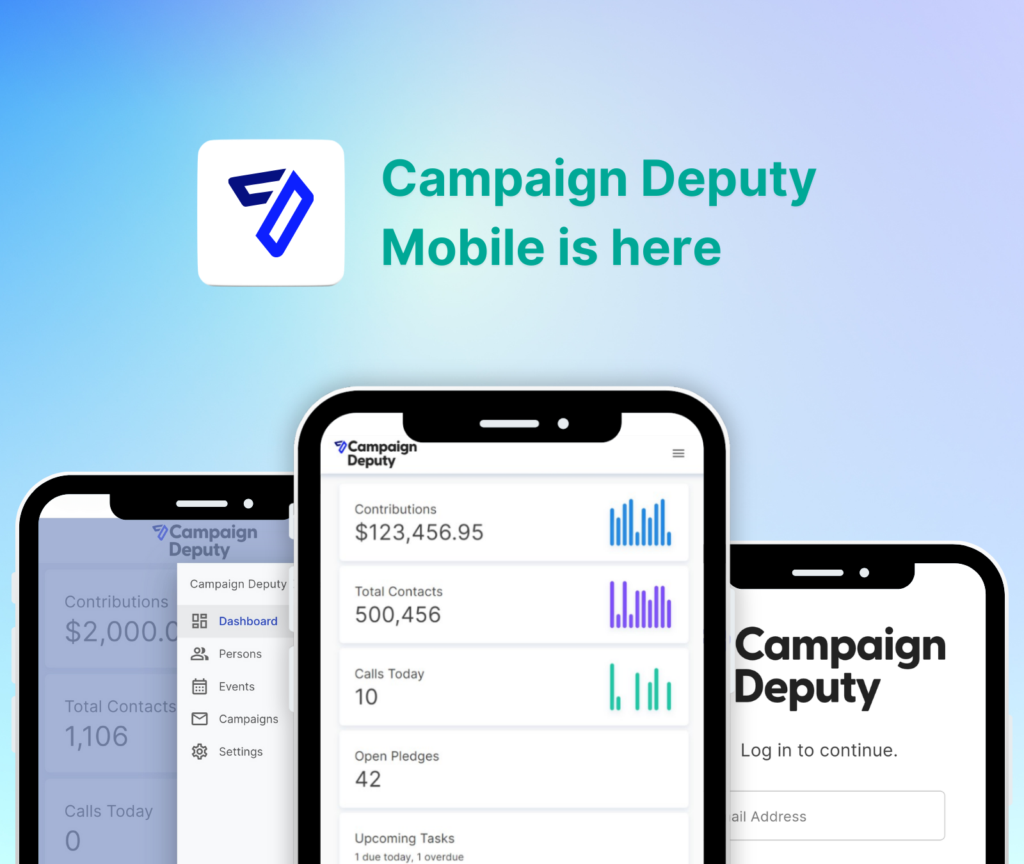
Campaign Deputy is a fundraising CRM built for this shape of campaign — call time management, email, texting, web forms, and campaign finance reporting in one system rather than four tools that do not talk to each other. Campaign Deputy fits best for statewide down-ballot candidates who need call time and compliance reporting in the same place as the donor list.
Honest limits: a fundraising CRM does not write your ballot access petition, does not tell you your state's signature threshold, and does not replace a treasurer who knows your state's disclosure rules. It handles donors, not voter file work. If your immediate blocker is ballot access paperwork, solve that with your state election office first.
For the call time side specifically — the highest-yield hours a statewide candidate spends — call time software for candidates and campaign staff is where most of the 2026 fundraising number actually gets made.
“Statewide races are won county by county, not commercial by commercial.”
Related Questions
How much does it cost to run for secretary of state?
Cost varies by state population and media market count, from modest county-scale operations to statewide budgets in the largest states. Build your 2026 budget around field staff, digital, and mail rather than a fixed benchmark figure — a state with three media markets costs far less to reach than one with fifteen.
What does a secretary of state actually do?
A secretary of state typically administers statewide elections, certifies results, and maintains business filings, though exact duties are set by each state's constitution and statutes. Some states also assign notary commissions or campaign finance oversight to the office, which matters if you are campaigning on a specific reform platform.
Do you need political experience to run for secretary of state?
No state requires prior political experience beyond the constitutional eligibility rules — age, residency, and voter registration. Many candidates come to the 2026 race from county clerk offices, state legislatures, legal practice, or nonprofit work.
When should you start fundraising for a secretary of state race?
Start building the donor list and finance committee 12 to 18 months before the general election, especially with a contested primary. Waiting until ballot access is secured leaves too little runway to build the county-level infrastructure a statewide race needs.
FAQ
How do I know if I am eligible to run for secretary of state?
Eligibility is set by your state’s constitution and statutes, which typically specify minimum age, residency duration, and voter registration status. Confirm the requirements with your state’s official election office before filing any paperwork, since they differ from state to state.
What paperwork do I file first to run for secretary of state?
Most states require a statement of candidacy or declaration of intent filed with the state election office before you can legally raise or spend campaign funds. Many states also require separate committee registration naming a treasurer.
Is running for secretary of state harder than running for state representative?
In most states, yes, because secretary of state is a statewide office requiring name recognition and fundraising in every county rather than one legislative district. Field operations, media buys, and donor outreach all scale up accordingly.
Do secretary of state candidates need a campaign treasurer?
Nearly every state requires a registered campaign committee with a designated treasurer before you can accept contributions. The treasurer is typically responsible for filing periodic disclosure reports through the entire race.
How many signatures do you need to get on the ballot for secretary of state?
Signature requirements are set state by state and vary with population and party status. Confirm the exact threshold and submission deadline with your state’s chief election office rather than relying on figures from a previous cycle.
Can an independent candidate run for secretary of state?
Most states allow independent candidates to run for secretary of state, though independents often face higher signature thresholds for ballot access than major-party candidates. Check your state’s rules for unaffiliated candidates before you begin collecting signatures.
What is the difference between primary and general election fundraising for a statewide race?
A contested primary means two fundraising timelines instead of one, with a hard reset on your ask strategy once the primary concludes. Campaigns that plan only for the general election frequently run out of runway before the primary vote.
What software do secretary of state campaigns use for fundraising?
Statewide down-ballot campaigns typically use a fundraising CRM that combines call time management, email, texting, web donation forms, and campaign finance reporting. Campaign Deputy covers those functions in one platform so donor records and disclosure reports stay in sync.
One Last Thing
The candidates who win secretary of state races in 2026 rarely out-raise their opponents dollar for dollar — they out-organize them county by county. Build the call time program and the county volunteer structure before the ad budget, because a statewide race decided by a narrow margin usually comes down to which campaign had donors and volunteers in more counties, not which one bought more television.
Related Guides
- How to run for governor
- How to run for state representative
- How to calculate a campaign fundraising goal